
在锯腿小树蛙中,雄性之间的竞争和雌性的选择受雄性鸣叫声学特征的影响不同。
Male-male competition and female choice are differentially affected by male call acoustics in the serrate-legged small treefrog, .
作者信息
Zhu Bicheng, Wang Jichao, Zhao Longhui, Chen Qinghua, Sun Zhixin, Yang Yue, Brauth Steven E, Tang Yezhong, Cui Jianguo
机构信息
Department of Herpetology, Chengdu Institute of Biology, Chinese Academy of Sciences, Chengdu, China.
University of Chinese Academy of Sciences, Beijing, China.
出版信息
PeerJ. 2017 Oct 31;5:e3980. doi: 10.7717/peerj.3980. eCollection 2017.
BACKGROUND
The evolution of exaggerated vocal signals in anuran species is an important topic. Males and females have both evolved the ability to discriminate communication sounds. However, the nature of sexual dimorphism in cognition and sensory discrimination and in the evolution and limitation of sexual signal exaggeration remain relatively unexplored.
METHODS
In the present study, we used male calls of varied complexity in the serrate-legged small treefrog, , as probes to investigate how both sexes respond to variations in call complexity and how sex differences in signal discrimination play a role in the evolution of sexual signal exaggeration. The compound calls of male consist of a series of one or more harmonic notes (A notes) which may be followed by one or more short broadband notes (B notes).
RESULTS
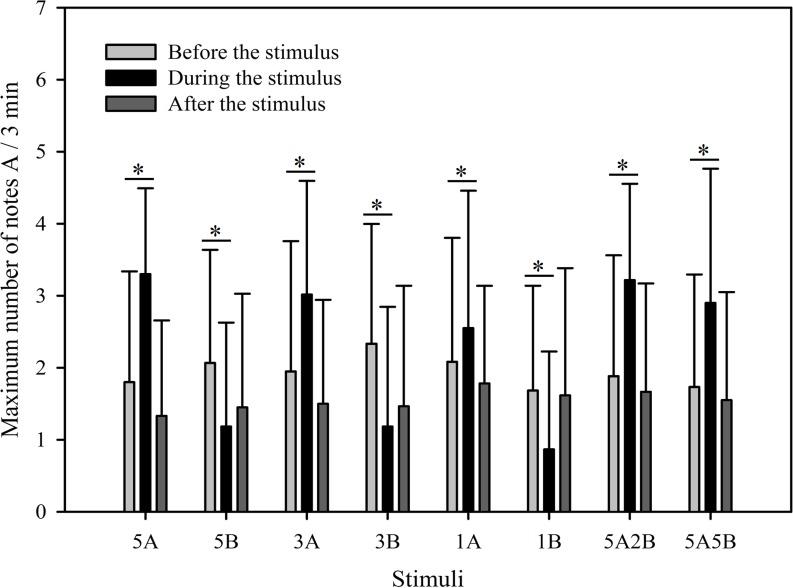
Male playback experiments and female phonotaxis tests showed that increasing the number of A notes in stimulus calls elicits increased numbers of response calls by males and increases the attractiveness of the stimulus calls to females. The addition of B notes, however, reduces male calling responses. Moreover, call stimuli which contain only B notes suppress spontaneous male calling responses. Phonotaxis experiments show that females prefer calls with greater numbers of A notes and calls containing both A notes and B notes, but do not prefer calls with only B notes.
DISCUSSION
Male-male competition and female choice appear to have played different roles in the evolution and limitation of signal complexity in . These results provide new insights into how exaggerated compound signals evolve and how signal complexity may be limited in anurans.
背景
无尾目物种中夸张发声信号的进化是一个重要课题。雄性和雌性都进化出了区分交流声音的能力。然而,认知和感官辨别方面的两性差异以及性信号夸张的进化和限制的本质仍有待进一步探索。
方法
在本研究中,我们使用锯齿腿小树蛙雄性具有不同复杂性的叫声作为探针,来研究两性如何对叫声复杂性的变化做出反应,以及信号辨别中的性别差异如何在性信号夸张的进化中发挥作用。雄性锯齿腿小树蛙的复合叫声由一系列一个或多个谐波音符(A音符)组成,随后可能跟有一个或多个短宽带音符(B音符)。
结果
雄性回放实验和雌性趋声性测试表明,增加刺激叫声中A音符的数量会引起雄性更多的回应叫声,并增加刺激叫声对雌性的吸引力。然而,添加B音符会减少雄性的叫声反应。此外,仅包含B音符的叫声刺激会抑制雄性的自发叫声反应。趋声性实验表明,雌性更喜欢具有更多A音符的叫声以及同时包含A音符和B音符的叫声,但不喜欢仅含有B音符的叫声。
讨论
雄性间竞争和雌性选择似乎在锯齿腿小树蛙信号复杂性的进化和限制中发挥了不同作用。这些结果为无尾目动物中夸张的复合信号如何进化以及信号复杂性如何受到限制提供了新的见解。




 Zotero 插件