Lenfant Caroline, Baz Patrick, Degavre Anne, Philippi Anne, Senée Valérie, Vandiedonck Claire, Derbois Céline, Nicolino Marc, Zalloua Pierre, Julier Cécile
INSERM UMR-S 958, Faculté de Médecine Paris Diderot, University Paris 7 Denis-Diderot, Sorbonne Paris Cité, Paris 75010, France.
Department of Ophthalmology, Hôtel Dieu Hospital, Beirut 166830, Lebanon.
Genes (Basel). 2017 Nov 7;8(11):309. doi: 10.3390/genes8110309.
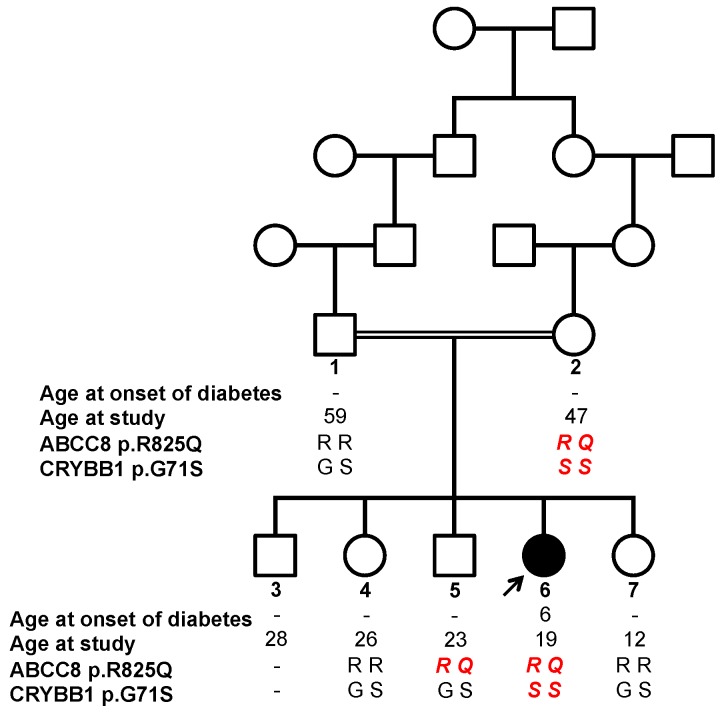
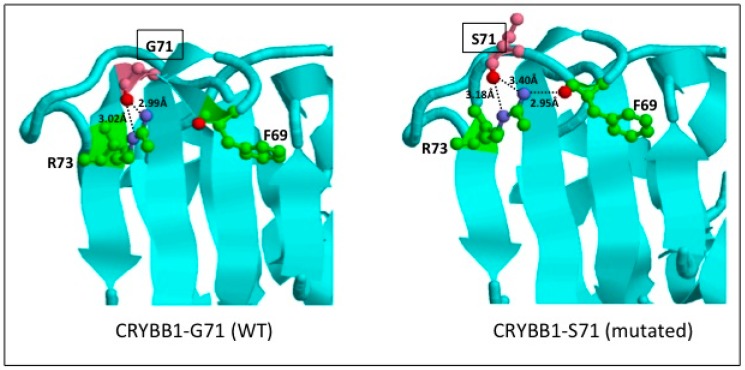
Monogenic forms of diabetes may account for 1-5% of all cases of diabetes, and may occur in the context of syndromic presentations. We investigated the case of a girl affected by insulin-dependent diabetes, diagnosed at 6 years old, associated with congenital cataract. Her consanguineous parents and her four other siblings did not have diabetes or cataract, suggesting a recessive syndrome. Using whole exome sequencing of the affected proband, we identified a heterozygous p.R825Q mutation, located at the exact same amino-acid position as the p.R825W recurring diabetes mutation, hence likely responsible for the diabetes condition, and a homozygous p.G71S mutation in , a gene known to be responsible for congenital cataract. Both mutations were predicted to be damaging and were absent or extremely rare in public databases. Unexpectedly, we found that the mother was also homozygous for the mutation, and both the mother and one unaffected sibling were heterozygous for the mutation, suggesting incomplete penetrance of both mutations. Incomplete penetrance of mutations is well documented, but this is the first report of an incomplete penetrance of a mutation, manifesting between susceptible subjects (unaffected mother vs. affected child) and to some extent within the patient herself, who had distinct cataract severities in both eyes. Our finding illustrates the importance of family studies to unmask the role of confounding factors such as double-gene mutations and incomplete penetrance that may mimic monogenic syndromes including in the case of strongly evocative family structure with consanguinity.
单基因糖尿病可能占所有糖尿病病例的1%至5%,并可能在综合征表现的情况下出现。我们调查了一名患胰岛素依赖型糖尿病的女孩的病例,她在6岁时被诊断出患有糖尿病,并伴有先天性白内障。她近亲结婚的父母和其他四个兄弟姐妹没有糖尿病或白内障,提示为隐性综合征。通过对受影响的先证者进行全外显子组测序,我们鉴定出一个杂合的p.R825Q突变,其位于与复发性糖尿病突变p.R825W相同的氨基酸位置,因此可能是导致糖尿病的原因,以及一个纯合的p.G71S突变,该基因已知与先天性白内障有关。这两个突变预计都具有损害性,且在公共数据库中不存在或极为罕见。出乎意料的是,我们发现母亲对于该突变也是纯合的,并且母亲和一名未受影响的兄弟姐妹对于该突变都是杂合的,提示这两个突变的外显率不完全。突变外显率不完全已有充分记录,但这是首次报道突变外显率不完全的情况,其在易感个体(未受影响的母亲与受影响的孩子)之间以及在患者自身内部(患者双眼白内障严重程度不同)表现出来。我们的发现说明了家族研究对于揭示混杂因素如双基因突变和外显率不完全的作用的重要性,这些因素可能会模拟单基因综合征,包括在具有近亲关系的强烈提示性家族结构的情况下。