Ericsson Daniel, Östenberg Anna Hafsteinsson, Andersson Erik, Alricsson Marie
Department of Sports Science, Linnaeus University, Kalmar/Växjö, Sweden.
Swedish Winter Sport Research Centre, Department of Health Sciences, Mid Sweden University, Östersund, Sweden.
J Exerc Rehabil. 2017 Oct 30;13(5):550-558. doi: 10.12965/jer.1735104.552. eCollection 2017 Oct.
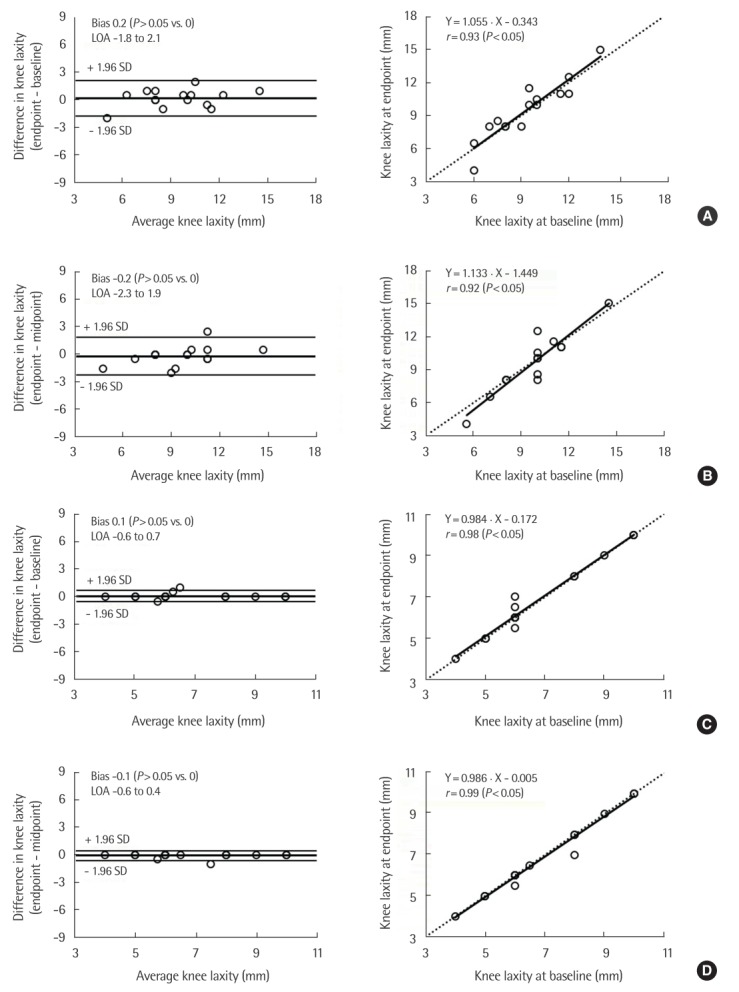
The purpose was to examine the test-retest reliability of the Rolimeter measurement procedure in the acute time phase, following a substantial knee trauma. In total, 15 participants with acute knee trauma were examined by one single observer at three different time-points with the Rolimeter using a maximum force. The selected time-points were: baseline (0-7 days after the trauma), midpoint (3-4 weeks after the trauma), and endpoint (3-4 weeks after the trauma). The anterior-posterior displacement was recorded where the endpoint evaluation was used as the reference value. The mean anterior laxity scores remained constant over the measurement time-points for both knees, with an anterior laxity that was 2.7 mm higher (on average) in the injured than the noninjured knee (9.5 mm vs. 6.8 mm). The mean difference (i.e., bias) between laxity scores, for the injured knee, measured at endpoint versus baseline was 0.2±1.0 mm and -0.2±1.1 mm when measured at endpoint versus midpoint, with average typical errors of 0.7 and 0.8 mm and intra-class correlations that were very strong (both =0.93). For the same comparisons on the noninjured knee, systematic bias was close to zero (0.1±0.3 and -0.1±0.3 mm, respectively), and both the intra-class correlations were almost perfect (=0.99). The current study implicates that repeated Rolimeter measurements are relatively reliable for quantifying anterior knee laxity during the acute time-phases following knee trauma. Hence, the Rolimeter, in combination with manual tests, seems to be a valuable tool for identifying anterior cruciate ligament injuries.
目的是在严重膝关节创伤后的急性期,检验Rolimeter测量程序的重测信度。总共15名急性膝关节创伤患者由一名观察者在三个不同时间点使用Rolimeter以最大力进行检查。选定的时间点为:基线(创伤后0 - 7天)、中点(创伤后3 - 4周)和终点(创伤后3 - 4周)。记录前后位移,其中终点评估用作参考值。双膝在测量时间点上的平均前向松弛度得分保持恒定,受伤膝关节的平均前向松弛度比未受伤膝关节高2.7毫米(平均)(9.5毫米对6.8毫米)。受伤膝关节在终点与基线测量时松弛度得分的平均差异(即偏差)为0.2±1.0毫米,在终点与中点测量时为 -0.2±1.1毫米,平均典型误差为0.7和0.8毫米,组内相关性非常强(两者均 =0.93)。对于未受伤膝关节的相同比较,系统偏差接近零(分别为0.1±0.3和 -0.1±0.3毫米),并且组内相关性几乎完美(=0.99)。当前研究表明,在膝关节创伤后的急性期,重复进行Rolimeter测量对于量化膝关节前向松弛度相对可靠。因此,Rolimeter与手动检查相结合,似乎是识别前交叉韧带损伤的有价值工具。