Department of Infectious Diseases and Child Neurology, University of Medical Sciences Poznan, Szpitalna 27/33, 60-572, Poznan, Poland.
Chair of Clinical Immunology, University of Medical Sciences Poznan, Poznan, Poland.
Med Microbiol Immunol. 2018 Feb;207(1):55-63. doi: 10.1007/s00430-017-0526-x. Epub 2017 Nov 8.
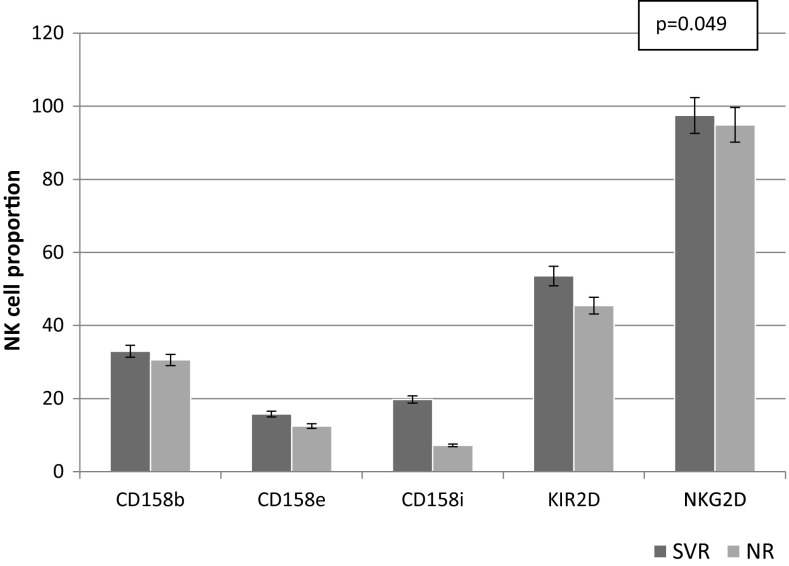
Treatment with pegylated interferon-α and ribavirin (PEG-IFN/RBV) is the only choice for chronic hepatitis C (CHC) in children. Natural killer (NK) cells were described to play a vital role in CHC. The aim of this study was to analyze the expression of peripheral blood NK cell receptors in their relation to PEG-IFN/RBV treatment response. Study included 26 children with CHC-13 boys, age range 13.42 ± 3.28 years. Blood for biochemical, virological and cytometric testing was taken for evaluation prior to the antiviral treatment. NK cell receptors were detected by flow cytometry and the results were presented as proportion of cells and mean fluorescence intensity (MFI). Therapy consisted of PEG-IFNα-2b (60 μg/m s.c 1×/week) and RBV (15 mg/kg p.o. daily). Treatment duration was response-related and varied from 12 to 72 weeks. Rapid virological response (RVR) was evaluated in the 4th week and sustained virological response (SVR) 6 months after completion of the therapy. RVR children were younger (11.67 ± 3.74 vs 15.35 ± 2.42; p = 0.001) and displayed higher CD158b (3.58 ± 0.16 vs 3.45 ± 0.13; p = 0.038) and CD158e expression (4.33 ± 0.21 vs 4.03 ± 0.16; p = 0.039). Density of CD158b (logMFI = 3.68 ± 0.22 vs 3.36 ± 0.16; p = 0.036) and CD158e expression was significantly higher (4.37 ± 0.14 vs 4.12 ± 0.21; p = 0.046) and NKG2D expression significantly lower (97.50 ± 3.46 vs 94.92 ± 5.93; p = 0.049) in SVR children. SVR children were also significantly younger (12.40 ± 3.66 vs 15.13 ± 2.83; p = 0.003). Significance of the age of patients, and expression of CD158b and CD158e were confirmed in univariate and multivariate analysis. Age of patients is negatively related to RVR and SVR. NK cell phenotype with higher expression density of CD158b and CD158e receptor was a positive predictor of SVR.
聚乙二醇干扰素-α和利巴韦林(PEG-IFN/RBV)治疗是儿童慢性丙型肝炎(CHC)的唯一选择。自然杀伤(NK)细胞被描述为在 CHC 中发挥重要作用。本研究旨在分析外周血 NK 细胞受体的表达及其与 PEG-IFN/RBV 治疗反应的关系。研究纳入 26 例 CHC 患儿-13 名男性,年龄 13.42±3.28 岁。在抗病毒治疗前采集血液进行生化、病毒学和细胞计量学检测。通过流式细胞术检测 NK 细胞受体,并以细胞比例和平均荧光强度(MFI)表示结果。治疗包括 PEG-IFNα-2b(60μg/m s.c 1×/周)和利巴韦林(15mg/kg p.o. 每日)。治疗持续时间与反应相关,从 12 周至 72 周不等。第 4 周评估快速病毒学应答(RVR),治疗结束后 6 个月评估持续病毒学应答(SVR)。获得 RVR 的患儿更年轻(11.67±3.74 岁 vs 15.35±2.42 岁;p=0.001),且 CD158b(3.58±0.16 vs 3.45±0.13;p=0.038)和 CD158e 表达(4.33±0.21 vs 4.03±0.16;p=0.039)更高。CD158b 密度(logMFI=3.68±0.22 vs 3.36±0.16;p=0.036)和 CD158e 表达显著更高(4.37±0.14 vs 4.12±0.21;p=0.046),NKG2D 表达显著更低(97.50±3.46 vs 94.92±5.93;p=0.049)。获得 SVR 的患儿也更年轻(12.40±3.66 岁 vs 15.13±2.83 岁;p=0.003)。在单变量和多变量分析中均证实了患者年龄、CD158b 和 CD158e 表达的重要性。患者年龄与 RVR 和 SVR 呈负相关。NK 细胞表型中 CD158b 和 CD158e 受体表达密度更高是 SVR 的阳性预测因子。