Department of Hematology, Radboud university medical center, Nijmegen, the Netherlands.
Department of Hematology, University Medical Centre, Groningen, the Netherlands.
Haematologica. 2018 Jan;103(1):69-79. doi: 10.3324/haematol.2017.171884. Epub 2017 Nov 9.
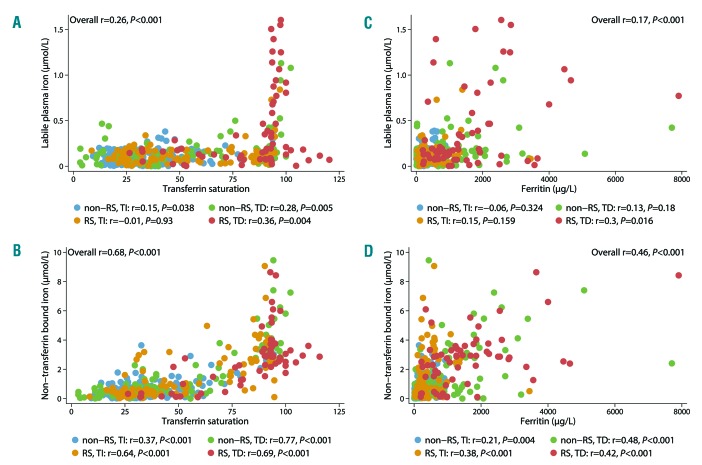
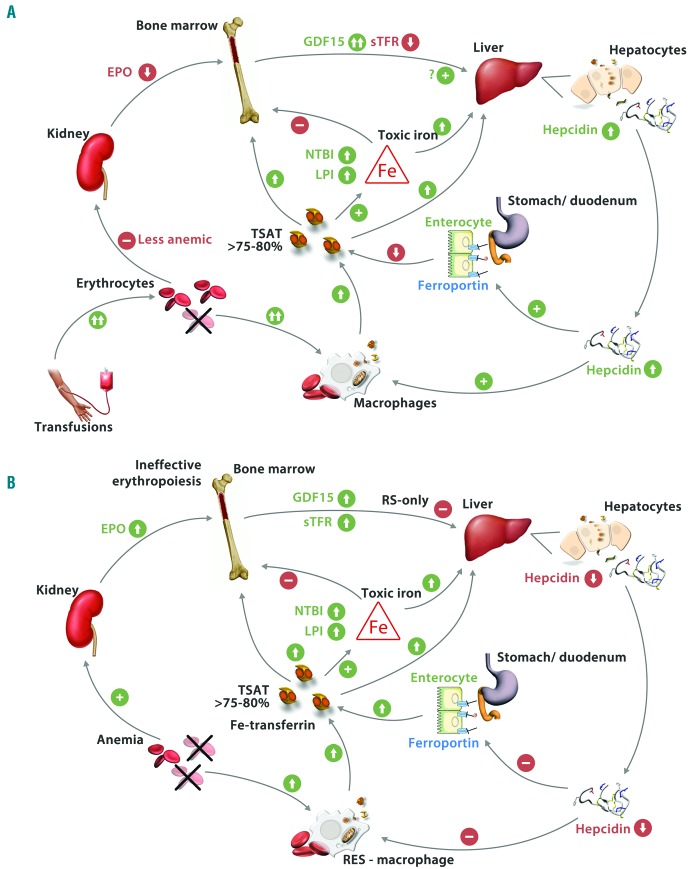
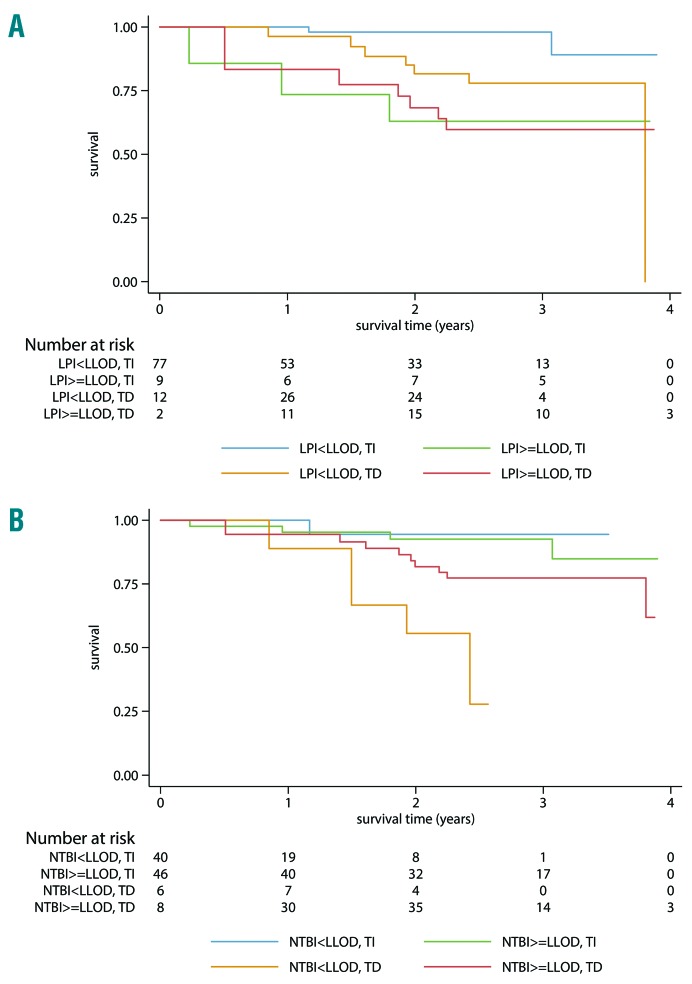
Red blood cell transfusions remain one of the cornerstones in supportive care of lower-risk patients with myelodysplastic syndromes. We hypothesized that patients develop oxidant-mediated tissue injury through the formation of toxic iron species, caused either by red blood cell transfusions or by ineffective erythropoiesis. We analyzed serum samples from 100 lower-risk patients with myelodysplastic syndromes at six-month intervals for transferrin saturation, hepcidin-25, growth differentiation factor 15, soluble transferrin receptor, non-transferrin bound iron and labile plasma iron in order to evaluate temporal changes in iron metabolism and the presence of potentially toxic iron species and their impact on survival. Hepcidin levels were low in 34 patients with ringed sideroblasts compared to 66 patients without. Increases of hepcidin and non-transferrin bound iron levels were visible early in follow-up of all transfusion-dependent patient groups. Hepcidin levels significantly decreased over time in transfusion-independent patients with ringed sideroblasts. Increased soluble transferrin receptor levels in transfusion-independent patients with ringed sideroblasts confirmed the presence of ineffective erythropoiesis and suppression of hepcidin production in these patients. Detectable labile plasma iron levels in combination with high transferrin saturation levels occurred almost exclusively in patients with ringed sideroblasts and all transfusion-dependent patient groups. Detectable labile plasma iron levels in transfusion-dependent patients without ringed sideroblasts were associated with decreased survival. In conclusion, toxic iron species occurred in all transfusion-dependent patients and in transfusion-independent patients with ringed sideroblasts. Labile plasma iron appeared to be a clinically relevant measure for potential iron toxicity and a prognostic factor for survival in transfusion-dependent patients.
红细胞输注仍然是低危骨髓增生异常综合征患者支持治疗的基石之一。我们假设患者通过形成有毒的铁物种而发生氧化剂介导的组织损伤,这些铁物种要么是由红细胞输注引起的,要么是由无效的红细胞生成引起的。我们分析了 100 例低危骨髓增生异常综合征患者的血清样本,每隔 6 个月检测一次转铁蛋白饱和度、hepcidin-25、生长分化因子 15、可溶性转铁蛋白受体、非转铁蛋白结合铁和不稳定血浆铁,以评估铁代谢的时间变化以及潜在毒性铁物种的存在及其对生存的影响。与 66 例无环形铁幼粒细胞患者相比,34 例环形铁幼粒细胞患者的 hepcidin 水平较低。所有依赖输血的患者组在随访早期都可见 hepcidin 和非转铁蛋白结合铁水平的升高。无环形铁幼粒细胞的非输血依赖患者的 hepcidin 水平随时间显著降低。无环形铁幼粒细胞的非输血依赖患者可溶性转铁蛋白受体水平升高证实了无效红细胞生成和这些患者 hepcidin 产生的抑制。可检测的不稳定血浆铁水平与高转铁蛋白饱和度水平结合几乎仅发生在环形铁幼粒细胞患者和所有依赖输血的患者组中。无环形铁幼粒细胞的依赖输血患者中可检测到不稳定的血浆铁水平与生存率降低相关。总之,所有依赖输血的患者和无环形铁幼粒细胞的非输血依赖患者中都存在有毒铁物种。不稳定的血浆铁似乎是潜在铁毒性的临床相关指标,也是依赖输血患者生存的预后因素。