Tyrkalska Sylwia D, Candel Sergio, Pérez-Oliva Ana B, Valera Ana, Alcaraz-Pérez Francisca, García-Moreno Diana, Cayuela María L, Mulero Victoriano
Facultad de Biología, Departamento de Biología Celular e Histología, Universidad de Murcia, IMIB-Arrixaca, Murcia, Spain.
Grupo de Telomerasa, Envejecimiento y Cáncer, CIBERehd, Hospital Clínico Universitario Virgen de la Arrixaca, IMIB-Arrixaca, Murcia, Spain.
Front Immunol. 2017 Oct 19;8:1375. doi: 10.3389/fimmu.2017.01375. eCollection 2017.
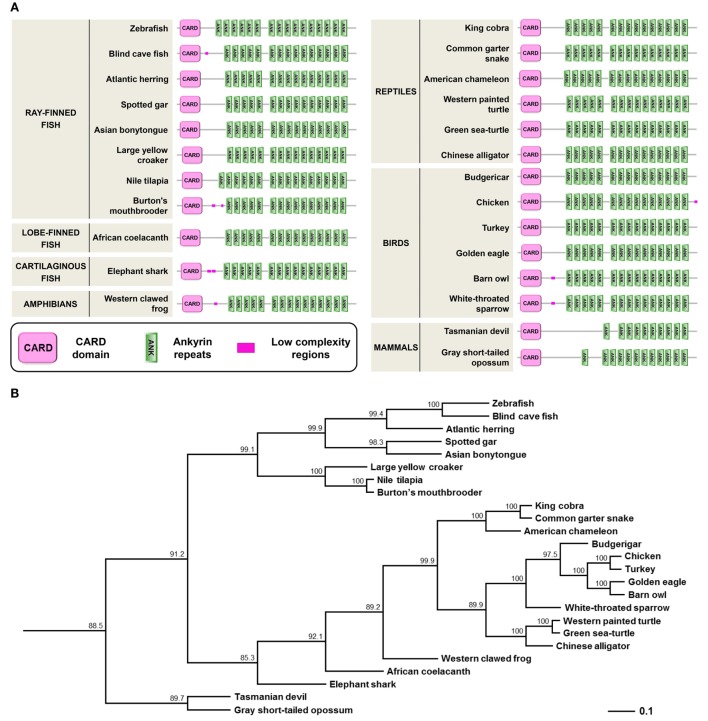
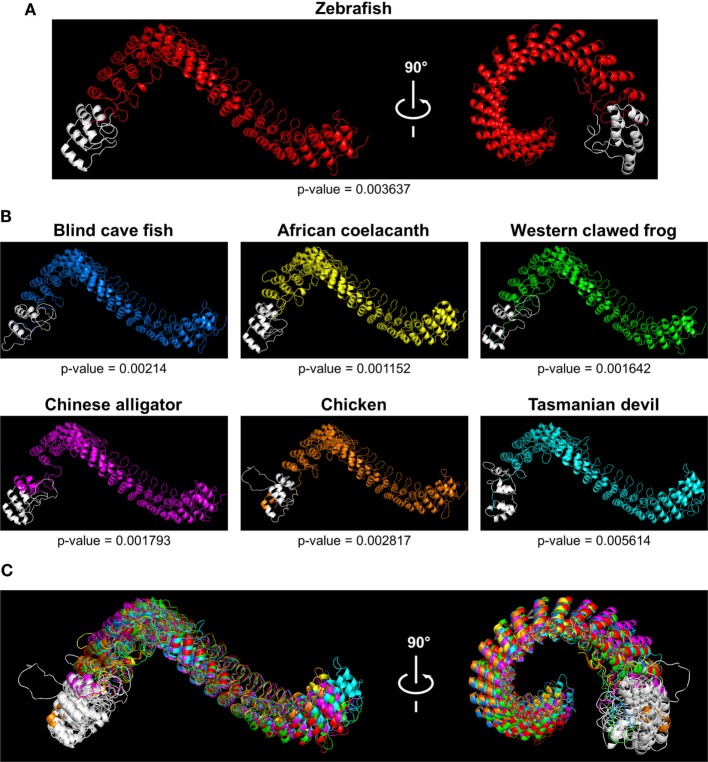
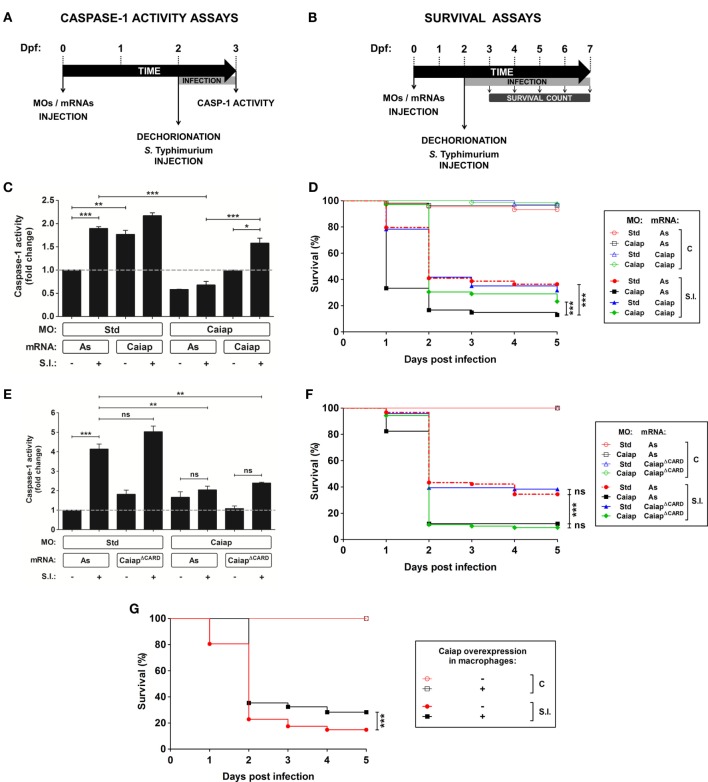
Many proteins contain tandemly repeated modules of several amino acids, which act as the building blocks that form the underlying architecture of a specific protein-binding interface. Among these motifs and one of the most frequently observed is ankyrin repeats (ANK), which consist of 33 amino acid residues that are highly conserved. ANK domains span a wide range of functions, including protein-protein interactions, such as the recruitment of substrate to the catalytic domain of an enzyme, or the assembly of stable multiprotein complexes. Here, we report the identification of an evolutionarily conserved protein, that we term Caiap (from ARD- and NK-containing Inflammasome daptor rotein), which has an N-terminal CARD domain and 16 C-terminal ANK domains and is required for the inflammasome-dependent resistance to Typhimurium in zebrafish. Intriguingly, Caiap is highly conserved from cartilaginous fish to marsupials but is absent in placental mammals. Mechanistically, Caiap acts downstream flagellin and interacts with catalytic active Caspa, the functional homolog of mammalian caspase-1, through its ANK domain, while its CARD domain promotes its self-oligomerization. Our results therefore point to ANK domain-containing proteins as key inflammasome adaptors required for the stabilization of active caspase-1 in functionally stable, high molecular weight complexes.
许多蛋白质包含由几个氨基酸串联重复组成的模块,这些模块充当构成特定蛋白质结合界面基础结构的构建单元。在这些基序中,最常观察到的基序之一是锚蛋白重复序列(ANK),它由33个高度保守的氨基酸残基组成。ANK结构域具有广泛的功能,包括蛋白质 - 蛋白质相互作用,例如将底物招募到酶的催化结构域,或组装稳定的多蛋白复合物。在此,我们报告鉴定了一种进化上保守的蛋白质,我们将其命名为Caiap(源自含ARD和NK的炎性小体衔接蛋白),它具有一个N端CARD结构域和16个C端ANK结构域,并且是斑马鱼中炎性小体依赖性抗鼠伤寒沙门氏菌所必需的。有趣的是,Caiap从软骨鱼到有袋动物都高度保守,但在胎盘哺乳动物中不存在。从机制上讲,Caiap在鞭毛蛋白下游起作用,并通过其ANK结构域与催化活性的Caspa(哺乳动物caspase-1的功能同源物)相互作用,而其CARD结构域促进其自身寡聚化。因此,我们的结果表明,含ANK结构域的蛋白质是在功能稳定的高分子量复合物中稳定活性caspase-1所需的关键炎性小体衔接蛋白。