Inokuchi Koichi, Sawano Makoto, Yamamoto Koji, Yamaguchi Atsushi, Sugiyama Satoru
Department of Emergency and Critical Care Medicine Saitama Medical Center Saitama Medical University Kawagoe Saitama Japan.
Department of Transfusion Medicine and Cell Therapy Saitama Medical Center Saitama Medical University Kawagoe Saitama Japan.
Acute Med Surg. 2017 Apr 2;4(3):271-277. doi: 10.1002/ams2.268. eCollection 2017 Jul.
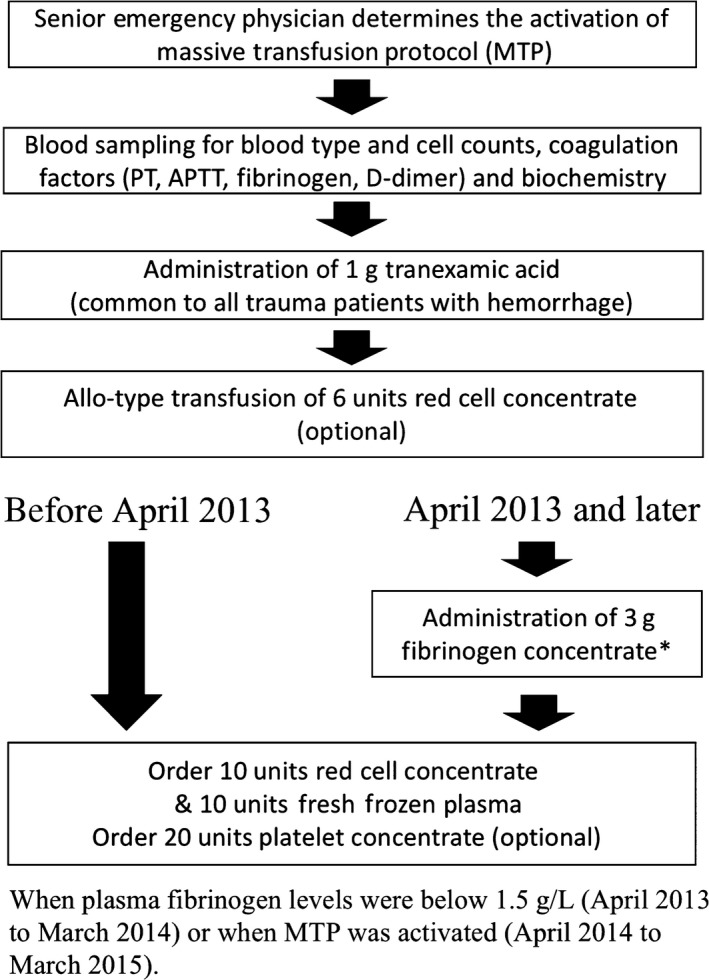
Hemorrhage from pelvic fracture is a major cause of mortality after blunt trauma. Several studies have suggested that early fibrinogen supplementation improves outcomes of traumatic hemorrhage. Thus, we revised our massive transfusion protocol (MTP) in April 2013 to include early off-label administration of fibrinogen concentrate. The objective of this study was to evaluate the impact of the revision on the short-term outcomes of pelvic fracture patients.
This was a single-center, retrospective, cohort study. A total of 224 consecutive pelvic fracture patients hospitalized in Saitama Medical Center (Saitama, Japan), 115 before the revision (Group E) and 109 after (Group L), were enrolled. Characteristics of the patients were compared between the groups. Impacts of the revision were evaluated by hazard ratios adjusted for characteristics, injury severity, and coagulation status using Cox's multivariate proportional hazard model. The impact was also evaluated by log-rank test and relative risk of 28-day mortality between the groups.
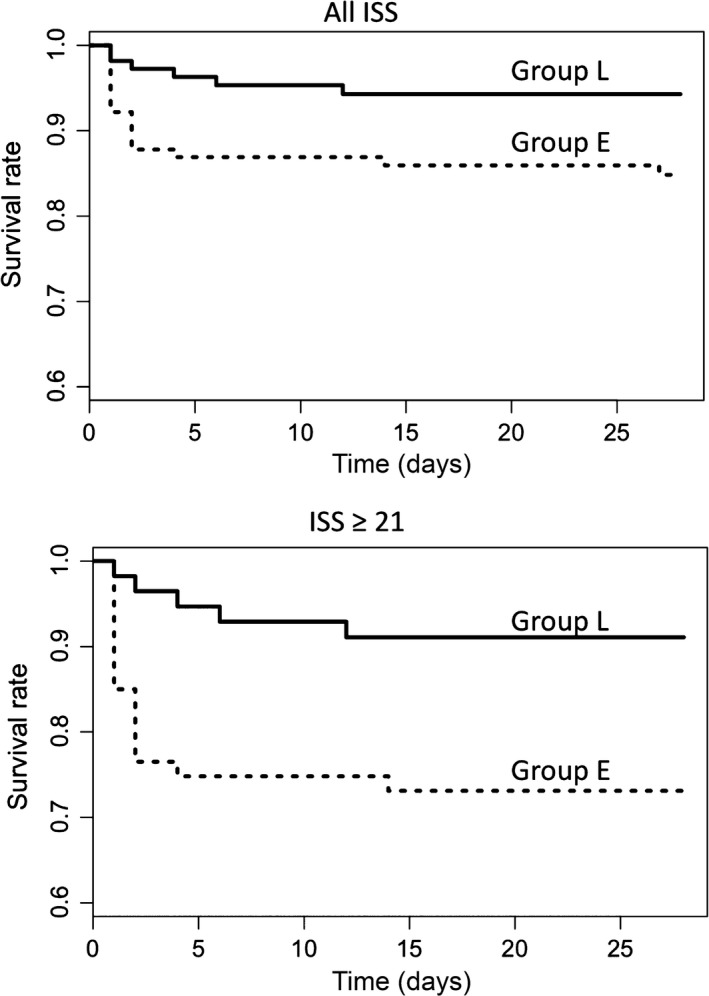
The characteristics were equivalent between the groups. The multivariate analysis revealed that the revision of MTP was significantly related to improved survival with an adjusted hazard ratio (95% confidence interval) of 0.45 (0.07-0.97). The log-rank test gave χ-test values of 5.2 ( = 0.022) and 6.7 ( = 0.009), and the relative risks were 0.37 (0.15-0.91) and 0.33 (0.13-0.84), in patients with all Injury Severity Scores and Injury Severity Score ≥21, respectively.
The revision of MTP to include aggressive off-label treatment with fibrinogen concentrate was related to improved short-term outcomes of severe pelvic fracture patients. However, due to the limitations of the study, the improvement could not be attributed totally to the revision.
骨盆骨折出血是钝性创伤后死亡的主要原因。多项研究表明,早期补充纤维蛋白原可改善创伤性出血的预后。因此,我们在2013年4月修订了大量输血方案(MTP),纳入了早期非标签使用纤维蛋白原浓缩剂。本研究的目的是评估该修订对骨盆骨折患者短期预后的影响。
这是一项单中心、回顾性队列研究。共纳入了在埼玉医疗中心(日本埼玉)住院的224例连续骨盆骨折患者,其中115例在修订前(E组),109例在修订后(L组)。比较两组患者的特征。使用Cox多变量比例风险模型,对根据特征、损伤严重程度和凝血状态调整后的风险比进行评估,以评价修订的影响。还通过对数秩检验和两组间28天死亡率的相对风险来评估影响。
两组患者的特征相当。多变量分析显示,MTP的修订与生存率提高显著相关,调整后的风险比(95%置信区间)为0.45(0.07 - 0.97)。对数秩检验在所有损伤严重程度评分患者和损伤严重程度评分≥21的患者中,χ检验值分别为5.2(P = = 0.022)和6.7(P = = 0.009),相对风险分别为0.37(0.15 - 0.91)和0.33(0.13 - 0.84)。
将纤维蛋白原浓缩剂积极用于非标签治疗纳入MTP的修订与严重骨盆骨折患者短期预后的改善有关。然而,由于本研究的局限性,这种改善不能完全归因于修订。