Hiromi Taro, Toida Chiaki, Muguruma Takashi, Hashiba Katsutaka, Doi Tomoki, Nakamura Kyota, Morimura Naoto
Department of Emergency Medicine Yokohama City University Graduate School of Medicine Minami-ku Yokohama Japan.
Cardiovascular Medicine Yokohama City University Graduate School of Medicine Minami-ku Yokohama Japan.
Acute Med Surg. 2017 Jul 13;4(4):446-450. doi: 10.1002/ams2.292. eCollection 2017 Oct.
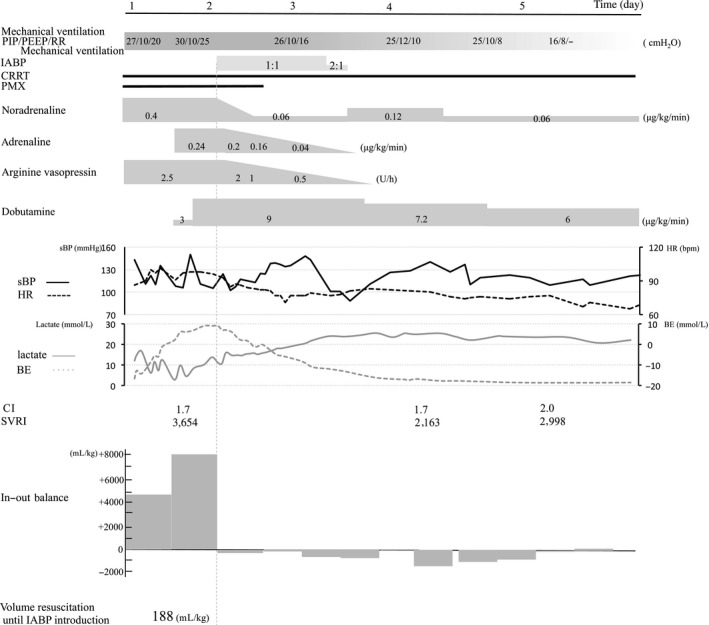
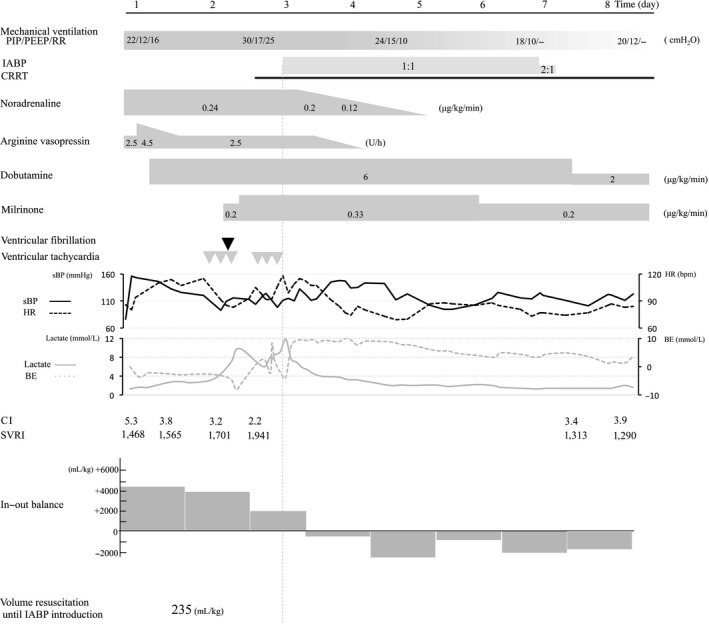
Septic cardiomyopathy is defined as a reversible left ventricular systolic dysfunction. Patients with severe septic cardiomyopathy have a high mortality rate, even if they receive conventional therapy. For those patients, previous reports showed intra-aortic balloon pump (IABP) efficacy. We report two rare cases with IABP introduction leading them to drastic improvement, and survival from severe septic cardiomyopathy. Case 1 is a 78-year-old woman diagnosed with renal calculus pyelonephritis, septic shock, and septic cardiomyopathy. Case 2 is a 62-year-old man diagnosed with pneumonia, septic shock, and septic cardiomyopathy.
In both cases, despite conventional therapy for cardiomyopathy, including high-dose catecholamine therapy, shock was not reversed, and the IABP was inserted. Circulatory status was improved after the introduction of the IABP.
Our findings suggest that an IABP can be useful for salvaging patients with septic cardiomyopathy who do not respond to conventional therapy.
感染性心肌病被定义为一种可逆的左心室收缩功能障碍。患有严重感染性心肌病的患者死亡率很高,即使接受传统治疗也是如此。对于这些患者,先前的报告显示主动脉内球囊反搏(IABP)有疗效。我们报告两例罕见病例,引入IABP后病情大幅改善,并从严重感染性心肌病中存活下来。病例1是一名78岁女性,诊断为肾积脓肾盂肾炎、感染性休克和感染性心肌病。病例2是一名62岁男性,诊断为肺炎、感染性休克和感染性心肌病。
在这两个病例中,尽管对心肌病进行了包括高剂量儿茶酚胺治疗在内的传统治疗,但休克并未得到逆转,于是插入了IABP。引入IABP后循环状态得到改善。
我们的研究结果表明,IABP对于挽救对传统治疗无反应的感染性心肌病患者可能有用。