
通过简单微波辅助方法合成的半导体辉锑矿纳米结构在丙二醇中用于降解染料污染物的光催化应用及其光学性质。
The Photocatalytic Application of Semiconductor Stibnite Nanostructure Synthesized via a Simple Microwave-Assisted Approach in Propylene Glycol for Degradation of Dye Pollutants and its Optical Property.
作者信息
Saksornchai Eksuree, Kavinchan Jutarat, Thongtem Somchai, Thongtem Titipun
机构信息
School of Science, University of Phayao, Phayao, 56000, Thailand.
Department of Physics and Materials Science, Faculty of Science, Chiang Mai University, Chiang Mai, 50200, Thailand.
出版信息
Nanoscale Res Lett. 2017 Nov 9;12(1):589. doi: 10.1186/s11671-017-2356-6.
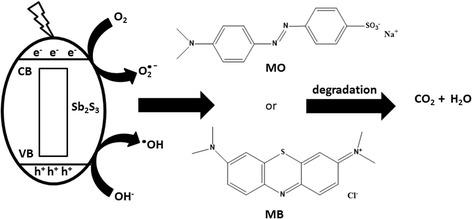
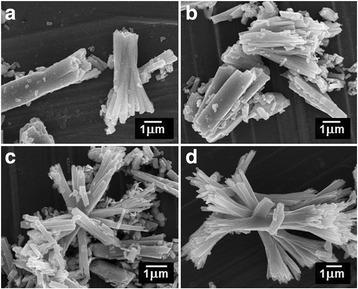
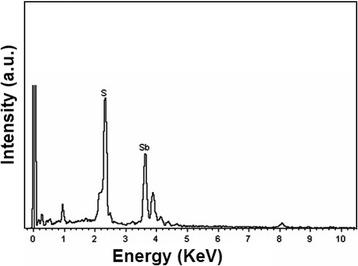
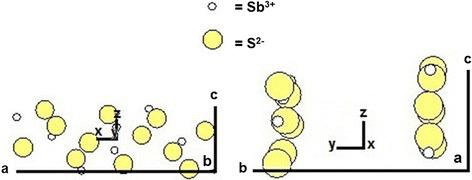
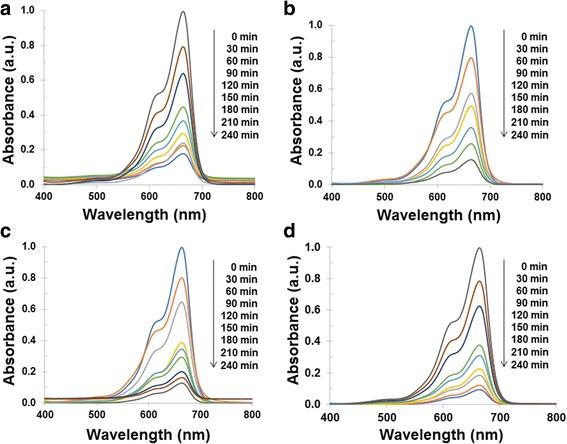
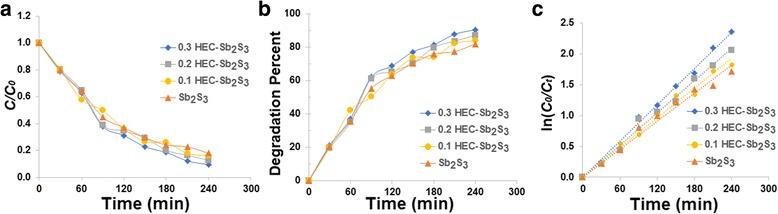
Stibnite (SbS) semiconducting material was successfully synthesized by a rapid and facile microwave route using antimony chloride (SbCl) and sodiumthiosulfate (NaSO) dissolved in propylene glycol (PG) containing different hydroxyethyl cellulose (HEC) masses. The phase identification, morphology, and elemental composition of products were characterized by X-ray diffraction (XRD), transmission electron microscopy (TEM), field- emission scanning electron microscopy (FE-SEM), energy dispersive X-ray (EDX) spectroscopy, and Fourier transform infrared spectroscopy (FTIR). The results revealed the orthorhombic phase of SbS single crystal-forming sheaf-like nanostructure, and a possible formation mechanism was proposed and discussed. Its direct band gap calculated from UV-visible absorption is 1.60 eV. In this research, the photocatalytic activities of SbS nanostructure were investigated through the degradation of methyl orange (MO) and methylene blue (MB) under visible light irradiation. The as-obtained 0.30 g HEC-added solution (0.3 HEC-SbS) photocatalyst exhibited better photocatalytic activity than the other products, which degraded 91% of MO within 300 min and 90% of MB within 240 min under the Xe-lamp irradiation. The first-order plot was fitted with this experiment which the rate constant (k) of 0.3 HEC-SbS for MO and MB degradation are 0.0085 and 0.0098 min, respectively. Therefore, the new experience with a novel and simple synthetic procedure of SbS photocatalyst that exhibits the characteristics of a highly effective photocatalyst under visible light irradiation was discovered.
通过快速简便的微波路线,使用溶解在含有不同质量羟乙基纤维素(HEC)的丙二醇(PG)中的氯化锑(SbCl)和硫代硫酸钠(Na₂S₂O₃),成功合成了辉锑矿(SbS)半导体材料。通过X射线衍射(XRD)、透射电子显微镜(TEM)、场发射扫描电子显微镜(FE-SEM)、能量色散X射线(EDX)光谱和傅里叶变换红外光谱(FTIR)对产物的相鉴定、形态和元素组成进行了表征。结果揭示了形成束状纳米结构的SbS单晶的正交相,并提出并讨论了可能的形成机制。由紫外可见吸收计算得到其直接带隙为1.60 eV。在本研究中,通过在可见光照射下对甲基橙(MO)和亚甲基蓝(MB)的降解来研究SbS纳米结构的光催化活性。所制备的添加0.30 g HEC的溶液(0.3 HEC-SbS)光催化剂表现出比其他产物更好的光催化活性,在氙灯照射下,该催化剂在300分钟内降解了91%的MO,在240分钟内降解了90%的MB。将一级图与该实验拟合,0.3 HEC-SbS对MO和MB降解的速率常数(k)分别为0.0085和0.0098 min⁻¹。因此,发现了一种具有新颖简单合成方法的SbS光催化剂的新经验,该催化剂在可见光照射下表现出高效光催化剂的特性。






 Zotero 插件