Kuck Jamie L, Bastarache Julie A, Shaver Ciara M, Fessel Joshua P, Dikalov Sergey I, May James M, Ware Lorraine B
Division of Allergy, Pulmonary and Critical Care Medicine, Department of Medicine, Vanderbilt University Medical Center, Nashville, TN, USA.
Division of Allergy, Pulmonary and Critical Care Medicine, Department of Medicine, Vanderbilt University Medical Center, Nashville, TN, USA; Department of Pathology, Microbiology and Immunology, Vanderbilt University Medical Center, Nashville, TN, USA.
Biochem Biophys Res Commun. 2018 Jan 1;495(1):433-437. doi: 10.1016/j.bbrc.2017.11.058. Epub 2017 Nov 9.
Increased endothelial permeability is central to shock and organ dysfunction in sepsis but therapeutics targeted to known mediators of increased endothelial permeability have been unsuccessful in patient studies. We previously reported that cell-free hemoglobin (CFH) is elevated in the majority of patients with sepsis and is associated with organ dysfunction, poor clinical outcomes and elevated markers of oxidant injury. Others have shown that Vitamin C (ascorbate) may have endothelial protective effects in sepsis. In this study, we tested the hypothesis that high levels of CFH, as seen in the circulation of patients with sepsis, disrupt endothelial barrier integrity.
Human umbilical vein endothelial cells (HUVEC) were grown to confluence and treated with CFH with or without ascorbate. Monolayer permeability was measured by Electric Cell-substrate Impedance Sensing (ECIS) or transfer of C-inulin. Viability was measured by trypan blue exclusion. Intracellular ascorbate was measured by HPLC.
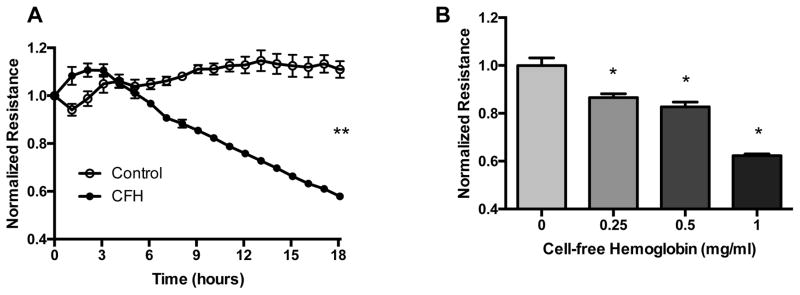
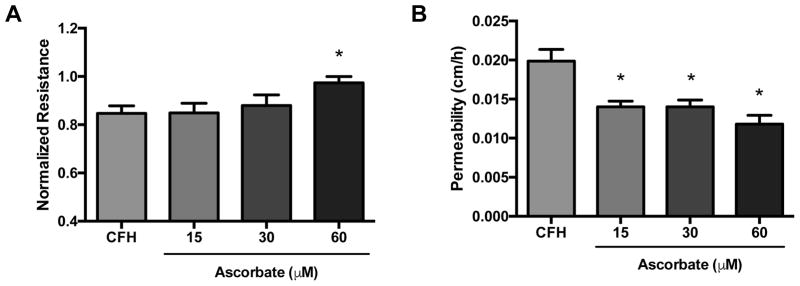
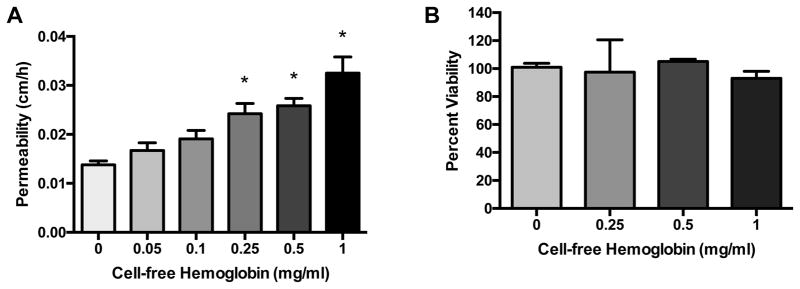
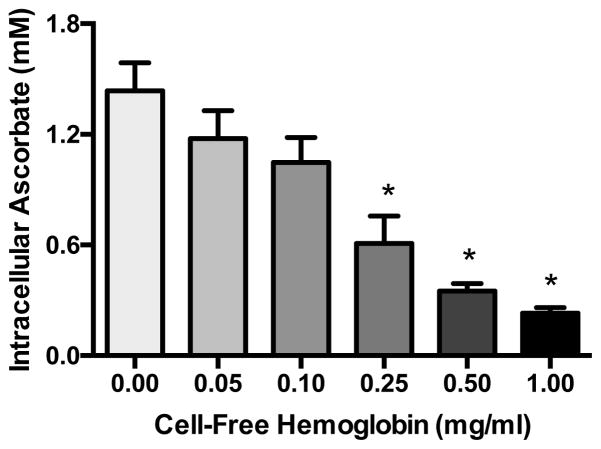
CFH increased permeability in a dose- and time-dependent manner with 1 mg/ml of CFH increasing inulin transfer by 50% without affecting cell viability. CFH (1 mg/ml) also caused a dramatic reduction in intracellular ascorbate in the same time frame (1.4 mM without CFH, 0.23 mM 18 h after 1 mg/ml CFH, p < 0.05). Pre-treatment of HUVECs with ascorbate attenuated CFH induced permeability.
CFH increases endothelial permeability in part through depletion of intracellular ascorbate. Supplementation of ascorbate can attenuate increases in permeability mediated by CFH suggesting a possible therapeutic approach in sepsis.
内皮细胞通透性增加是脓毒症休克和器官功能障碍的核心,但针对已知的内皮细胞通透性增加介质的治疗方法在患者研究中并未取得成功。我们之前报道,大多数脓毒症患者的游离血红蛋白(CFH)升高,且与器官功能障碍、不良临床结局及氧化损伤标志物升高有关。其他人已表明,维生素C(抗坏血酸盐)可能对脓毒症具有内皮保护作用。在本研究中,我们检验了如下假设:脓毒症患者循环中所见的高水平CFH会破坏内皮屏障完整性。
将人脐静脉内皮细胞(HUVEC)培养至汇合状态,并用CFH处理,同时或不同时添加抗坏血酸盐。通过细胞-基质电阻抗传感(ECIS)或¹⁴C-菊粉转运来测量单层通透性。通过台盼蓝排斥法测量细胞活力。通过高效液相色谱法测量细胞内抗坏血酸盐。
CFH以剂量和时间依赖性方式增加通透性,1mg/ml的CFH使菊粉转运增加50%,而不影响细胞活力。CFH(1mg/ml)在同一时间范围内也导致细胞内抗坏血酸盐显著降低(无CFH时为1.4mM,1mg/ml CFH处理18小时后为0.23mM,p<0.05)。用抗坏血酸盐预处理HUVEC可减弱CFH诱导的通透性增加。
CFH部分通过消耗细胞内抗坏血酸盐增加内皮通透性。补充抗坏血酸盐可减弱CFH介导的通透性增加,提示在脓毒症中可能存在一种治疗方法。