Davidson James P, King Andrew J, Kumaraswamy Padmapriya, Caldwell Jeremy S, Korner Paul, Blanks Robert C, Jacobs Jeffrey W
1 Ardelyx, Inc, Fremont, CA, USA.
J Cardiovasc Pharmacol Ther. 2018 May;23(3):244-253. doi: 10.1177/1074248417741685. Epub 2017 Nov 12.
Hyperkalemia is a common complication in patients with heart failure or chronic kidney disease, particularly those who are taking inhibitors of the renin-angiotensin-aldosterone system. RDX7675, the calcium salt of a reengineered polystyrene sulfonate-based resin, is a potassium binder that is being investigated as a novel treatment for hyperkalemia. This study evaluated the pharmacodynamic effects of RDX7675 in mice, compared to 2 current treatments, sodium polystyrene sulfonate (SPS) and patiromer.
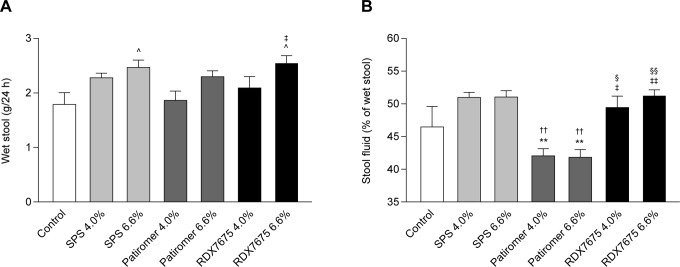
Seven groups of 8 male CD-1 mice were given either standard chow (controls) or standard chow containing 4.0% or 6.6% active moiety of RDX7675, patiromer, or SPS for 72 hours. Stool and urine were collected over the final 24 hours of treatment for ion excretion analyses.
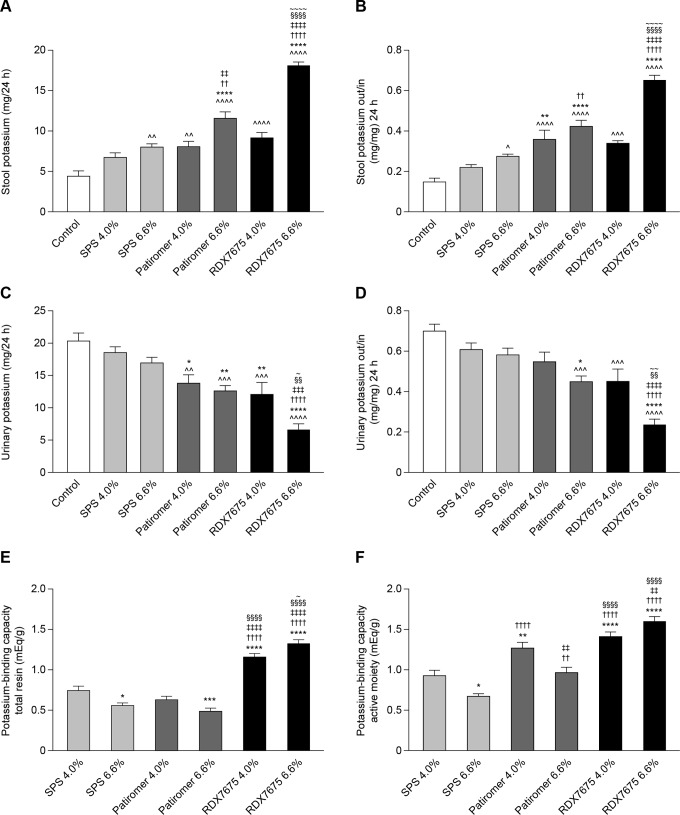
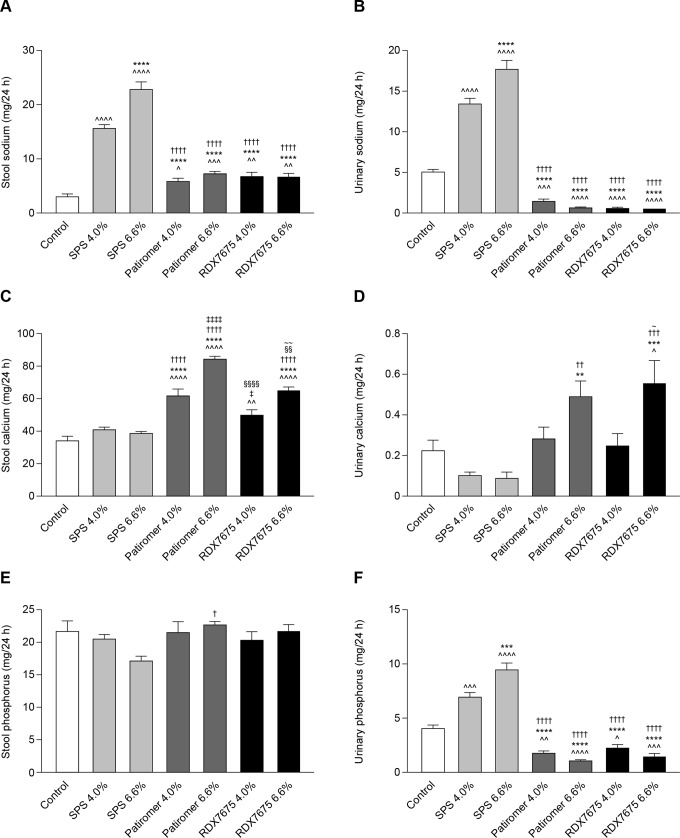
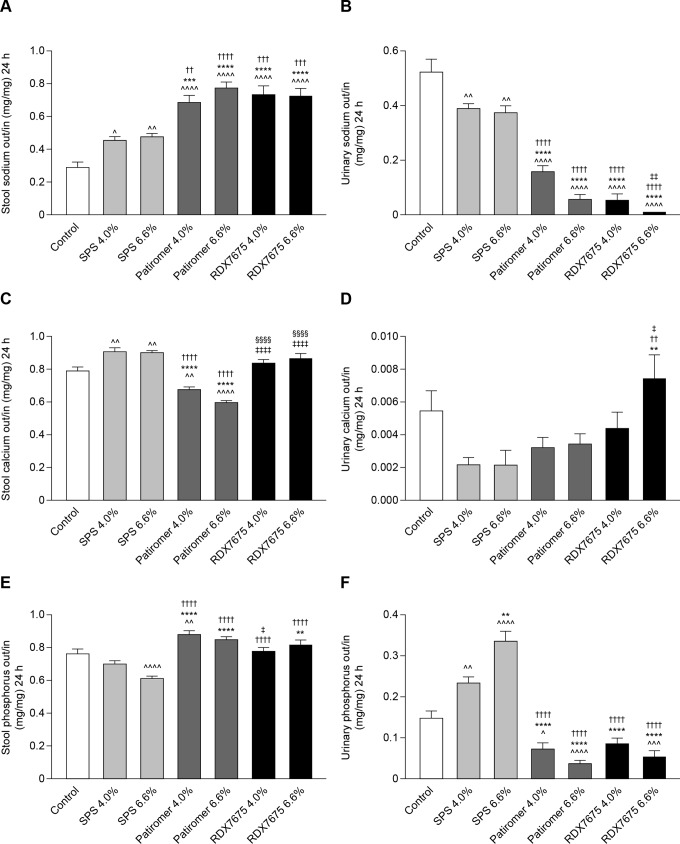
RDX7675 increased stool potassium (mean 24-hour excretion: 4.0%, 9.19 mg; 6.6%, 18.11 mg; both P < .0001) compared with controls (4.47 mg) and decreased urinary potassium (mean 24-hour excretion: 4.0%, 12.05 mg, P < .001; 6.6%, 6.68 mg, P < .0001; vs controls, 20.38 mg). The potassium-binding capacity of RDX7675 (stool potassium/gram of resin: 4.0%, 1.14 mEq/g; 6.6%, 1.32 mEq/g) was greater (all P < .0001) than for patiromer (4.0%, 0.63 mEq/g; 6.6%, 0.48 mEq/g) or SPS (4.0%, 0.73 mEq/g; 6.6% 0.55 mEq/g). RDX7675 and patiromer decreased urinary sodium (mean 24-hour excretion: 0.07-1.38 mg; all P < .001) compared to controls (5.01 mg). In contrast, SPS increased urinary sodium excretion (4.0%, 13.31 mg; 6.6%, 17.60 mg; both P < .0001) compared to controls.
RDX7675 reduced intestinal potassium absorption and had a greater potassium-binding capacity than patiromer or SPS in mice. The calcium-based resins RDX7675 and patiromer reduced intestinal sodium absorption, unlike sodium-based SPS. These results support further studies in humans to confirm the potential of RDX7675 for the treatment of patients with hyperkalemia.
高钾血症是心力衰竭或慢性肾脏病患者常见的并发症,尤其是那些正在服用肾素 - 血管紧张素 - 醛固酮系统抑制剂的患者。RDX7675是一种重新设计的聚苯乙烯磺酸盐基树脂的钙盐,是一种钾结合剂,正作为高钾血症的新型治疗方法进行研究。本研究评估了RDX7675在小鼠中的药效学作用,并与两种现有治疗方法——聚苯乙烯磺酸钠(SPS)和帕替罗莫进行了比较。
将七组,每组8只雄性CD - 1小鼠分为三组,分别给予标准饲料(对照组)或含有4.0%或6.6%活性成分的RDX7675、帕替罗莫或SPS的标准饲料,持续72小时。在治疗的最后24小时收集粪便和尿液进行离子排泄分析。
与对照组(4.47毫克)相比,RDX7675增加了粪便钾排泄(平均24小时排泄量:4.0%,9.19毫克;6.6%,18.11毫克;两者P <.0001),并减少了尿钾排泄(平均24小时排泄量:4.0%,12.05毫克,P <.001;6.6%,6.68毫克,P <.0001;对照组为20.38毫克)。RDX7675的钾结合能力(粪便钾/克树脂:4.0%,1.14毫当量/克;6.6%,1.32毫当量/克)高于帕替罗莫(4.0%,0.63毫当量/克;6.6%,0.48毫当量/克)或SPS(4.0%,0.73毫当量/克;6.6%,0.55毫当量/克)(所有P <.0001)。与对照组相比,RDX7675和帕替罗莫减少了尿钠排泄(平均24小时排泄量:0.07 - 1.38毫克;所有P <.001)。相比之下,与对照组相比,SPS增加了尿钠排泄(4.0%,13.31毫克;6.6%,17.60毫克;两者P <.0001)。
在小鼠中,RDX7675减少了肠道钾吸收,并且钾结合能力比帕替罗莫或SPS更强。与基于钠的SPS不同,基于钙的树脂RDX7675和帕替罗莫减少了肠道钠吸收。这些结果支持在人体中进行进一步研究,以确认RDX7675治疗高钾血症患者的潜力。