Rozek Jessica C, Camp Richard J, Reed J Michael
Department of Biology, Tufts University, Medford, MA, United States of America.
Hawai`i Cooperative Studies Unit, University of Hawai`i at Hilo, Hawai`i National Park, United States of America.
PLoS One. 2017 Nov 13;12(11):e0187518. doi: 10.1371/journal.pone.0187518. eCollection 2017.
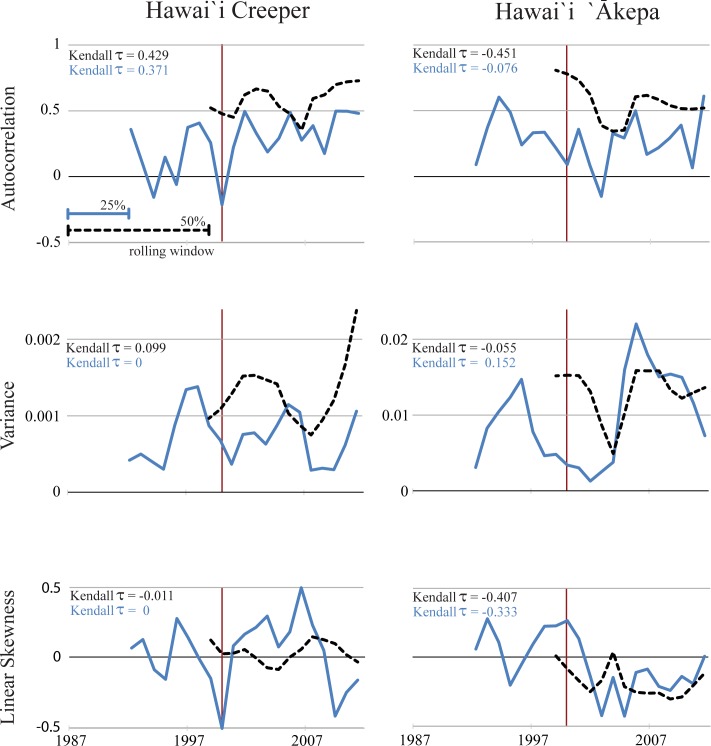
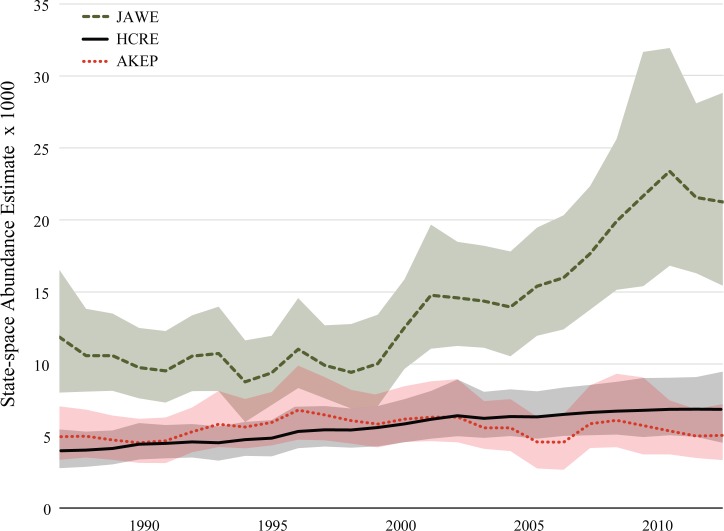
There is debate about the current population trends and predicted short-term fates of the endangered forest birds, Hawaii Creeper (Loxops mana) and Hawaii Ākepa (L. coccineus). Using long-term population size estimates, some studies report forest bird populations as stable or increasing, while other studies report signs of population decline or impending extinction associated with introduced Japanese White-eye (Zosterops japonicus) increase. Reliable predictors of impending population collapse, well before the collapse begins, have been reported in simulations and microcosm experiments. In these studies, statistical indicators of critical slowing down, a phenomenon characterized by longer recovery rates after population size perturbation, are reported to be early warning signals of an impending regime shift observable prior to the tipping point. While the conservation applications of these metrics are commonly discussed, early warning signal detection methods are rarely applied to population size data from natural populations, so their efficacy and utility in species management remain unclear. We evaluated two time series of state-space abundance estimates (1987-2012) from Hakalau Forest National Wildlife Refuge, Hawaii to test for evidence of early warning signals of impending population collapse for the Hawaii Creeper and Hawaii `Ākepa. We looked for signals throughout the time series, and prior to 2000, when white-eye abundance began increasing. We found no evidence for either species of increasing variance, autocorrelation, or skewness, which are commonly reported early warning signals. We calculated linear rather than ordinary skewness because the latter is biased, particularly for small sample sizes. Furthermore, we identified break-points in trends over time for both endangered species, indicating shifts in slopes away from strongly increasing trends, but they were only weakly supported by Bayesian change-point analyses (i.e., no step-wise changes in abundance). The break-point and change-point test results, in addition to the early warning signal analyses, support that the two populations do not appear to show signs of critical slowing down or decline.
对于濒危森林鸟类夏威夷攀雀(Loxops mana)和夏威夷阿基帕雀(L. coccineus)当前的种群趋势以及预测的短期命运存在争议。一些研究利用长期种群规模估计报告称森林鸟类种群稳定或在增加,而其他研究则报告了与外来的日本绣眼鸟(Zosterops japonicus)数量增加相关的种群下降或即将灭绝的迹象。在模拟和微观世界实验中已经报告了在种群崩溃开始之前很久就能可靠预测种群即将崩溃的指标。在这些研究中,临界减速的统计指标,即一种在种群规模受到扰动后恢复率变长的现象,被报告为在临界点之前可观察到的即将发生的 regime 转变的早期预警信号。虽然这些指标在保护方面的应用经常被讨论,但早期预警信号检测方法很少应用于自然种群的种群规模数据,因此它们在物种管理中的有效性和实用性仍不明确。我们评估了来自夏威夷哈卡拉乌森林国家野生动物保护区的两个状态空间丰度估计的时间序列(1987 - 2012 年),以测试夏威夷攀雀和夏威夷阿基帕雀是否有即将发生种群崩溃的早期预警信号的证据。我们在整个时间序列以及白眼鸟数量开始增加的 2000 年之前寻找信号。我们没有发现这两个物种中任何一个有方差增加、自相关或偏度增加的证据,而这些通常是报告的早期预警信号。我们计算的是线性偏度而非普通偏度,因为后者存在偏差,特别是对于小样本量。此外,我们确定了这两种濒危物种随时间变化趋势的断点,表明斜率从强烈增加的趋势发生了变化,但贝叶斯变化点分析对它们的支持力度较弱(即丰度没有逐步变化)。除了早期预警信号分析外,断点和变化点测试结果都支持这两个种群似乎没有显示出临界减速或下降的迹象。