Department of Pathology, The Johns Hopkins University, Baltimore, MD.
Department of Pathology, UT Southwestern Medical Center, Dallas, TX.
Am J Surg Pathol. 2018 Mar;42(3):319-325. doi: 10.1097/PAS.0000000000000990.
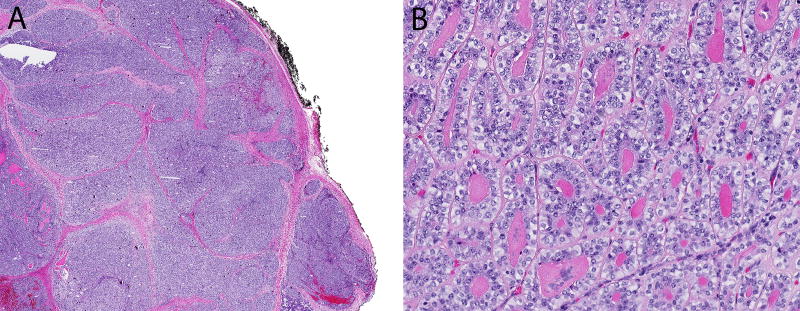
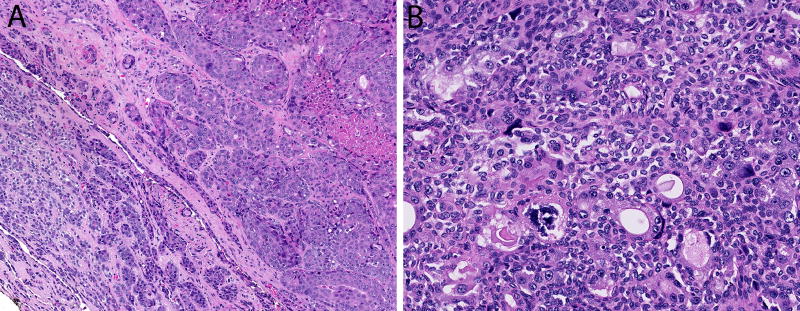
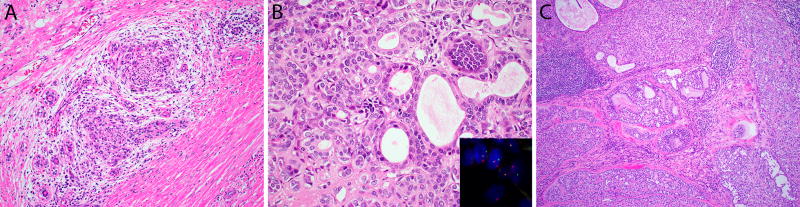
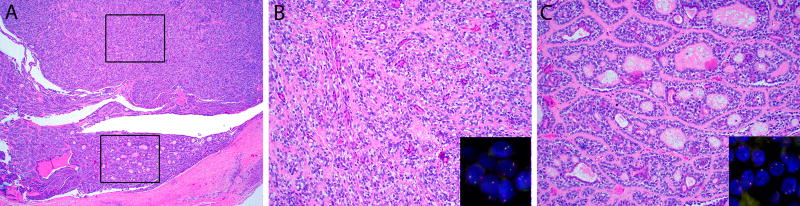
Epithelial-myoepithelial carcinoma (EMC) is a malignant salivary gland neoplasm comprised of a biphasic arrangement of inner luminal ductal cells and outer myoepithelial cells. Adenoid cystic carcinoma (AdCC) is also a biphasic tumor comprised of ductal and myoepithelial cells, but these components tend to be arranged in a more cribriform pattern. The occurrence of "hybrid carcinomas" that show mixed patterns of EMC and AdCC raises questions about the relationship of these morphologically overlapping but clinically distinct tumors. AdCCs frequently harbor MYB-NFIB gene fusions. Mapping of EMCs (including hybrid forms with an AdCC component) for this fusion could help clarify the true nature of EMC as a distinct entity or simply as some variant form of AdCC. Twenty-nine cases of EMC were evaluated including 15 classic low-grade EMCs, 7 intermediate-grade EMCs, 2 EMCs with myoepithelial anaplasia, 1 EMC with high-grade transformation, and 4 hybrid EMCs with an AdCC component. Break apart fluorescence in situ hybridization for MYB was performed, as was MYB immunohistochemistry. For the hybrid carcinomas and those with high-grade transformation, the divergent tumor components were separately analyzed. A MYB translocation was identified in 5 of 28 (18%) tumors including 3 of 4 (75%) hybrid carcinomas and 2 of 7 (29%) intermediate-grade EMCs. For the positive hybrid carcinomas, the fusion was detected in both the EMC and AdCC components. The MYB fusion was not detected in any of the classic EMCs (0/15) or in any of the EMCs with myoepithelial anaplasia (0/2) or high-grade transformation (0/1). The fluorescence in situ hybridization assay was unsuccessful in 1 case. MYB immunostaining was seen in 5 of 5 fusion-positive cases, and also 9 of 23 fusion-negative tumors. Classic low-grade EMCs are genetically distinct from AdCCs in that they do not harbor MYB fusions. The presence of a MYB fusion in EMCs showing hybrid features of AdCC or exhibiting highly infiltrative growth points to a subset of these tumors that may well be true AdCCs masquerading as EMCs.
上皮-肌上皮癌 (EMC) 是一种恶性涎腺肿瘤,由内腔导管细胞和外肌上皮细胞的双相排列组成。腺样囊性癌 (AdCC) 也是一种双相肿瘤,由导管和肌上皮细胞组成,但这些成分往往呈筛状排列。出现具有 EMC 和 AdCC 混合模式的“混合癌”,引发了对这些形态上重叠但临床上不同的肿瘤之间关系的疑问。AdCCs 常含有 MYB-NFIB 基因融合。对这些融合进行 EMC (包括具有 AdCC 成分的混合形式)作图可以帮助澄清 EMC 作为一个独特实体的真正性质,或者只是 AdCC 的某种变体形式。评估了 29 例 EMC 病例,包括 15 例经典低级别 EMC、7 例中级 EMC、2 例具有肌上皮间变的 EMC、1 例高级别转化的 EMC 和 4 例具有 AdCC 成分的混合 EMC。进行了 MYB 分离荧光原位杂交,并进行了 MYB 免疫组织化学分析。对于混合癌和高级别转化的肿瘤,分别分析了不同的肿瘤成分。在 28 个肿瘤中有 5 个(18%)发现了 MYB 易位,包括 4 个混合癌中的 3 个(75%)和 7 个中级 EMC 中的 2 个(29%)。对于阳性混合癌,融合在 EMC 和 AdCC 成分中均被检测到。在任何经典 EMC(0/15)或任何具有肌上皮间变(0/2)或高级别转化(0/1)的 EMC 中均未检测到 MYB 融合。在 1 例中,荧光原位杂交检测不成功。在 5 例融合阳性病例中均可见 MYB 免疫染色,在 23 例融合阴性肿瘤中也有 9 例可见。经典低级别 EMC 在遗传学上与 AdCC 不同,因为它们不含有 MYB 融合。在表现出 AdCC 混合特征或表现出高度浸润性生长的 EMC 中存在 MYB 融合,表明这些肿瘤的一个亚组可能是真正的 AdCC,伪装成 EMC。