Bachhuber Marcus A, Mehta Pooja K, Faherty Laura J, Saloner Brendan
*Department of Medicine, Division of General Internal Medicine, Montefiore Medical Center/Albert Einstein College of Medicine, Bronx, NY †Department of Obstetrics and Gynecology, Boston University School of Medicine ‡RAND Corporation, Boston, MA §Department of Health Policy and Management, Johns Hopkins Bloomberg School of Public Health, Baltimore, MD.
Med Care. 2017 Dec;55(12):985-990. doi: 10.1097/MLR.0000000000000803.
Opioid agonist therapy (OAT) is the standard of care for pregnant women with opioid use disorder (OUD). Medicaid coverage policies may strongly influence OAT use in this group.
To examine the association between Medicaid coverage of methadone maintenance and planned use of OAT in the publicly funded treatment system.
Retrospective cross-sectional analysis of treatment admissions in 30 states extracted from the Treatment Episode Data Set (2013 and 2014).
Medicaid-insured pregnant women with OUD (n=3354 treatment admissions).
The main outcome measure was planned use of OAT on admission. The main exposure was state Medicaid coverage of methadone maintenance. Using multivariable logistic regression models adjusting for sociodemographic, substance use, and treatment characteristics, we compared the probability of planned OAT use in states with Medicaid coverage of methadone maintenance versus states without coverage.
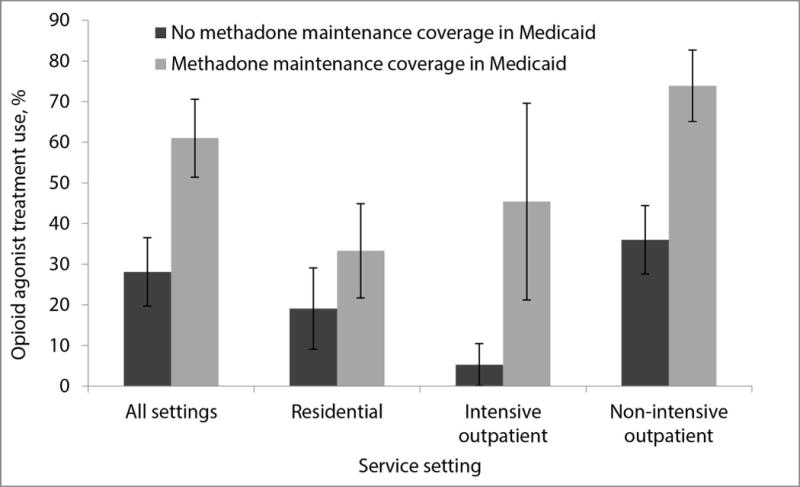
A total of 71% of pregnant women admitted to OUD treatment were 18-29 years old, 85% were white non-Hispanic, and 56% used heroin. Overall, 74% of admissions occurred in the 18 states with Medicaid coverage of methadone maintenance and 53% of admissions involved planned use of OAT. Compared with states without Medicaid coverage of methadone maintenance, admissions in states with coverage were significantly more likely to involve planned OAT use (adjusted difference: 32.9 percentage points, 95% confidence interval, 19.2-46.7).
Including methadone maintenance in the Medicaid benefit is essential to increasing OAT among pregnant women with OUD and should be considered a key policy strategy to enhance outcomes for mothers and newborns.
阿片类激动剂疗法(OAT)是患有阿片类物质使用障碍(OUD)的孕妇的标准治疗方法。医疗补助覆盖政策可能会对该群体中OAT的使用产生重大影响。
研究美沙酮维持治疗的医疗补助覆盖情况与公共资助治疗系统中OAT的计划使用之间的关联。
对从治疗事件数据集(2013年和2014年)中提取的30个州的治疗入院情况进行回顾性横断面分析。
有OUD的医疗补助参保孕妇(n = 3354例治疗入院)。
主要结局指标是入院时OAT的计划使用情况。主要暴露因素是州医疗补助对美沙酮维持治疗的覆盖情况。我们使用多变量逻辑回归模型,对社会人口统计学、物质使用和治疗特征进行调整,比较了有美沙酮维持治疗医疗补助覆盖的州与无覆盖的州中计划使用OAT的概率。
共有71%的入院接受OUD治疗的孕妇年龄在18 - 29岁之间,85%为非西班牙裔白人,56%使用海洛因。总体而言,74%的入院情况发生在有美沙酮维持治疗医疗补助覆盖的18个州,53%的入院涉及OAT的计划使用。与没有美沙酮维持治疗医疗补助覆盖的州相比,有覆盖的州的入院情况更有可能涉及计划使用OAT(调整差异:32.9个百分点,95%置信区间,19.2 - 46.7)。
将美沙酮维持治疗纳入医疗补助福利对于增加患有OUD的孕妇的OAT使用至关重要,应被视为改善母亲和新生儿结局的关键政策策略。