de Andrade Luis Gustavo Modelli, Contti Mariana Moraes, Nga Hong Si, Bravin Ariane Moyses, Takase Henrique Mochida, Viero Rosa Marlene, da Silva Trycia Nunes, Chagas Kelem De Nardi, Palma Lilian Monteiro Pereira
Department of Internal Medicine, University São Paulo State(UNESP), Botucatu, São Paulo State, Brazil.
Department of Internal Medicine, Hospital Estadual de Bauru, Bauru, São Paulo State, Brazil.
PLoS One. 2017 Nov 14;12(11):e0188155. doi: 10.1371/journal.pone.0188155. eCollection 2017.
The treatment of choice for Atypical Hemolytic Uremic Syndrome (aHUS) is the monoclonal antibody eculizumab. The objective of this study was to assess the efficacy and safety of eculizumab in a cohort of kidney transplant patients suffering from aHUS.
Description of the prospective cohort of all the patients primarily treated with eculizumab after transplantation and divided into the therapeutic (onset of aHUS after transplantation) and prophylactic use (patients with previous diagnosis of aHUS undergoing kidney transplantation).
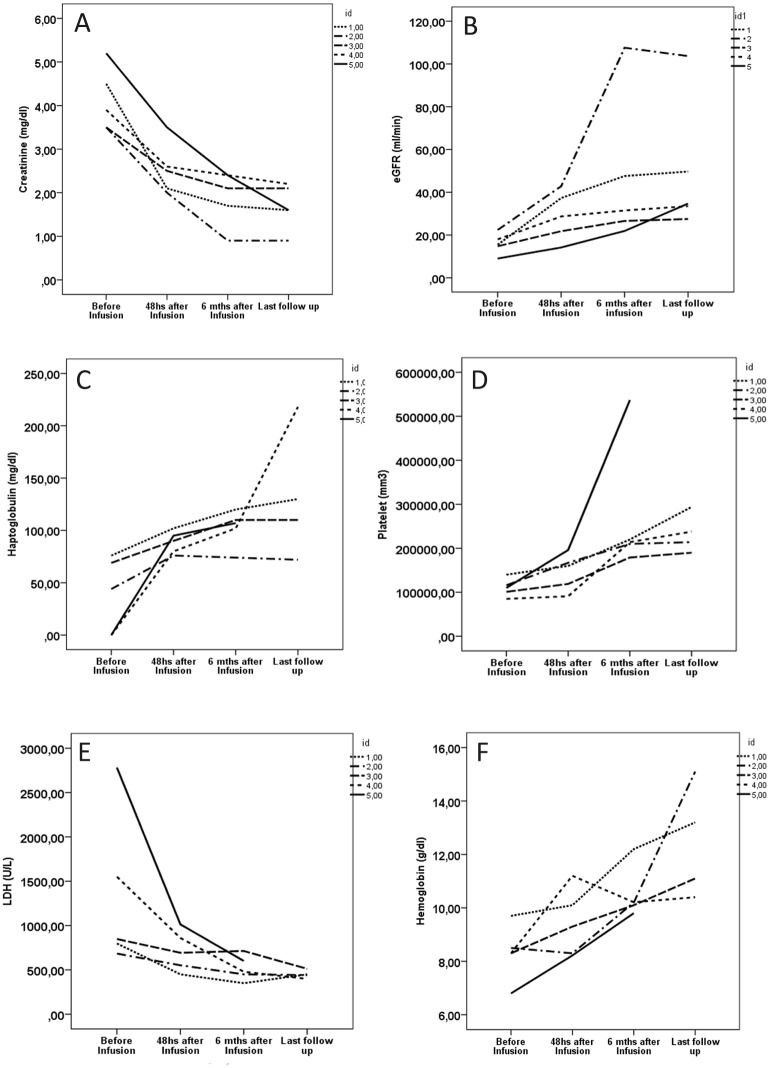
Seven cases were outlined: five of therapeutic use and two, prophylactic. From the five cases of therapeutic use, there was improvement of the thrombotic microangiopathy in the 48 hours following the start of the drug and no patient experienced relapse during an average follow-up of 21 months in the continuous use of eculizumab (minimum of 6 and maximum of 42 months). One patient died at 6 months, due to Aspergillus infection. From the two cases of prophylactic use, one patient experienced relapsed thrombotic microangiopathy after 4 months and another patient remained asymptomatic after 16 months of follow-up, both on chronic treatment.
The therapeutic use of eculizumab showed to be effective, with improvement of the microangiopathy parameters and persisting up to the end of the follow-up, without relapses. The additional risk of immunosuppression, leading to opportunistic infections, was well tolerated. The prophylactic use showed to be effective and safe; however, the doses and intervals should be individualized in order to avoid relapsed microangiopathy, especially in patients with factor H mutation.
非典型溶血尿毒综合征(aHUS)的首选治疗方法是使用单克隆抗体依库珠单抗。本研究的目的是评估依库珠单抗在一组患有aHUS的肾移植患者中的疗效和安全性。
描述所有移植后主要接受依库珠单抗治疗的患者的前瞻性队列,这些患者分为治疗组(移植后发生aHUS)和预防组(先前诊断为aHUS并接受肾移植的患者)。
概述了7例病例:5例为治疗组,2例为预防组。在治疗组的5例病例中,用药开始后48小时内血栓性微血管病有所改善,在持续使用依库珠单抗的平均21个月随访期内(最短6个月,最长42个月)无患者复发。1例患者在6个月时死于曲霉感染。在预防组的2例病例中,1例患者在4个月后复发性血栓性微血管病,另1例患者在随访16个月后无症状,均接受慢性治疗。
依库珠单抗的治疗用途显示有效,微血管病参数得到改善且持续至随访结束,无复发。免疫抑制导致机会性感染的额外风险耐受性良好。预防用途显示有效且安全;然而,剂量和间隔应个体化,以避免复发性微血管病,尤其是在有H因子突变的患者中。