Research Center of Avian Disease, College of Veterinary Medicine of Sichuan Agricultural University, Wenjiang District, Chengdu 611130, China.
Institute of Preventive Veterinary Medicine, Sichuan Agricultural University, Wenjiang District, Chengdu 611130, China.
Viruses. 2017 Nov 13;9(11):338. doi: 10.3390/v9110338.
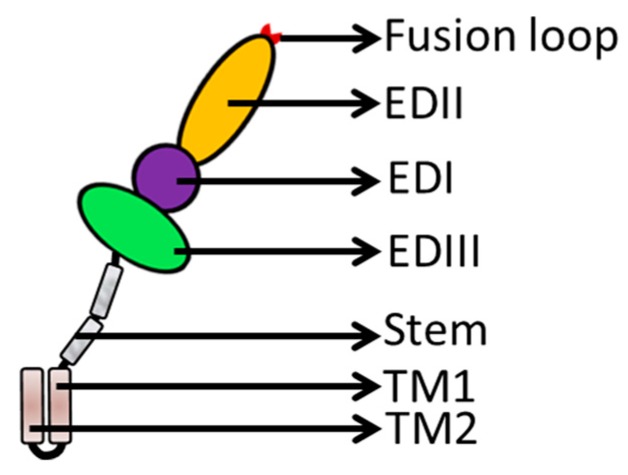
Flaviviruses are enveloped, single-stranded RNA viruses that widely infect many animal species. The envelope protein, a structural protein of flavivirus, plays an important role in host cell viral infections. It is composed of three separate structural envelope domains I, II, and III (EDI, EDII, and EDIII). EDI is a structurally central domain of the envelope protein which stabilizes the overall orientation of the protein, and the glycosylation sites in EDI are related to virus production, pH sensitivity, and neuroinvasiveness. EDII plays an important role in membrane fusion because of the immunodominance of the fusion loop epitope and the envelope dimer epitope. Additionally, EDIII is the major target of neutralization antibodies. The envelope protein is an important target for research to develop vaccine candidates and antiviral therapeutics. This review summarizes the structures and functions of ED I/II/III, and provides practical applications for the three domains, with the ultimate goal of implementing strategies to utilize the envelope protein against flavivirus infections, thus achieving better diagnostics and developing potential flavivirus therapeutics and vaccines.
黄病毒是一类包膜、单链 RNA 病毒,广泛感染多种动物物种。包膜蛋白是黄病毒的一种结构蛋白,在宿主细胞病毒感染中发挥重要作用。它由三个独立的结构包膜域 I、II 和 III(EDI、EDII 和 EDIII)组成。EDI 是包膜蛋白的结构中心域,稳定了蛋白质的整体取向,而 EDI 中的糖基化位点与病毒产生、pH 敏感性和神经侵袭性有关。EDII 在膜融合中起着重要作用,因为融合环表位和包膜二聚体表位的免疫优势。此外,EDIII 是中和抗体的主要靶标。包膜蛋白是研究开发疫苗候选物和抗病毒治疗药物的重要靶点。本综述总结了 EDI/II/III 的结构和功能,并提供了三个结构域的实际应用,最终目标是利用包膜蛋白对抗黄病毒感染,从而实现更好的诊断,并开发潜在的黄病毒治疗药物和疫苗。