Department of Plant & Microbial Biology, University of Minnesota Twin Cities, Saint Paul, MN, 55108, USA.
Department of Mathematics & Statistics, University of Minnesota Duluth, Duluth, MN, 55812, USA.
BMC Plant Biol. 2017 Nov 14;17(1):201. doi: 10.1186/s12870-017-1146-8.
Pennycress [Thlaspi arvense L (Brassicaceae)] is being domesticated as a renewable biodiesel feedstock that also provides crucial ecosystems services, including as a nutritional resource for pollinators. However, its flowers produce significantly less nectar than other crop relatives in the Brassicaceae. This study was undertaken to understand the basic biology of the pennycress nectary as an initial step toward the possibility of enhancing nectar output from its flowers.
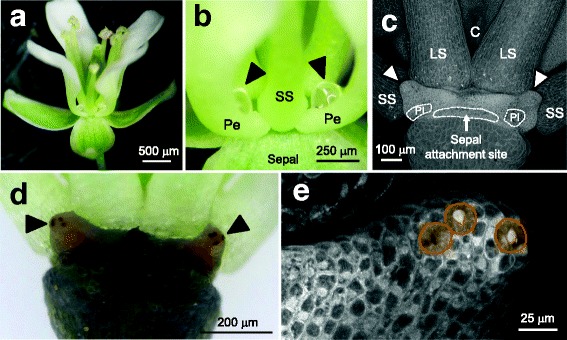
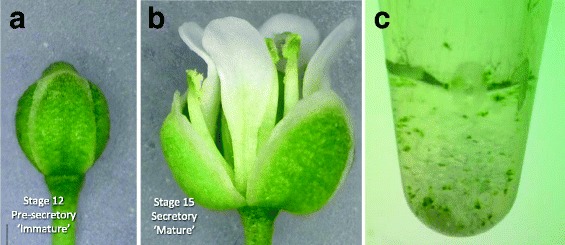
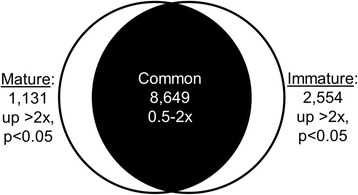
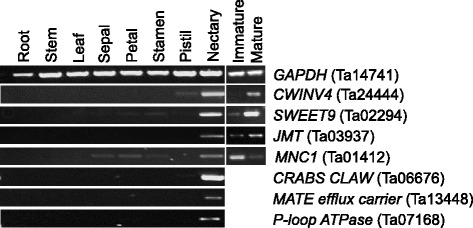
Pennycress flowers contain four equivalent nectaries located extrastaminally at the base of the insertion sites of short and long stamens. Like other Brassicaceae, the nectaries have open stomates on their surface, which likely serve as the sites of nectar secretion. The nectaries produce four distinct nectar droplets that accumulate in concave structures at the base of each of the four petals. To understand the molecular biology of the pennycress nectary, RNA was isolated from 'immature' (pre-secretory) and 'mature' (secretory) nectaries and subjected to RNA-seq. Approximately 184 M paired-end reads (368 M total reads) were de novo assembled into a total of 16,074 independent contigs, which mapped to 12,335 unique genes in the pennycress genome. Nearly 3700 genes were found to be differentially expressed between immature and mature nectaries and subjected to gene ontology and metabolic pathway analyses. Lastly, in silico analyses identified 158 pennycress orthologs to Arabidopsis genes with known enriched expression in nectaries. These nectary-enriched expression patterns were verified for select pennycress loci by semi-quantitative RT-PCR.
Pennycress nectaries are unique relative to those of other agriculturally important Brassicaceae, as they contain four equivalent nectaries that present their nectar in specialized cup-shaped structures at the base of the petals. In spite of these morphological differences, the genes underlying the regulation and production of nectar appear to be largely conserved between pennycress and Arabidopsis thaliana. These results provide a starting point for using forward and reverse genetics approaches to enhance nectar synthesis and secretion in pennycress.
菥蓂[菥蓂(Thlaspi arvense L)(十字花科)]正在被驯化成为一种可再生的生物柴油饲料,同时也提供了至关重要的生态系统服务,包括作为传粉媒介的营养资源。然而,它的花朵产生的花蜜量明显少于十字花科的其他作物近亲。本研究旨在了解菥蓂蜜腺的基本生物学,作为提高其花朵花蜜产量的可能性的初步步骤。
菥蓂花含有四个位于短和长雄蕊插入点基部的外部蜜腺。与其他十字花科植物一样,蜜腺表面有开放的气孔,这些气孔可能是花蜜分泌的部位。蜜腺产生四个独特的花蜜滴,在四个花瓣基部的凹形结构中积累。为了了解菥蓂蜜腺的分子生物学,从“未成熟”(分泌前)和“成熟”(分泌时)蜜腺中分离出 RNA,并进行 RNA-seq。大约 18400 万对末端读取(总计 36800 万对读取)从头组装成 16074 个独立的连续体,这些连续体映射到菥蓂基因组中的 12335 个独特基因。在未成熟和成熟蜜腺之间发现近 3700 个基因表达差异,并进行了基因本体和代谢途径分析。最后,在计算机分析中鉴定出 158 个菥蓂与拟南芥基因的同源物,这些基因在已知的花蜜腺中表达丰富。通过半定量 RT-PCR 验证了选择菥蓂基因座的这些花蜜腺富集表达模式。
菥蓂蜜腺与其他重要的农业十字花科植物的蜜腺相比是独特的,因为它们含有四个相等的蜜腺,在花瓣基部呈现出特殊的杯状结构分泌花蜜。尽管存在这些形态学差异,但调节和产生花蜜的基因在菥蓂和拟南芥之间似乎是高度保守的。这些结果为使用正向和反向遗传学方法来增强菥蓂花蜜的合成和分泌提供了一个起点。