Department and Institute of Physiology, School of Medicine, National Yang-Ming University, Taipei, Taiwan.
Department of Anesthesiology, Chi-Mei Medical Center, Tainan, Taiwan.
Neural Plast. 2017;2017:3467805. doi: 10.1155/2017/3467805. Epub 2017 Aug 24.
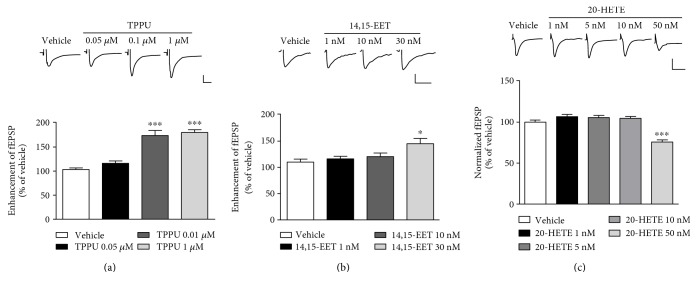
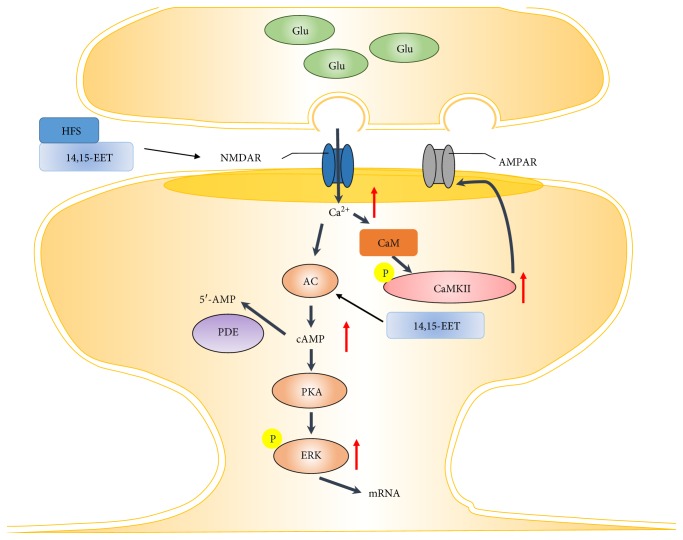
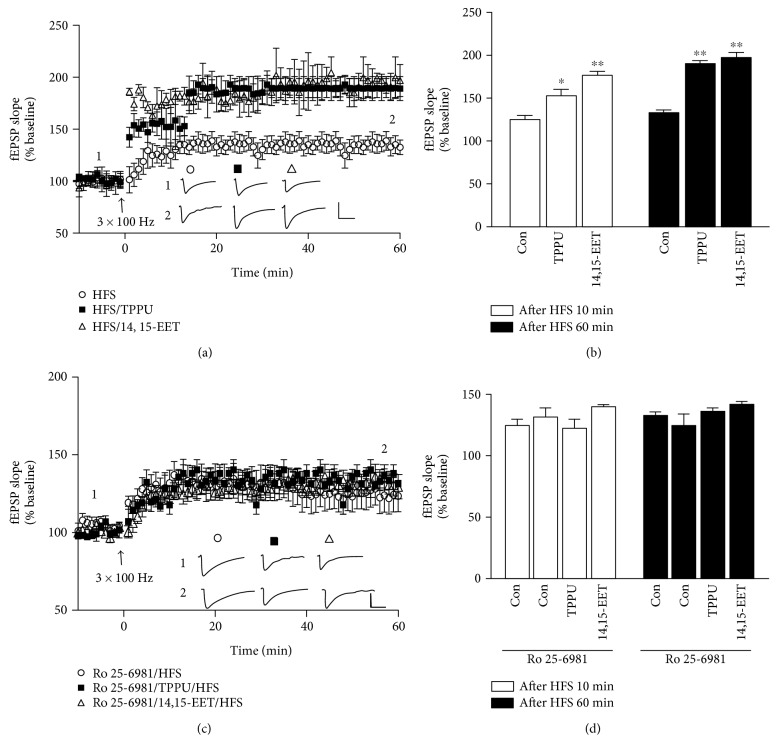
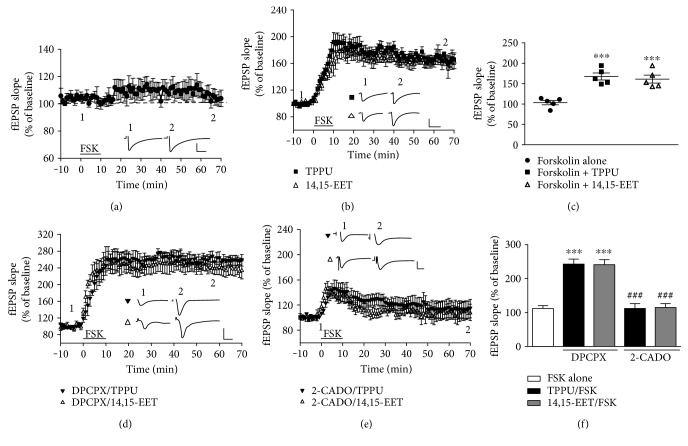
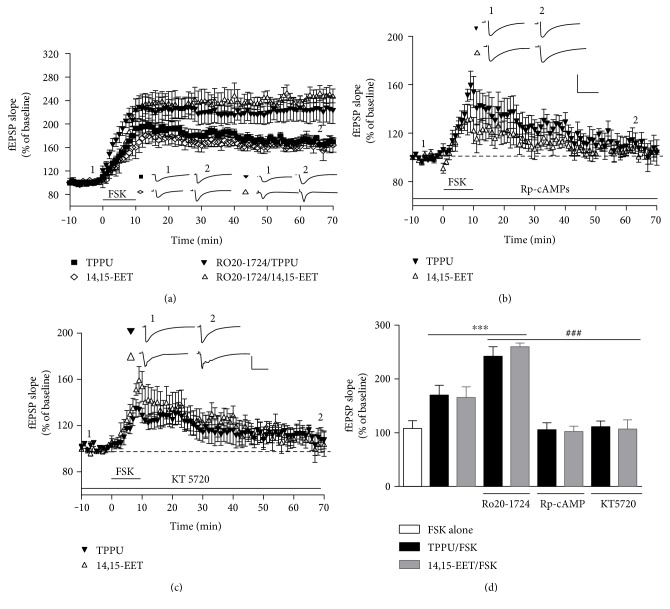
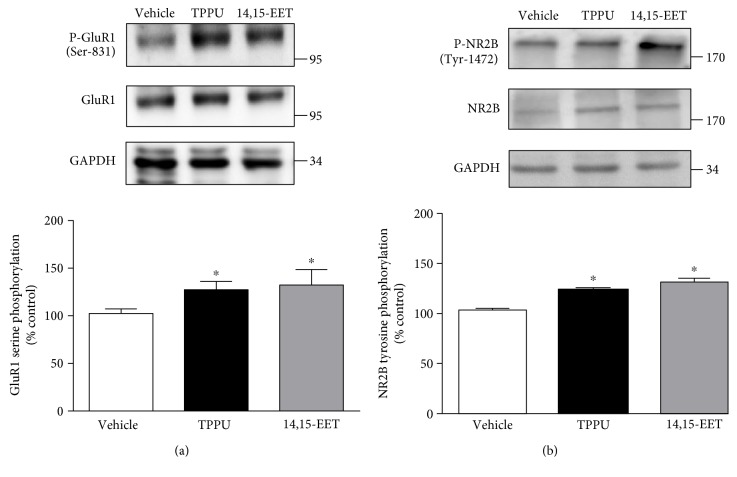
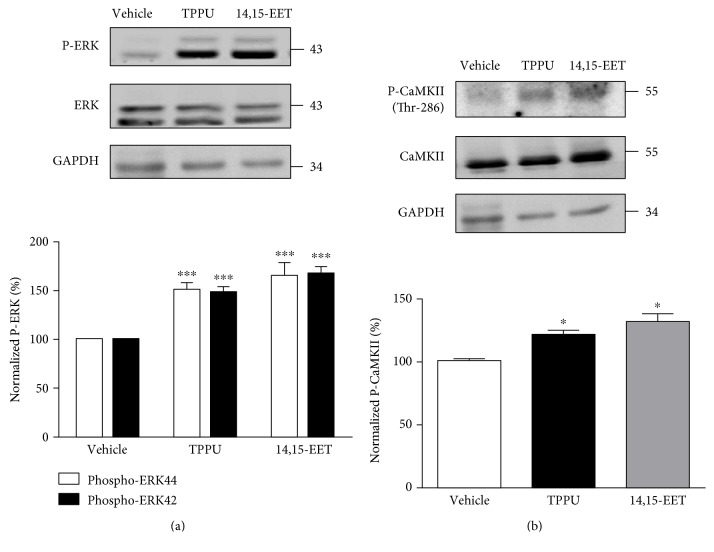
Epoxyeicosatrienoic acids (EETs) are derived from arachidonic acid and metabolized by soluble epoxide hydrolase (sEH). The role of EETs in synaptic function in the central nervous system is still largely unknown. We found that pharmacological inhibition of sEH to stabilize endogenous EETs and exogenous 14,15-EET significantly increased the field excitatory postsynaptic potential (fEPSP) response in the CA1 area of the hippocampus, while additionally enhancing high-frequency stimulation- (HFS-) induced long-term potentiation (LTP) and forskolin- (FSK-) induced LTP. sEH inhibitor (sEHI) N-[1-(oxopropyl)-4-piperidinyl]-N'-[4-(trifluoromethoxy) phenyl)-urea (TPPU) and exogenous 14,15-EET increased HFS-LTP, which could be blocked by an N-methyl-D-aspartate (NMDA) receptor subunit NR2B antagonist. TPPU- or 14,15-EET-facilitated FSK-mediated LTP can be potentiated by an A1 adenosine receptor antagonist and a phosphodiesterase inhibitor, but is prevented by a cAMP-dependent protein kinase (PKA) inhibitor. sEHI and 14,15-EET upregulated the activation of extracellular signal-regulated kinases (ERKs) and Ca2+/calmodulin- (CaM-) dependent protein kinase II (CaMKII). Phosphorylation of synaptic receptors NR2B and -amino-3-hydroxy-5-methyl-4-isoxazolepropionic acid (AMPA) receptor subunit GluR1 was increased by TPPU and 14,15-EET administration. These results indicated that EETs increased NMDAR- and FSK-mediated synaptic potentiation via the AC-cAMP-PKA signaling cascade and upregulated the ERKs and CaMKII, resulting in increased phosphorylation of NR2B and GluR1 in the hippocampus.
环氧二十碳三烯酸 (EETs) 来源于花生四烯酸,并由可溶性环氧化物水解酶 (sEH) 代谢。EETs 在中枢神经系统中的突触功能中的作用在很大程度上仍然未知。我们发现,药理学抑制 sEH 以稳定内源性 EETs 和外源性 14,15-EET 显著增加了海马 CA1 区的场兴奋性突触后电位 (fEPSP) 反应,同时增强了高频刺激- (HFS-) 诱导的长时程增强 (LTP) 和 forskolin- (FSK-) 诱导的 LTP。sEH 抑制剂 (sEHI) N-[1-(氧丙基)-4-哌啶基]-N'-[4-(三氟甲氧基)苯基]-脲 (TPPU) 和外源性 14,15-EET 增加了 HFS-LTP,这可以被 N-甲基-D-天冬氨酸 (NMDA) 受体亚基 NR2B 拮抗剂阻断。TPPU 或 14,15-EET 促进的 FSK 介导的 LTP 可以被 A1 腺苷受体拮抗剂和磷酸二酯酶抑制剂增强,但被 cAMP 依赖性蛋白激酶 (PKA) 抑制剂阻止。sEHI 和 14,15-EET 上调了细胞外信号调节激酶 (ERKs) 和钙/钙调蛋白- (CaM-) 依赖性蛋白激酶 II (CaMKII) 的激活。TPPU 和 14,15-EET 给药增加了突触受体 NR2B 和 -氨基-3-羟基-5-甲基-4-异恶唑丙酸 (AMPA) 受体亚基 GluR1 的磷酸化。这些结果表明,EETs 通过 AC-cAMP-PKA 信号级联增加了 NMDA 受体和 FSK 介导的突触增强,并上调了 ERKs 和 CaMKII,导致海马中 NR2B 和 GluR1 的磷酸化增加。