Department of Pediatrics, University of Connecticut School of Medicine, Connecticut Children's Medical Center, Hartford, CT.
Department of Pediatrics, University of Tennessee Health Science Center, Memphis, TN.
Pediatr Emerg Care. 2020 Sep;36(9):e513-e526. doi: 10.1097/PEC.0000000000001354.
Sustained neuronal activity during seizures causes cellular perturbations, alterations in cerebral physiology, and potentially neurological injury, a neurological emergency. With variable clinical manifestations of seizures, frequent failure of seizure recognition by providers in pediatric and developmentally challenged patients can increase seizure complications. Neuroresuscitation should include rapid cerebral physiology assessment for increased seizure recognition and optimal neurological outcomes. In neurological emergencies, cerebral oximetry has demonstrated its utility in altered cerebral physiology and a standard combat neurological assessment tool. During adult seizures, cerebral oximetry (regional cerebral oxygen saturation [rcSO2]) has been shown as a useful neurological assessment tool, but research is lacking in pediatric emergency department (PED) seizure patients.
The aim of this study was to identify trends in rcSO2 readings for patients presenting to the PED with seizure activity and in the postseizure state in order to evaluate usefulness of rcSO2 as a neurological assessment tool in pediatric seizure patients.
This was a PED observational case series comparing hemispheric rcSO2 readings in first-time clinically evident generalized and focal seizure patients to first-time postseizure patients with no PED seizures.
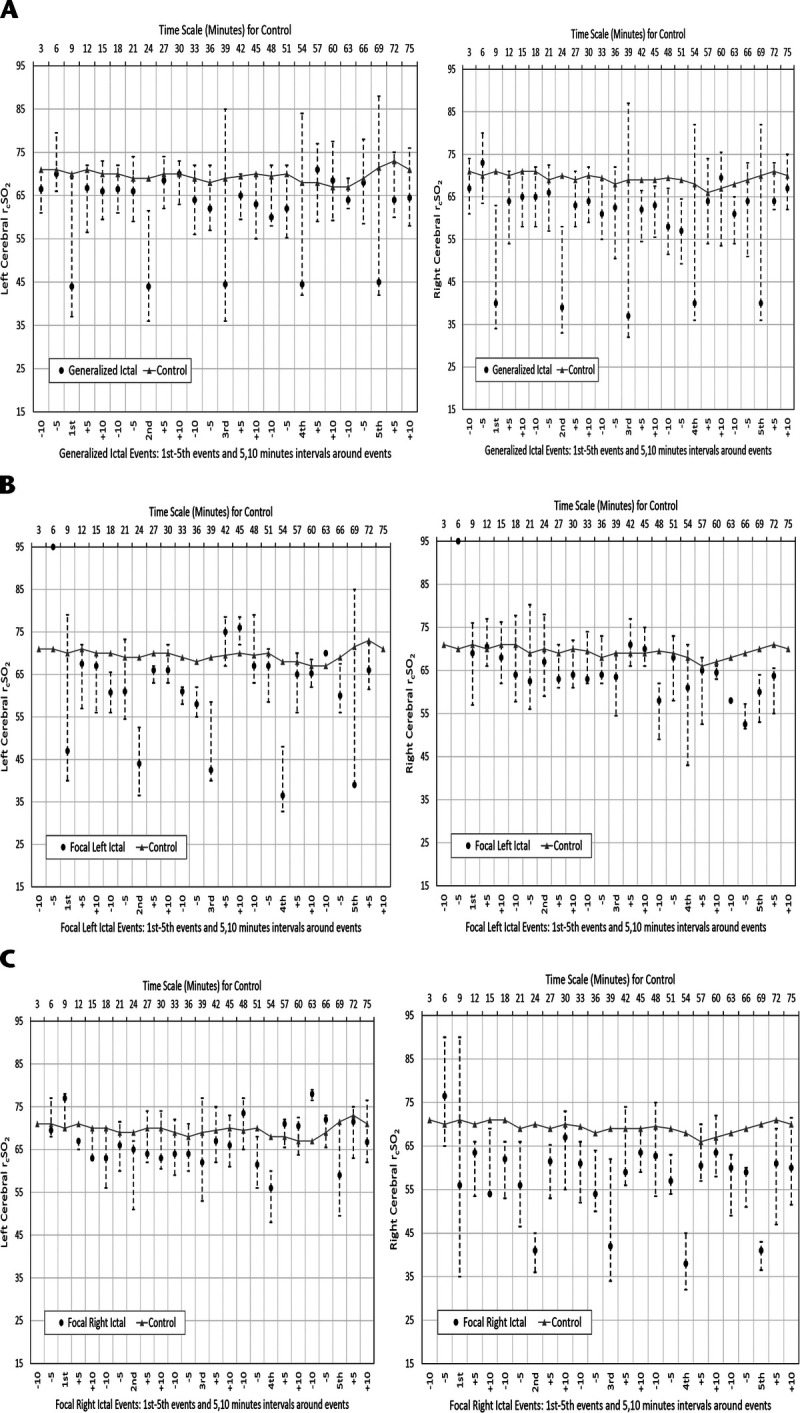
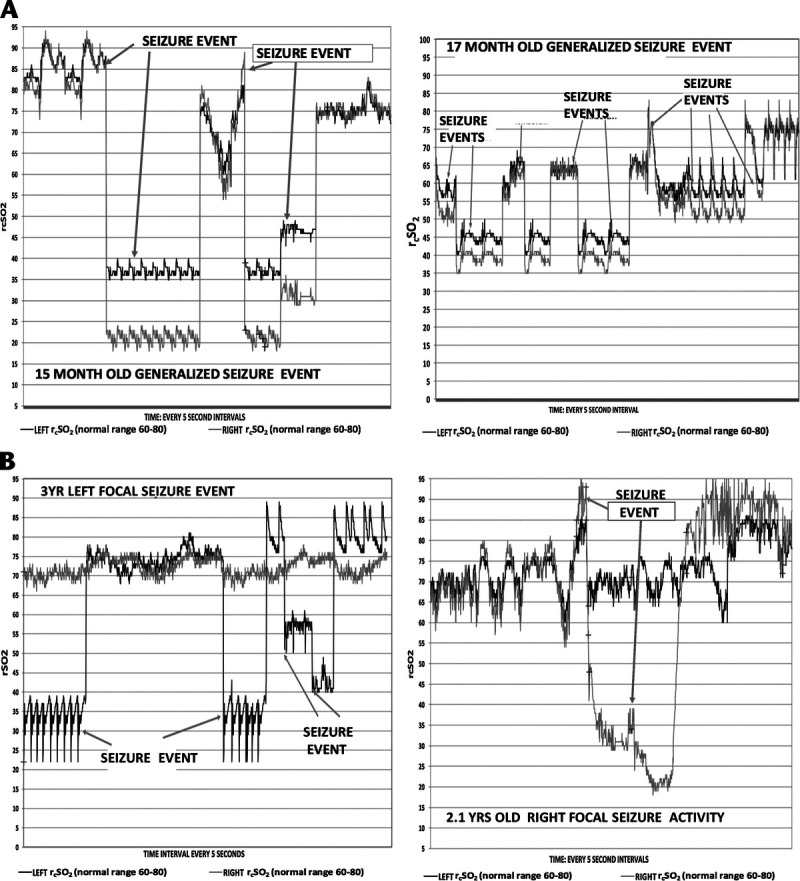
Generalized or focal seizure (n = 185) hemispheric rcSO2 revealed significant differences compared with nonseizure and controls' rcSO2 readings (n = 115) (P < 0.0001). Generalized and focal seizure rcSO2's were either less than 60% or greater than 80% compared with nonseizure rcSO2 (P < 0.0001). Ipsilateral focal seizure rcSO2 correlated to seizure side (P < 0.0001) and was less than the contralateral rcSO2 (P < 0.0001), with interhemispheric rcSO2 discordance greater than 16 (P < 0.0001). Seizure to preseizure rcSO2 discordance was as follows: generalized 15.2, focal: left 19.8, right 20.3 (P < 0.0001).
Hemispheric during-seizure rcSO2 readings significantly correlated with generalized and focal seizures and reflected altered cerebral physiology. Ipsilateral focal seizure rcSO2 readings correlated to the focal side with wide interhemispheric rcSO2 discordance. All postseizure rcSO2 readings returned to preseizure readings, showing altered cerebral physiology resolution. Overall, in generalized or focal seizure, rcSO2 readings were less than 60% or greater than 80%, and in focal seizure, interhemispheric rcSO2 discordance was greater than 10. During seizures, hemispheric rcSO2 readings demonstrated its potential pediatric seizure utility. Utilizing rcSO2 readings related to seizure activity could expedite pediatric and developmentally challenged patients' seizure recognition, cerebral assessment, and interventions especially in pharmacoresistant seizures.
癫痫发作期间持续的神经元活动会导致细胞扰动、大脑生理学改变,并可能导致神经损伤,即神经急症。由于癫痫发作的临床表现多种多样,儿科和发育障碍患者的提供者经常无法识别癫痫发作,这可能会增加癫痫发作的并发症。神经复苏应包括快速进行大脑生理学评估,以提高对癫痫发作的识别能力和实现最佳神经学结局。在神经急症中,脑氧饱和度已证明其在改变的大脑生理学和标准的战斗神经评估工具方面的效用。在成人癫痫发作中,脑氧饱和度(区域性脑氧饱和度 [rcSO2])已被证明是一种有用的神经学评估工具,但在儿科急诊科(PED)癫痫发作患者中缺乏相关研究。
本研究旨在确定在出现癫痫发作和癫痫发作后状态的 PED 就诊患者中,rcSO2 读数的趋势,以评估 rcSO2 作为儿科癫痫发作患者神经学评估工具的有用性。
这是一项 PED 观察性病例系列研究,比较了首次出现临床明显的全身性和局灶性癫痫发作患者与无 PED 癫痫发作的首次癫痫发作后患者的半球性 rcSO2 读数。
全身性或局灶性癫痫发作(n=185)的半球性 rcSO2 与非癫痫发作和对照组的 rcSO2 读数(n=115)相比,存在显著差异(P<0.0001)。与非癫痫发作的 rcSO2 相比,全身性和局灶性癫痫发作的 rcSO2 要么低于 60%,要么高于 80%(P<0.0001)。同侧局灶性癫痫发作的 rcSO2 与癫痫发作侧相关(P<0.0001),且低于对侧 rcSO2(P<0.0001),半球间 rcSO2 差异大于 16(P<0.0001)。癫痫发作与癫痫发作前的 rcSO2 差异如下:全身性为 15.2,局灶性:左侧为 19.8,右侧为 20.3(P<0.0001)。
发作期间的半球性 rcSO2 读数与全身性和局灶性癫痫发作显著相关,反映了大脑生理学的改变。同侧局灶性癫痫发作的 rcSO2 读数与局灶侧相关,且半球间 rcSO2 差异较大。所有癫痫发作后的 rcSO2 读数均恢复到癫痫发作前的读数,表明大脑生理学的改变得到了缓解。总体而言,在全身性或局灶性癫痫发作中,rcSO2 读数低于 60%或高于 80%,而在局灶性癫痫发作中,半球间 rcSO2 差异大于 10。在癫痫发作期间,半球性 rcSO2 读数显示出其在儿科癫痫中的潜在应用。利用与癫痫发作活动相关的 rcSO2 读数可以加快儿科和发育障碍患者对癫痫发作的识别、大脑评估和干预,尤其是在抗癫痫药物治疗耐药性癫痫发作的情况下。