Ortiz Angela B, Garcia Diego, Vicente Yolanda, Palka Magda, Bellas Carmen, Martin Paloma
Pathology Department, Instituto de Investigación Sanitaria Puerta de Hierro-Majadahonda (IDIPHIM) Majadahonda, Madrid, Spain.
Medical Oncology Department, Instituto de Investigación Sanitaria Puerta de Hierro-Majadahonda (IDIPHIM) Majadahonda, Madrid, Spain.
PLoS One. 2017 Nov 15;12(11):e0188068. doi: 10.1371/journal.pone.0188068. eCollection 2017.
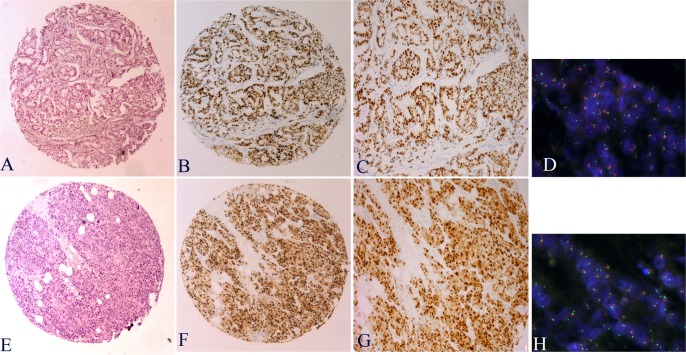
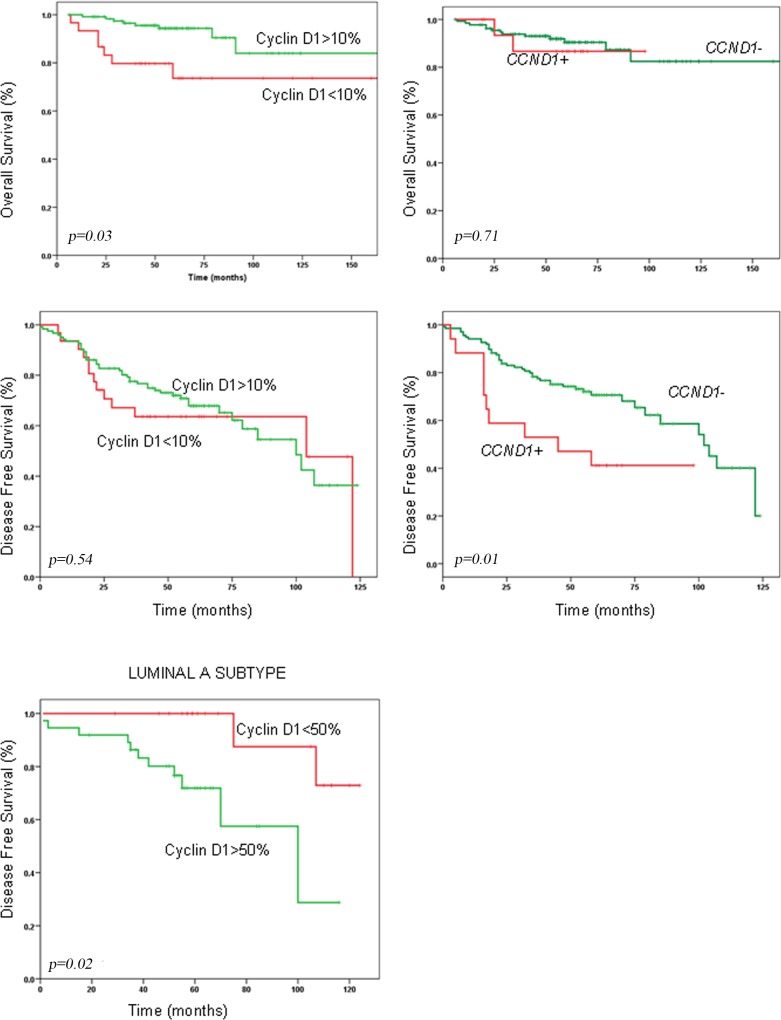
The oncogenic capacity of cyclin D1 has long been established in breast cancer. CCND1 amplification has been identified in a subset of patients with poor prognosis, but there are conflicting data regarding the predictive value of cyclin D1 protein overexpression. This study was designed to analyze the expression of cyclin D1 and its correlation with CCND1 amplification and their prognostic implications in invasive breast cancer. By using the tissue microarray technique, we performed an immunohistochemical study of ER, PR, HER2, p53, cyclin D1, Ki67 and p16 in 179 invasive breast carcinoma cases. The FISH method was performed to detect HER2/Neu and CCND1 amplification. High cyclin D1 expression was identified in 94/179 (52%) of invasive breast cancers. Cyclin D1 overexpression and CCND1 amplification were significantly associated (p = 0.010). Overexpression of cyclin D1 correlated with ER expression, PR expression and Luminal subtypes (p<0.001), with a favorable impact on overall survival in the whole series. However, in the Luminal A group, high expression of cyclin D1 correlated with shorter disease-free survival, suggesting that the prognostic role of cyclin D1 depends on the molecular subtype. CCND1 gene amplification was detected in 17 cases (9%) and correlated significantly with high tumor grade (p = 0.038), high Ki-67 protein expression (p = 0.002), and the Luminal B subtype (p = 0.002). Patients with tumors with high amplification of CCND1 had an increased risk of recurrence (HR = 2.5; 95% CI, 1.2-4.9, p = 0.01). These findings suggest that CCND1 amplification could be useful for predicting recurrence in invasive breast cancer.
细胞周期蛋白D1的致癌能力在乳腺癌中早已得到证实。在一部分预后不良的患者中已发现CCND1基因扩增,但关于细胞周期蛋白D1蛋白过表达的预测价值,数据存在矛盾。本研究旨在分析细胞周期蛋白D1的表达及其与CCND1基因扩增的相关性,以及它们在浸润性乳腺癌中的预后意义。通过组织芯片技术,我们对179例浸润性乳腺癌病例进行了雌激素受体(ER)、孕激素受体(PR)、人表皮生长因子受体2(HER2)、p53、细胞周期蛋白D1、Ki67和p16的免疫组化研究。采用荧光原位杂交(FISH)方法检测HER2/Neu和CCND1基因扩增。在179例浸润性乳腺癌中,94例(52%)检测到细胞周期蛋白D1高表达。细胞周期蛋白D1过表达与CCND1基因扩增显著相关(p = 0.010)。细胞周期蛋白D1过表达与ER表达、PR表达及Luminal亚型相关(p<0.001),对整个队列的总生存期有有利影响。然而,在Luminal A组中,细胞周期蛋白D1高表达与无病生存期缩短相关,提示细胞周期蛋白D1的预后作用取决于分子亚型。17例(9%)检测到CCND1基因扩增,其与高肿瘤分级(p = 0.038)、高Ki-67蛋白表达(p = 0.002)及Luminal B亚型显著相关(p = 0.002)。CCND1基因高度扩增的肿瘤患者复发风险增加(风险比=2.5;95%可信区间,1.2 - 4.9,p = 0.01)。这些发现提示CCND1基因扩增可能有助于预测浸润性乳腺癌的复发。