Tsuang Fon-Yih, Hsieh Yueh-Ying, Kuo Yi-Jie, Chen Chia-Hsien, Lin Feng-Huei, Chen Chen-Sheng, Chiang Chang-Jung
Institute of Biomedical Engineering, National Taiwan University, Taipei City, Taiwan.
Division of Neurosurgery, Department of Surgery, National Taiwan University Hospital, Taipei City, Taiwan.
PLoS One. 2017 Nov 16;12(11):e0188034. doi: 10.1371/journal.pone.0188034. eCollection 2017.
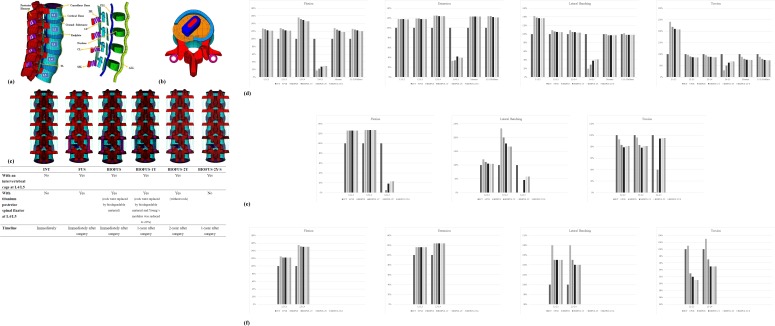
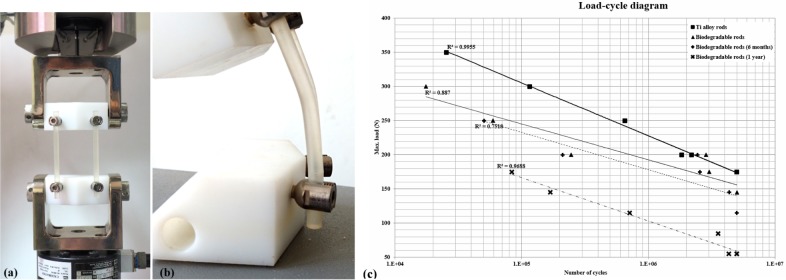
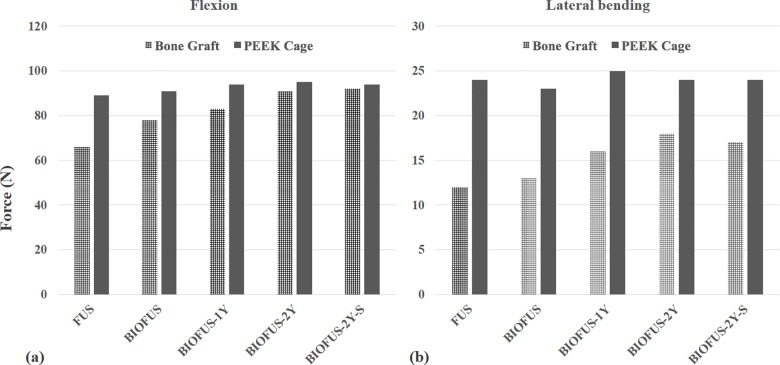
Interbody fusion with posterior instrumentation is a common method for treating lumbar degenerative disc diseases. However, the high rigidity of the fusion construct may produce abnormal stresses at the adjacent segment and lead to adjacent segment degeneration (ASD). As such, biodegradable implants are becoming more popular for use in orthopaedic surgery. These implants offer sufficient stability for fusion but at a reduced stiffness. Tailored to degrade over a specific timeframe, biodegradable implants could potentially mitigate the drawbacks of conventional stiff constructs and reduce the loading on adjacent segments. Six finite element models were developed in this study to simulate a spine with and without fixators. The spinal fixators used both titanium rods and biodegradable rods. The models were subjected to axial loading and pure moments. The range of motion (ROM), disc stresses, and contact forces of facet joints at adjacent segments were recorded. A 3-point bending test was performed on the biodegradable rods and a dynamic bending test was performed on the spinal fixators according to ASTM F1717-11a. The finite element simulation showed that lumbar spinal fusion using biodegradable implants had a similar ROM at the fusion level as at adjacent levels. As the rods degraded over time, this produced a decrease in the contact force at adjacent facet joints, less stress in the adjacent disc and greater loading on the anterior bone graft region. The mechanical tests showed the initial average fatigue strength of the biodegradable rods was 145 N, but this decreased to 115N and 55N after 6 months and 12 months of soaking in solution. Also, both the spinal fixator with biodegradable rods and with titanium rods was strong enough to withstand 5,000,000 dynamic compression cycles under a 145 N axial load. The results of this study demonstrated that biodegradable rods may present more favourable clinical outcomes for lumbar fusion. These polymer rods could not only provide sufficient initial stability, but the loss in rigidity of the fixation construct over time gradually transfers loading to adjacent segments.
椎间融合联合后路内固定是治疗腰椎间盘退变疾病的常用方法。然而,融合结构的高刚度可能在相邻节段产生异常应力并导致相邻节段退变(ASD)。因此,可生物降解植入物在骨科手术中的应用越来越广泛。这些植入物为融合提供了足够的稳定性,但刚度降低。可生物降解植入物经定制可在特定时间内降解,有可能减轻传统刚性结构的缺点并减少相邻节段的负荷。本研究建立了六个有限元模型,以模拟有无固定器的脊柱。脊柱固定器使用钛棒和可生物降解棒。对模型施加轴向载荷和纯弯矩。记录相邻节段的活动度(ROM)、椎间盘应力和小关节接触力。根据ASTM F1717-11a对可生物降解棒进行三点弯曲试验,对脊柱固定器进行动态弯曲试验。有限元模拟表明,使用可生物降解植入物的腰椎融合在融合节段的ROM与相邻节段相似。随着棒材随时间降解,相邻小关节的接触力降低,相邻椎间盘的应力减小,前路骨移植区域的负荷增加。力学试验表明,可生物降解棒的初始平均疲劳强度为145 N,但在溶液中浸泡6个月和12个月后分别降至115 N和55 N。此外,使用可生物降解棒和钛棒的脊柱固定器都足够坚固,能够在145 N轴向载荷下承受500万个动态压缩循环。本研究结果表明,可生物降解棒可能为腰椎融合带来更有利的临床结果。这些聚合物棒不仅能提供足够的初始稳定性,而且固定结构随时间的刚度损失会逐渐将负荷转移到相邻节段。