
儿童铁干预措施的益处与风险(BRISC):孟加拉国一项三臂平行组随机对照现场试验方案
Benefits and risks of Iron interventions in children (BRISC): protocol for a three-arm parallel-group randomised controlled field trial in Bangladesh.
作者信息
Hasan Mohammed Imrul, Hossain Sheikh Jamal, Braat Sabine, Dibley Michael John, Fisher Jane, Grantham-McGregor Sally, Tofail Fahmida, Simpson Julie A, Arifeen Shams Ei, Hamadani Jena, Biggs Beverley-Ann, Pasricha Sant-Rayn
机构信息
Maternal and Child Health Division, International Centre for Diarrhoeal Disease Research, Dhaka, Bangladesh.
Centre for Epidemiology and Biostatistics, Melbourne School of Population and Global Health and Melbourne Clinical and Translational Sciences (MCATS), University of Melbourne, Melbourne, Australia.
出版信息
BMJ Open. 2017 Nov 15;7(11):e018325. doi: 10.1136/bmjopen-2017-018325.
INTRODUCTION
Anaemia is a major global health problem affecting about 43% of preschool children globally and 60% of 6-24-month-old children in rural Bangladesh, half of which is attributed to iron deficiency (ID). Although WHO recommends universal supplementation with iron or home fortification with iron-containing multiple micronutrient powders (MMPs) to children under 2 years, evidence for benefits of these interventions on childhood development (a key rationale for these interventions) and harms (especially infection) remains limited. This study aims to evaluate the impact of iron or MMPs supplementation compared with placebo on (a) children's development, (b) growth, (c) morbidity from infections and (d) haematological and iron indices.
METHODS AND ANALYSIS
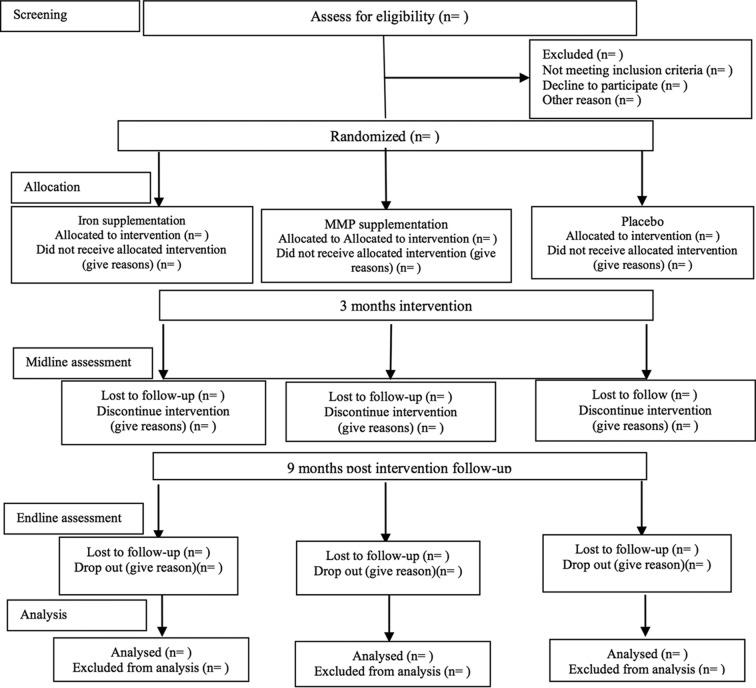
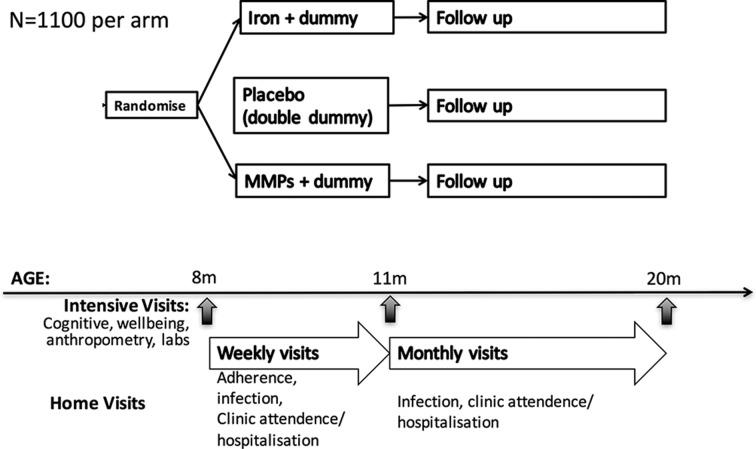
This study is a three-arm, blinded, double-dummy, parallel-group, placebo-controlled superiority trial using stratified individual block randomisation. The trial will randomise 3300 children aged 8-9 months equally to arm 1: iron syrup (12.5 mg elemental iron), placebo MMPs; arm 2: MMPs (including 12.5 mg elemental iron), placebo syrup; and arm 3: placebo syrup, placebo MNPs. Children will receive interventions for 3 months based on WHO recommendations and then be followed up for 9 months post intervention. The primary outcome is cognitive composite score measured by Bayley III. Secondary outcomes include motor and language composite score by Bayley III, behaviour rating using selected items from Wolke's rating scales and BSID-II behaviour ratings, temperament, growth, haemoglobin, anaemia and iron status, and infectious morbidity. Outcomes will be measured at baseline, at the end of 3-month intervention and after 9 months postintervention follow-up.
ETHICS AND DISSEMINATION
The trial has been approved by the Ethical Review Committee of icddr,b (Dhaka, Bangladesh) and the Melbourne Health Human Research Ethics Committee (Melbourne, Australia). Results of the study will be disseminated through scientific publications, presentations at international meetings and policy briefs to key stakeholders.
TRIAL REGISTRATION NUMBER
ACTRN12617000660381;Pre-results.
WHO UNIVERSAL TRIAL NUMBER
U1111-1196-1125.
引言
贫血是一个重大的全球健康问题,全球约43%的学龄前儿童受其影响,在孟加拉国农村地区,60%的6至24个月大儿童受影响,其中一半归因于缺铁(ID)。尽管世界卫生组织建议对2岁以下儿童普遍补充铁剂或采用含铁多种微量营养素粉(MMPs)进行家庭强化,但这些干预措施对儿童发育(这些干预措施的一个关键基本原理)和危害(尤其是感染)的益处证据仍然有限。本研究旨在评估补充铁剂或MMPs与安慰剂相比对(a)儿童发育、(b)生长、(c)感染发病率以及(d)血液学和铁指标的影响。
方法与分析
本研究是一项三臂、盲法、双模拟、平行组、安慰剂对照的优效性试验,采用分层个体区组随机化。该试验将把3300名8至9个月大的儿童平均随机分为三组:第一组:铁糖浆(12.5毫克元素铁),安慰剂MMPs;第二组:MMPs(包括12.5毫克元素铁),安慰剂糖浆;第三组:安慰剂糖浆,安慰剂MMPs。儿童将根据世界卫生组织的建议接受3个月的干预,然后在干预后进行9个月的随访。主要结局是用贝利婴幼儿发展量表第三版(Bayley III)测量的认知综合得分。次要结局包括贝利婴幼儿发展量表第三版的运动和语言综合得分、使用沃尔克评定量表的选定项目和BSID-II行为评定进行的行为评分、气质、生长、血红蛋白、贫血和铁状态以及感染发病率。结局将在基线、3个月干预结束时和干预后9个月随访时进行测量。
伦理与传播
该试验已获得孟加拉国腹泻病研究国际中心(icddr,b,达卡)伦理审查委员会和澳大利亚墨尔本健康人类研究伦理委员会(墨尔本)的批准。研究结果将通过科学出版物、在国际会议上的报告以及向主要利益相关者提供政策简报的方式进行传播。
试验注册号
ACTRN12617000660381;预结果。
世界卫生组织通用试验编号
U1111-1196-1125。
 Zotero 插件