Maternal and Child Health Division (MCHD), Internationational Centre for Diarrhoeal Disease Research, Bangladesh (icddr,b), Mohakhali, Dhaka, 1212, Bangladesh.
BMC Psychol. 2019 Mar 5;7(1):13. doi: 10.1186/s40359-019-0289-9.
There is sufficient evidence that psychosocial stimulation (PS) benefits children's neurocognitive behavior, however, there is no information on how it works when delivered through an Unconditional Cash Transfer (UCT) platform for poor rural population in developing countries. The objective of this study is to measure effects of adding PS for children of lactating mothers enrolled to receive UCT with health education (HE) on neurocognitive behavior of children in rural Bangladesh.
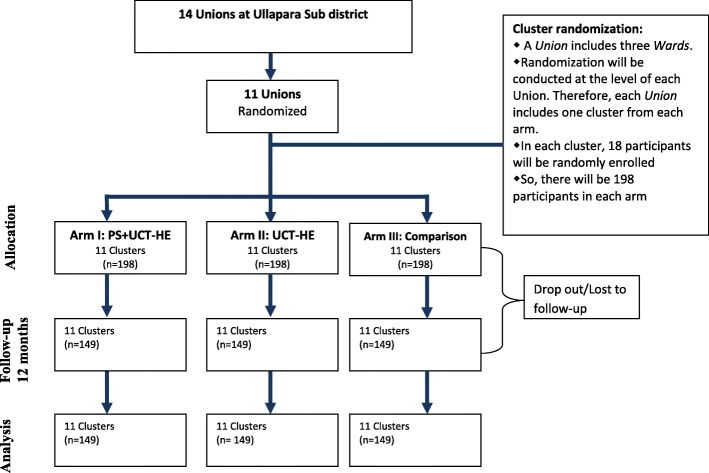
The study will be conducted at 11 unions of Ullapara sub-district in Bangladesh. The study is a cluster randomized controlled trial with three-arms; (i) PS and UCT with HE (ii) UCT with HE and iii) Comparison arm. The cluster will be considered as an old Ward of a Union, the lowest tier of local government system in rural Bangladesh. There are three old Wards in a union. These three clusters will be randomized to one of the three arms. Similarly, randomization will be done for each 11 Unions and then 11 clusters will be assigned to an arm. Eighteen participants will be recruited from each cluster randomly (n = 196 in each arm). The intervention designed for one year includes UCT with HE for the poor as a safety net program in rural Bangladesh with or without PS. An age-based curriculum of PS is already available for Bangladeshi children and this will be administered by trained local women; play leaders (PL) in intervention clusters. The government of Bangladesh is providing UCT of taka 500 ($6.25) as maternity allowance per month with HE. The primary outcomes will be cognitive, motor and language composite scores measured by Bayley-III and behavior using Wolke's behavior rating scale. The secondary outcomes will be children and mothers' growth, family food security status, health seeking behavior, mothers' depressive symptoms and self-esteem and violence against mothers.
The study will provide a unique opportunity to assess an integrated early childhood development intervention using UCT platform to mitigate developmental delays in poor vulnerable children of rural Bangladesh.
ClinicalTrials.gov NCT03281980, registered on September 13, 2017.
有充分的证据表明,心理社会刺激(PS)有益于儿童的神经认知行为,但对于如何通过发展中国家贫困农村地区的无条件现金转移(UCT)平台来实现这一目标,尚无信息。本研究的目的是衡量为接受 UCT 加健康教育(HE)的哺乳期母亲的子女提供 PS 对孟加拉国农村儿童神经认知行为的影响。
该研究将在孟加拉国 Ullapara 分区的 11 个联盟中进行。这是一项三臂的集群随机对照试验;(一)PS 和 UCT 加 HE(二)UCT 加 HE 和(三)对照臂。集群将被视为联盟的旧病房,这是孟加拉国农村地区基层政府系统的最低级别。一个联盟有三个旧病房。这三个集群将被随机分配到三个臂之一。同样,将对每个 11 个联盟进行随机化,然后将 11 个集群分配到一个臂。每个集群将随机招募 18 名参与者(每个臂 196 名)。为期一年的干预措施包括为孟加拉国穷人提供 UCT 加 HE 作为农村地区的安全网计划,无论是否进行 PS。已经为孟加拉国儿童制定了基于年龄的 PS 课程,将由经过培训的当地妇女;干预集群中的游戏领导者(PL)来管理。孟加拉国政府每月提供 500 塔卡(6.25 美元)的 UCT 作为产妇津贴,并提供健康教育。主要结果将是通过贝利三世测量的认知、运动和语言综合评分以及沃尔克行为评定量表测量的行为。次要结果将是儿童和母亲的生长、家庭粮食安全状况、寻求医疗行为、母亲的抑郁症状和自尊以及对母亲的暴力行为。
该研究将提供一个独特的机会,评估使用 UCT 平台的综合儿童早期发展干预措施,以减轻孟加拉国农村贫困脆弱儿童的发育迟缓。
ClinicalTrials.gov NCT03281980,于 2017 年 9 月 13 日注册。