Endocrinology and Metabolism, Clinical Center Stella Maris, Strada Rovereta, 42-47891 Falciano, San Marino.
School of Medicine and Surgery, University of Milano-Bicocca via Cadore, 48-20900 Monza Brianza, Italy.
Int J Mol Sci. 2017 Nov 17;18(11):2441. doi: 10.3390/ijms18112441.
Human neurodegenerative diseases increase progressively with age and present a high social and economic burden. Growth hormone (GH) and insulin-like growth factor-1 (IGF-1) are both growth factors exerting trophic effects on neuronal regeneration in the central nervous system (CNS) and peripheral nervous system (PNS). GH and IGF-1 stimulate protein synthesis in neurons, glia, oligodendrocytes, and Schwann cells, and favor neuronal survival, inhibiting apoptosis. This study aims to evaluate the effect of GH and IGF-1 on neurons, and their possible therapeutic clinical applications on neuron regeneration in human subjects.
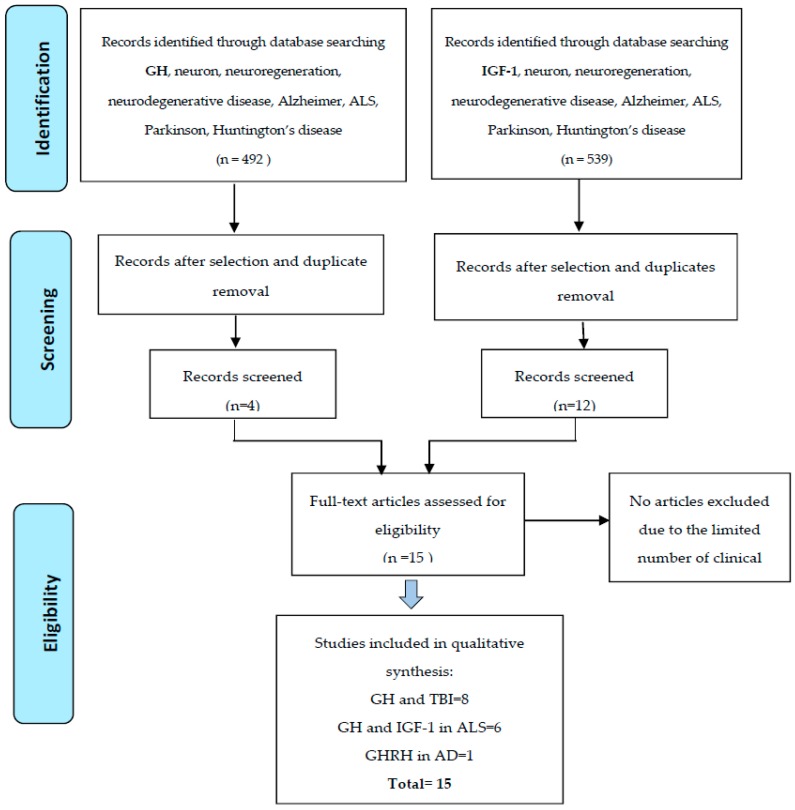
In the literature, we searched the clinical trials and followed up studies in humans, which have evaluated the effect of GH/IGF-1 on CNS and PNS. The following keywords have been used: "GH/IGF-1" associated with "neuroregeneration", "amyotrophic lateral sclerosis", "Alzheimer disease", "Parkinson's disease", "brain", and "neuron".
Of the retrieved articles, we found nine articles about the effect of GH in healthy patients who suffered from traumatic brain injury (TBI), and six studies (four using IGF-1 and two GH therapy) in patients with amyotrophic lateral sclerosis (ALS). The administration of GH in patients after TBI showed a significantly positive recovery of brain and mental function. Treatment with GH and IGF-1 therapy in ALS produced contradictory results.
Although strong findings have shown the positive effects of GH/IGF-1 administration on neuroregeneration in animal models, a very limited number of clinical studies have been conducted in humans. GH/IGF-1 therapy had different effects in patients with TBI, evidencing a high recovery of neurons and clinical outcome, while in ALS patients, the results are contradictory. More complex clinical protocols are necessary to evaluate the effect of GH/IGF-1 efficacy in neurodegenerative diseases. It seems evident that GH and IGF-1 therapy favors the optimal recovery of neurons when a consistent residual activity is still present. Furthermore, the effect of GH/IGF-1 could be mediated by, or be overlapped with that of other hormones, such as estradiol and testosterone.
人类神经退行性疾病随着年龄的增长而逐渐增加,并带来了巨大的社会和经济负担。生长激素(GH)和胰岛素样生长因子-1(IGF-1)都是生长因子,对中枢神经系统(CNS)和周围神经系统(PNS)中的神经元再生具有营养作用。GH 和 IGF-1 刺激神经元、神经胶质细胞、少突胶质细胞和施万细胞中的蛋白质合成,并有利于神经元存活,抑制细胞凋亡。本研究旨在评估 GH 和 IGF-1 对神经元的影响,以及它们在人类神经元再生中的潜在治疗临床应用。
在文献中,我们搜索了评估 GH/IGF-1 对 CNS 和 PNS 影响的临床试验和随访研究。使用了以下关键词:“GH/IGF-1”与“神经再生”、“肌萎缩侧索硬化症”、“阿尔茨海默病”、“帕金森病”、“大脑”和“神经元”相关联。
在检索到的文章中,我们发现了 9 篇关于 GH 在创伤性脑损伤(TBI)健康患者中的作用的文章,以及 6 项关于肌萎缩侧索硬化症(ALS)患者的研究(4 项使用 IGF-1,2 项 GH 治疗)。TBI 后 GH 治疗的患者大脑和精神功能明显恢复。GH 和 IGF-1 联合治疗 ALS 的结果则相互矛盾。
尽管大量研究表明 GH/IGF-1 对动物模型中的神经再生具有积极作用,但在人类中进行的临床研究非常有限。GH/IGF-1 治疗在 TBI 患者中产生了不同的效果,证明神经元和临床结果有较高的恢复,而在 ALS 患者中,结果则相互矛盾。需要更复杂的临床方案来评估 GH/IGF-1 在神经退行性疾病中的疗效。显然,当仍然存在一致的残余活性时,GH 和 IGF-1 治疗有利于神经元的最佳恢复。此外,GH/IGF-1 的作用可能通过其他激素(如雌二醇和睾酮)来介导或与之重叠。