Yu Weiwei, Chu Li, Zhao Kuaile, Chen Haiquan, Xiang Jiaqing, Zhang Yawei, Li Hecheng, Zhao Weixin, Sun Menghong, Wei Qiao, Fu Xiaolong, Xie Congying, Zhu Zhengfei
Department of Radiation Oncology, Fudan University Shanghai Cancer Center, Shanghai, China.
Department of Radiation Oncology, Shanghai Jiao Tong University Affiliated Sixth People's Hospital, Shanghai, China.
J Cancer. 2017 Oct 17;8(18):3755-3763. doi: 10.7150/jca.20828. eCollection 2017.
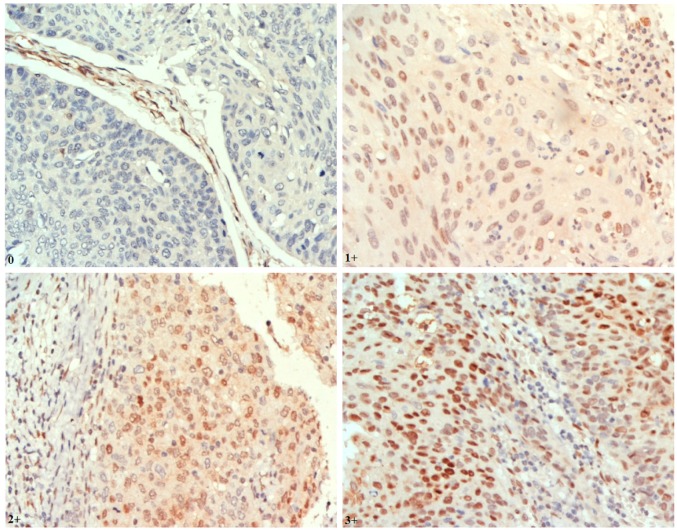
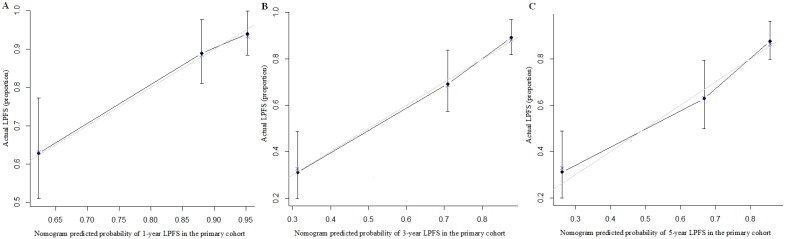
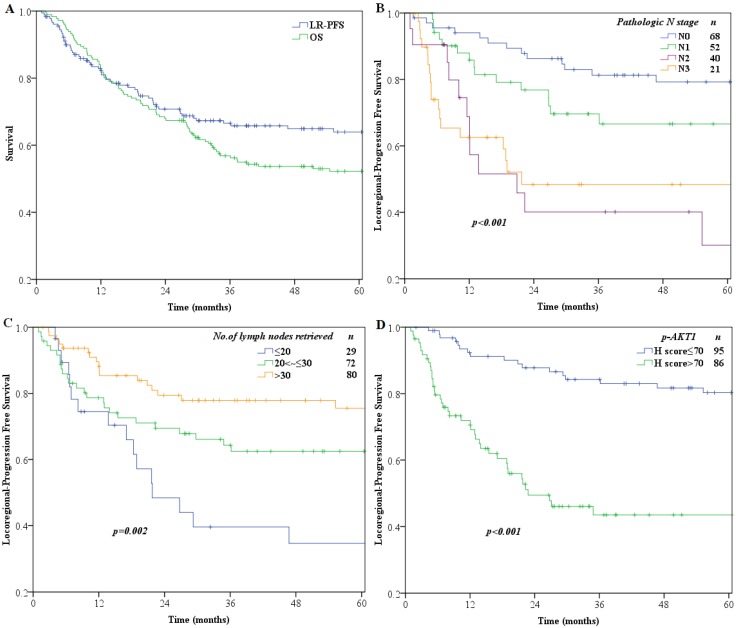
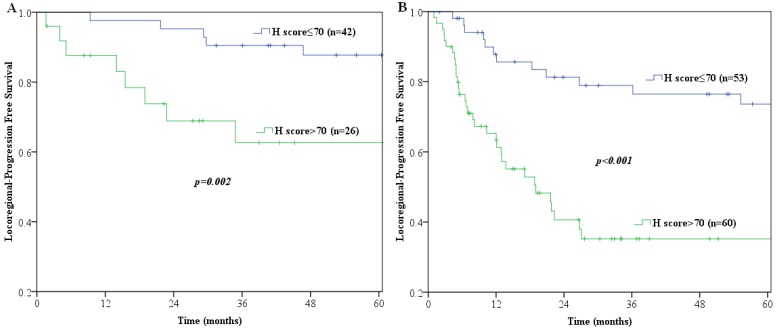
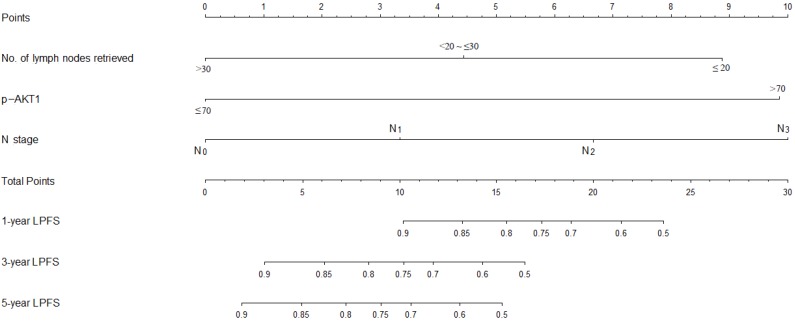
The AKT signalling pathway controls survival and growth in many malignant tumours. However, the prognostic value of phosphorylated AKT1 (p-AKT1) for locoregional-progression free survival (LPFS) in oesophageal squamous cell carcinoma (ESCC) has not been established. Our aim was to develop a nomogram to predict local recurrence using p-AKT1 and main clinical characteristics in patients with thoracic ESCC undergoing radical three-field lymph node dissection. Immunohistochemistry was performed to examine p-AKT1 expression in 181 thoracic ESCC patients. The Kaplan-Meier method was used to calculate LPFS. Cox regression analysis was also performed to evaluate prognostic factors. A nomogram comprising biological and clinical factors was established to predict LPFS. The 5-year LPFS rate was 63.9%. Multivariate analysis revealed that expression of p-AKT1 (p<0.001), pathologic N category (p=0.004) and number of lymph nodes retrieved (p=0.001) were independent prognostic factors for LPFS. Increased expression of p-AKT1 was associated with decreased LPFS in patients with ESCC. In addition, a nomogram was established based on all significant independent factors for locoregional recurrence risk. Harrell's c-index for predicting LPFS was 0.78. Activation of AKT1 was associated with poor locoregional control in ESCC patients. The nomogram, based on p-AKT1 expression and clinically significant parameters, could be used as an accurate stratification model for predicting locoregional recurrence in patients with ESCC after radical resection.
AKT信号通路控制着许多恶性肿瘤的生存和生长。然而,磷酸化AKT1(p-AKT1)对食管鳞状细胞癌(ESCC)局部区域无进展生存期(LPFS)的预后价值尚未明确。我们的目的是建立一个列线图,以利用p-AKT1和接受根治性三野淋巴结清扫的胸段ESCC患者的主要临床特征来预测局部复发。对181例胸段ESCC患者进行免疫组织化学检测以检查p-AKT1表达。采用Kaplan-Meier法计算LPFS。还进行了Cox回归分析以评估预后因素。建立了一个包含生物学和临床因素的列线图来预测LPFS。5年LPFS率为63.9%。多变量分析显示,p-AKT1表达(p<0.001)、病理N分期(p=0.004)和获取的淋巴结数量(p=0.001)是LPFS的独立预后因素。ESCC患者中p-AKT1表达增加与LPFS降低相关。此外,基于所有局部区域复发风险的显著独立因素建立了一个列线图。预测LPFS的Harrell c指数为0.78。AKT1的激活与ESCC患者局部区域控制不佳相关。基于p-AKT1表达和临床显著参数的列线图可作为预测根治性切除术后ESCC患者局部区域复发的准确分层模型。