Frombach Aaron Andrew, Brett Kendra, Lapner Peter
Division of Orthopaedics, Ottawa Hospital Research Institute, University of Ottawa, Ontario, Canada.
Open Orthop J. 2017 Sep 30;11:1108-1114. doi: 10.2174/1874325001711011108. eCollection 2017.
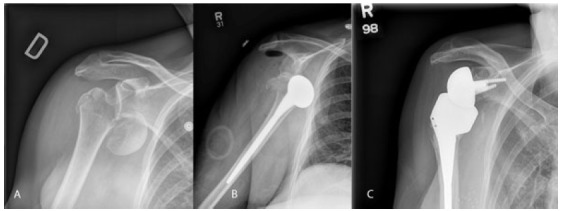
Acute proximal humeral fractures in the elderly are generally treated non-operatively if alignment is acceptable and in stable fracture patterns. When operative treatment is indicated, surgical fixation is often difficult or impossible to obtain. Hemiarthroplasty has long been the standard of care. However, with its reliance on tuberosity healing, functional outcomes and patient satisfaction are often poor. Reverse shoulder arthroplasty has emerged as a new technology for treating proximal humeral fractures but the indications for its use remain uncertain. While not conclusive, the evidence suggests that reverse shoulder arthroplasty yields more consistent results, with improved forward elevation and higher functional outcome scores. The primary advantages of hemiarthroplasty are improved shoulder rotation and shorter operative time. Complication rates do not vary significantly between the two options. Although higher quality trials are needed to further define the role of reverse shoulder arthroplasty, current evidence suggests that this is a reasonable option for surgeons who are highly familiar with its use.
如果老年患者的急性肱骨近端骨折对线良好且骨折模式稳定,通常采用非手术治疗。当需要手术治疗时,往往难以或无法实现手术固定。长期以来,半关节置换术一直是标准的治疗方法。然而,由于其依赖于结节愈合,功能结果和患者满意度往往较差。反肩关节置换术已成为治疗肱骨近端骨折的一项新技术,但其使用指征仍不明确。虽然尚无定论,但证据表明反肩关节置换术能产生更一致的结果,前屈抬高改善,功能结果评分更高。半关节置换术的主要优点是肩关节旋转改善和手术时间缩短。两种选择的并发症发生率没有显著差异。尽管需要更高质量的试验来进一步明确反肩关节置换术的作用,但目前的证据表明,对于非常熟悉其使用方法的外科医生来说,这是一个合理的选择。