Trayhurn Paul
Clore Laboratory, University of Buckingham, Buckingham, UK.
Obesity Biology Unit, University of Liverpool, Liverpool, UK.
J Nutr Sci. 2017 Sep 4;6:e47. doi: 10.1017/jns.2017.53. eCollection 2017.
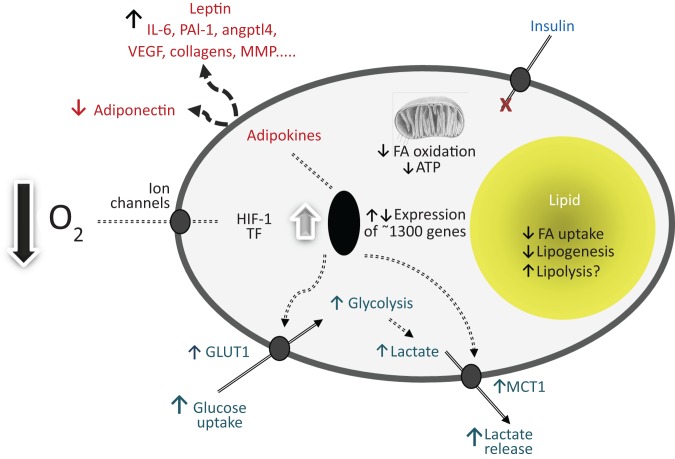
O is essential for the maintenance and growth of aerobic animals, similar to the essentiality of what are classically considered nutrients. Nevertheless, O is not customarily regarded as a nutrient, this reflecting the route by which it enters the body - through the lungs or gills in vertebrates, rather than via the mouth and gastrointestinal tract. A relative deficiency of O occurs at high altitudes and during deep-sea diving, to which distinct adaptations occur. Deficiency is also evident in lung diseases such as emphysema. Without O, mitochondrial respiration and oxidative phosphorylation cannot take place. At a molecular level, cells adapt to O deficiency by switching from oxidative metabolism to anaerobic glycolysis and there are changes in the expression of a multiplicity of genes, driven by hypoxia-sensitive transcription factors, particularly hypoxia-inducible factor-1. It is argued that O should be fully included within the remit of nutritional science alongside the other essential macronutrients.
氧气对于需氧动物的维持和生长至关重要,这类似于传统上被视为营养素的物质的必要性。然而,氧气通常不被视为一种营养素,这反映了它进入身体的途径——在脊椎动物中通过肺或鳃,而不是通过口腔和胃肠道。在高海拔地区和深海潜水期间会出现相对的氧气缺乏,对此会发生明显的适应性变化。在诸如肺气肿等肺部疾病中,氧气缺乏也很明显。没有氧气,线粒体呼吸和氧化磷酸化就无法进行。在分子水平上,细胞通过从氧化代谢转变为无氧糖酵解来适应氧气缺乏,并且在缺氧敏感转录因子,特别是缺氧诱导因子-1的驱动下,多种基因的表达会发生变化。有人认为,氧气应与其他必需的大量营养素一起完全纳入营养科学的范畴。