Strickland Jasmin A, Austen Joseph M, Sanderson David J
Department of Psychology, Durham University, Science Site, South Road, Durham DH1 3LE, UK.
Department of Psychology, Durham University, Science Site, South Road, Durham DH1 3LE, UK.
Physiol Behav. 2018 Feb 1;184:129-134. doi: 10.1016/j.physbeh.2017.11.019. Epub 2017 Nov 22.
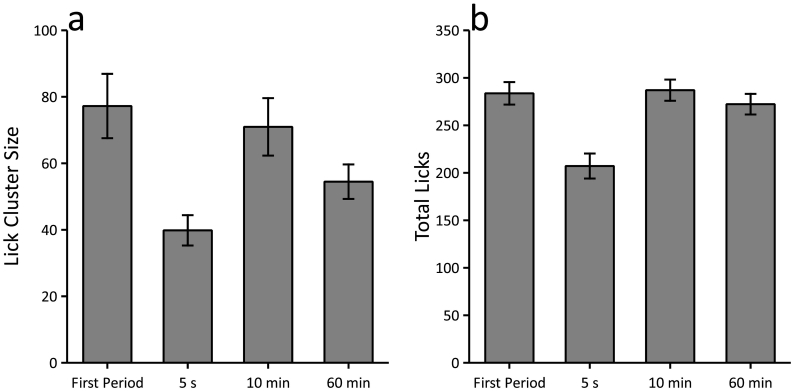
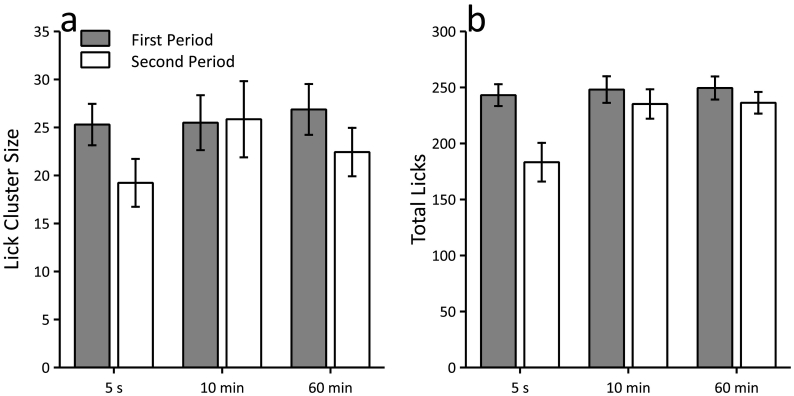
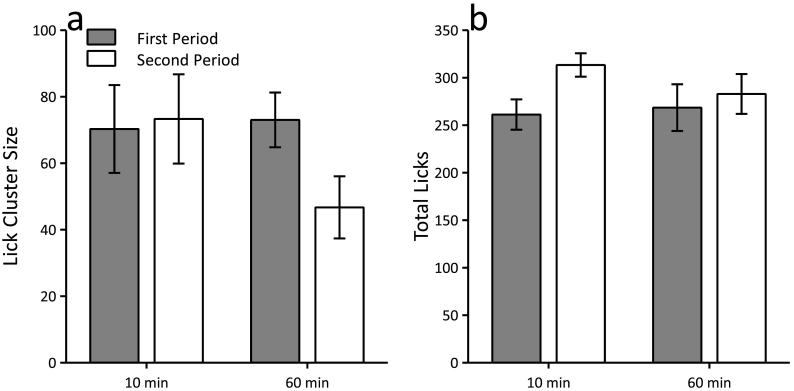
Consumption of foods results in a transient reduction in hedonic value that influences the extent and nature of feeding behavior. The time course of this effect, however, is poorly specified. In an initial experiment, using an analysis of the microstructure of licking in mice we found that consumption of sucrose led to a rapid reduction in lick cluster size, a measure of palatability, which recovered after 10 min, but reemerged 60min after initial consumption. We then replicated the finding that lick cluster size is reduced after 60min, but not 10min, under conditions in which a number of potential behavioural confounds were removed. In Experiment 2 the effect was replicated using a between-subjects design that ruled out the possibility that the effect was a specific consequence of the within-subjects procedures used in the first experiment, in which mice may have come to expect sucrose at different time points within the feeding session. While Experiments 1 and 2 confounded the time between periods of access to sucrose with time since the start of the feeding session, this confound was removed in Experiment 3, and, similar to the previous experiments, it was found that a second reduction in palatability occurred after 60min. Therefore, the effect was dependent only on the time since the previous exposure to sucrose, demonstrating that sucrose consumption initiates a biphasic reduction in palatability. The reduction in lick cluster size after 60min was not typically accompanied by a reduction in consumption suggesting that the more slowly developing reduction in the palatability measure was not simply a consequence of post-ingestive satiety. The cause of the biphasic change is not yet clear, and may reflect independent processes or the consequence of a single process that initiates multiple changes in palatability over time.
食物的摄入会导致享乐价值的短暂降低,这会影响进食行为的程度和性质。然而,这种效应的时间进程却不太明确。在最初的实验中,通过对小鼠舔舐微观结构的分析,我们发现蔗糖的摄入导致舔舐簇大小迅速减小,舔舐簇大小是衡量适口性的指标,10分钟后恢复,但在最初摄入后60分钟再次出现减小。然后,我们在排除了一些潜在行为混淆因素的条件下,重复了60分钟后舔舐簇大小减小而10分钟后未减小的这一发现。在实验2中,使用组间设计重复了这一效应,排除了该效应是第一个实验中所采用的组内程序的特定结果的可能性,在第一个实验中,小鼠可能在进食过程中的不同时间点预期会有蔗糖。虽然实验1和实验2将获取蔗糖的时间段之间的时间与进食开始后的时间混淆了,但在实验3中消除了这种混淆,并且与之前的实验类似,发现适口性在60分钟后再次降低。因此,这种效应仅取决于自上次接触蔗糖以来的时间,表明蔗糖的摄入引发了适口性的双相降低。60分钟后舔舐簇大小的减小通常并不伴随着摄入量的减少,这表明适口性测量中发展较慢的降低并非仅仅是摄入后饱腹感的结果。双相变化的原因尚不清楚,可能反映了独立的过程,或者是一个随着时间推移引发适口性感官特性发生多重变化的单一过程的结果。