International Agency for Research on Cancer, Lyon, France.
International Agency for Research on Cancer, Lyon, France.
Lancet Infect Dis. 2018 Feb;18(2):198-206. doi: 10.1016/S1473-3099(17)30653-9. Epub 2017 Nov 17.
Data on carcinogenicity of human papillomavirus (HPV) types in the anus are needed to inform anal cancer prevention through vaccination and screening. This is particularly the case for people infected with HIV, who are at an increased risk of anal cancer.
We did a systematic review of studies published from January, 1986, to July, 2017, in MEDLINE, Embase, and the Cochrane Library on anal HPV infection, without any language restrictions. Eligible studies reported type-specific HPV prevalence by strata of cytopathological or histopathological anal diagnosis, sex, and HIV status. Data requests were made to authors when necessary. We did a meta-analysis of type-specific HPV prevalence across the full spectrum of anal diagnoses, from normal cytology to anal cancer. We assessed the main outcome of type-specific HPV prevalence ratios [PR], calculated across strata of anal diagnoses, gender, or HIV status, by use of generalised linear models.
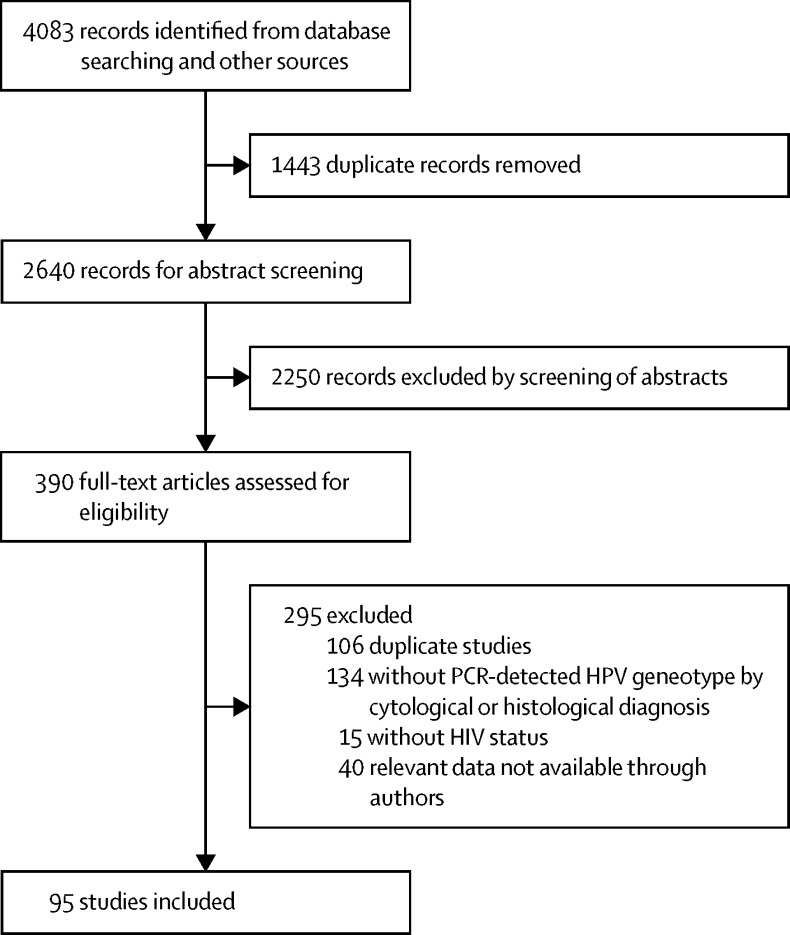
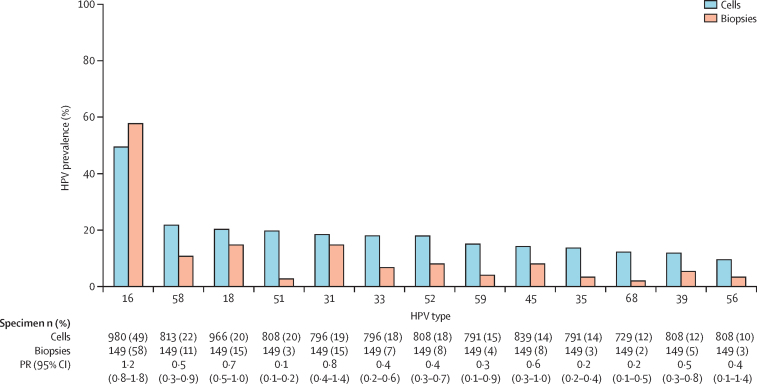
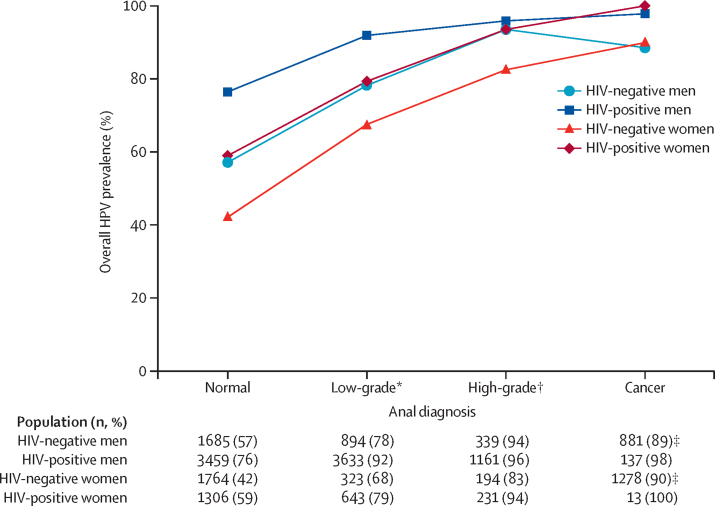
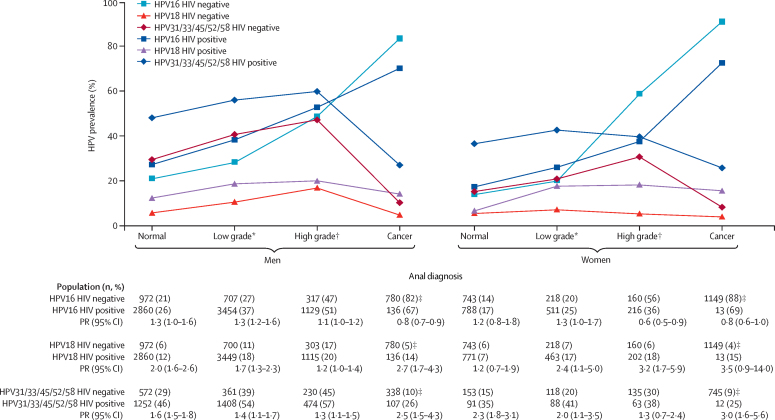
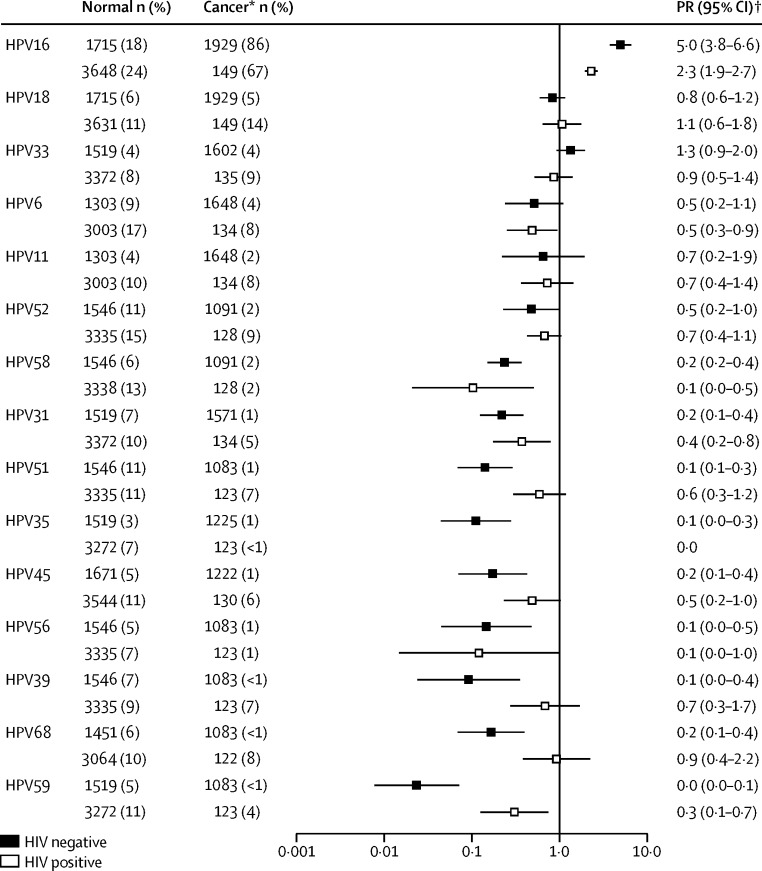
95 studies were identified from the search, published between 1992-2017, from which 18 646 individuals fulfilled the criteria for inclusion in the analyses: 8534 people with normal cytology, 5730 with low-grade lesions, 2024 with high-grade lesions, and 2358 with anal cancer. HPV prevalence varied in normal cytology from 42% in HIV-negative women to 76% in HIV-positive men and, for each diagnosis, was higher in individuals who were HIV positive than those who were HIV negative. HPV16 positivity increased with diagnosis severity, being the only HPV type accounting for more HPV infection in anal cancer than normal cytology, both in individuals who were HIV negative (PR 5·0, 95% CI 3·8-6·6, p<0·0001) and those who were HIV positive (2·3, 1·9-2·7, p<0·0001). HPV16 positivity increased even between high-grade lesions and anal cancer, whereas other high-risk HPV types accounted for high proportions of low-grade or high-grade lesions but their prevalence decreased in anal cancer. However, HPV16 was less frequent in HIV-positive than HIV-negative anal cancer, both in men (PR 0·8, 95% CI 0·7-0·9, p<0·0001) and women (0·8, 0·6-1·0, p=0·063), and in HIV-positive versus HIV-negative high-grade lesions in women (0·6, 0·5-0·9, p=0·0077). Type-specific attribution of the non-HPV16 fraction of HIV-positive anal cancer is hindered by a high prevalence of multiple HPV infections.
HPV16 is by far the most carcinogenic HPV type in the anus, with enrichment of HPV16 even from high-grade lesions to anal cancer, both in individuals who are HIV negative and those who are HIV positive. Nevertheless, the fraction of anal cancer attributable to HPV16 is smaller in the HIV-positive population.
International Agency for Research on Cancer.
为了通过疫苗接种和筛查来预防肛门癌,我们需要了解人类乳头瘤病毒(HPV)在肛门部位致癌的相关数据。对于感染艾滋病毒的人群,这一点尤为重要,因为他们罹患肛门癌的风险会增加。
我们对 1986 年 1 月至 2017 年 7 月间发表在 MEDLINE、Embase 和 Cochrane 图书馆的有关肛门 HPV 感染的研究进行了系统综述,不设任何语言限制。合格的研究报告了按照细胞学或组织病理学肛门诊断、性别和 HIV 状况分层的特定 HPV 流行率。在必要时,我们向作者提出了数据请求。我们对从正常细胞学到肛门癌的全谱肛门诊断进行了特定 HPV 流行率的荟萃分析。我们使用广义线性模型评估了在不同的肛门诊断、性别或 HIV 状况分层下特定 HPV 流行率比(PR)这一主要结局。
从检索中确定了 95 项研究,发表时间为 1992 年至 2017 年,其中有 18646 人符合纳入分析的标准:8534 人有正常细胞学,5730 人有低度病变,2024 人有高度病变,2358 人患有肛门癌。在正常细胞学中,HPV 流行率从 HIV 阴性女性的 42%到 HIV 阳性男性的 76%不等,而且对于每种诊断,HIV 阳性个体的流行率均高于 HIV 阴性个体。HPV16 阳性率随诊断严重程度而增加,它是唯一一种在 HIV 阴性个体中导致肛门癌的 HPV 感染比正常细胞学更多的 HPV 类型(PR 5·0,95%CI 3·8-6·6,p<0·0001),在 HIV 阳性个体中也是如此(2·3,1·9-2·7,p<0·0001)。HPV16 阳性率甚至在高度病变和肛门癌之间也有所增加,而其他高危 HPV 类型在低度或高度病变中占很大比例,但在肛门癌中其流行率却降低了。然而,HPV16 在 HIV 阳性肛门癌中的频率低于 HIV 阴性肛门癌,无论是在男性(PR 0·8,95%CI 0·7-0·9,p<0·0001)还是女性(0·8,0·6-1·0,p=0·063)中,还是在 HIV 阳性女性的高度病变中(0·6,0·5-0·9,p=0·0077)。由于 HPV 感染的多发性,很难对 HIV 阳性肛门癌中非 HPV16 型的特定类型进行归因。
HPV16 是迄今为止肛门部位致癌性最强的 HPV 类型,无论是在 HIV 阴性还是 HIV 阳性个体中,HPV16 甚至从高度病变到肛门癌都有所增加。然而,在 HIV 阳性人群中,HPV16 导致的肛门癌比例较小。
国际癌症研究机构。