Department of Mathematics, Courant Institute of Mathematical Sciences, New York University, New York, NY 10012;
Center for Atmosphere Ocean Science, Courant Institute of Mathematical Sciences, New York University, New York, NY 10012.
Proc Natl Acad Sci U S A. 2017 Dec 5;114(49):12864-12869. doi: 10.1073/pnas.1717017114. Epub 2017 Nov 20.
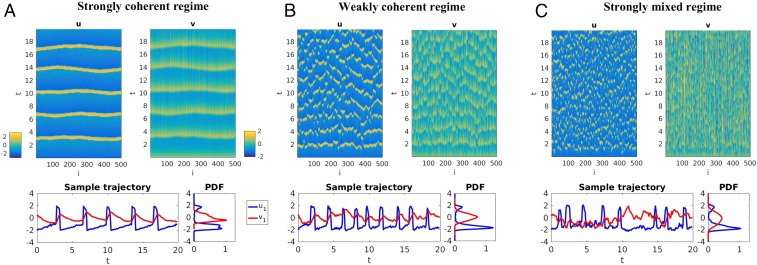
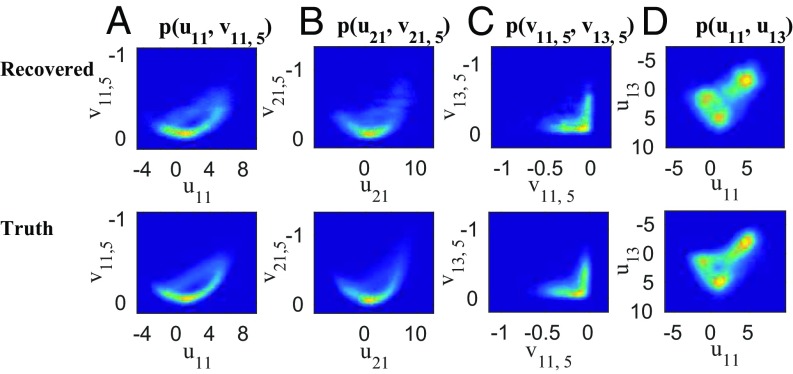
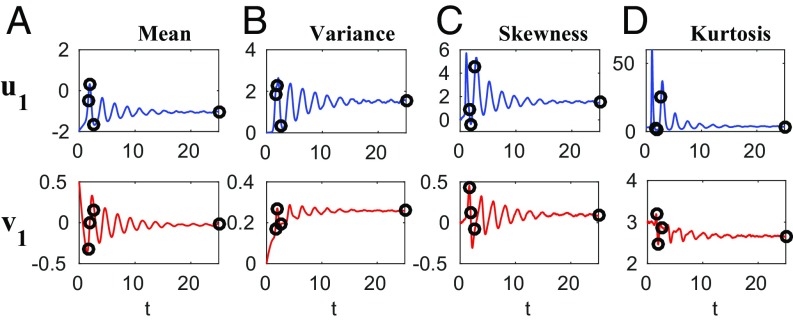
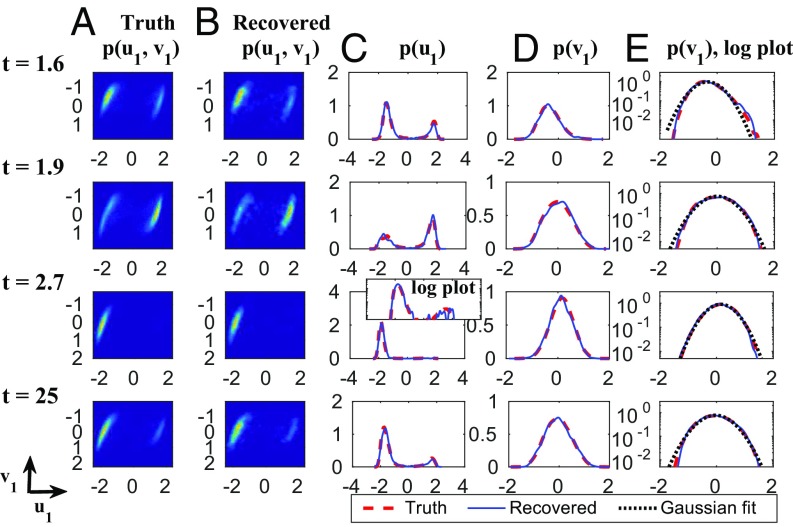
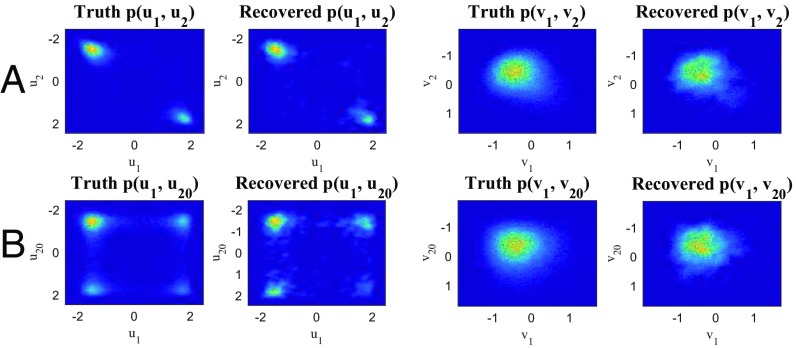
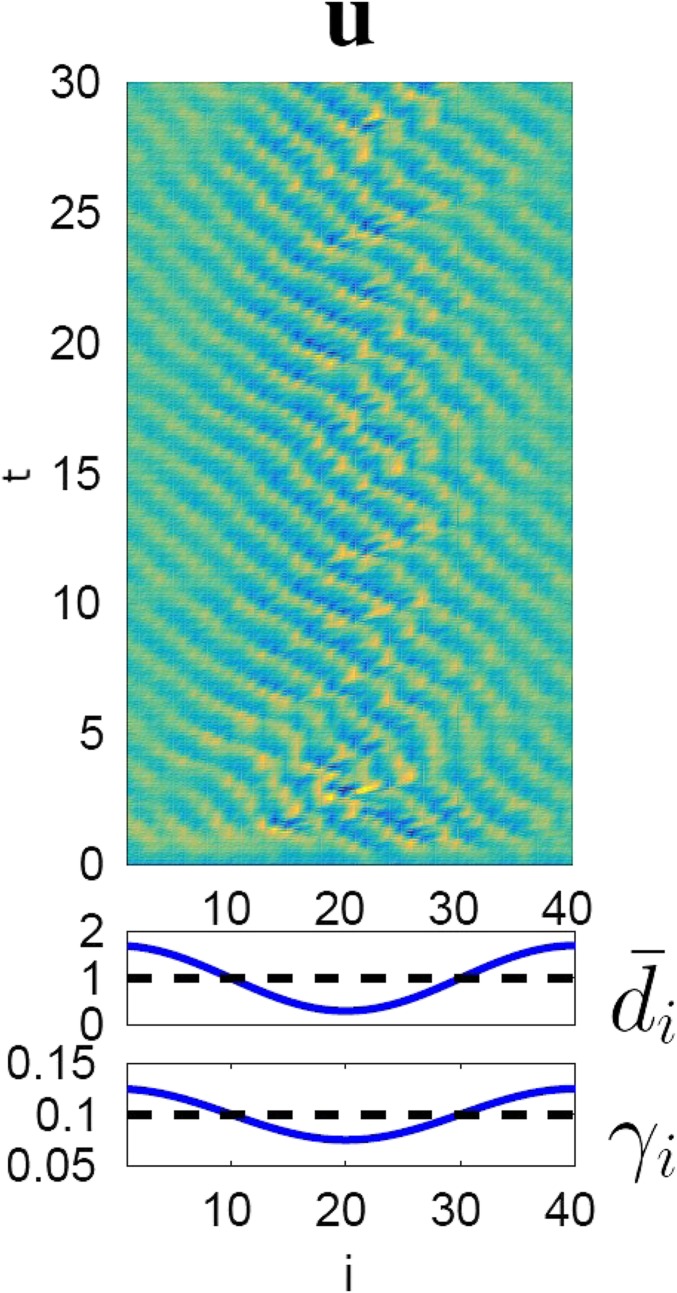
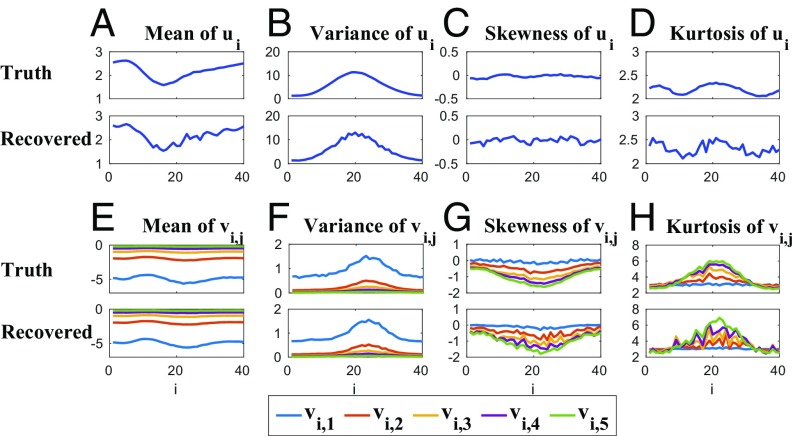
Solving the Fokker-Planck equation for high-dimensional complex dynamical systems is an important issue. Recently, the authors developed efficient statistically accurate algorithms for solving the Fokker-Planck equations associated with high-dimensional nonlinear turbulent dynamical systems with conditional Gaussian structures, which contain many strong non-Gaussian features such as intermittency and fat-tailed probability density functions (PDFs). The algorithms involve a hybrid strategy with a small number of samples [Formula: see text], where a conditional Gaussian mixture in a high-dimensional subspace via an extremely efficient parametric method is combined with a judicious Gaussian kernel density estimation in the remaining low-dimensional subspace. In this article, two effective strategies are developed and incorporated into these algorithms. The first strategy involves a judicious block decomposition of the conditional covariance matrix such that the evolutions of different blocks have no interactions, which allows an extremely efficient parallel computation due to the small size of each individual block. The second strategy exploits statistical symmetry for a further reduction of [Formula: see text] The resulting algorithms can efficiently solve the Fokker-Planck equation with strongly non-Gaussian PDFs in much higher dimensions even with orders in the millions and thus beat the curse of dimension. The algorithms are applied to a [Formula: see text]-dimensional stochastic coupled FitzHugh-Nagumo model for excitable media. An accurate recovery of both the transient and equilibrium non-Gaussian PDFs requires only [Formula: see text] samples! In addition, the block decomposition facilitates the algorithms to efficiently capture the distinct non-Gaussian features at different locations in a [Formula: see text]-dimensional two-layer inhomogeneous Lorenz 96 model, using only [Formula: see text] samples.
求解高维复杂动力系统的福克-普朗克方程是一个重要问题。最近,作者开发了高效的统计精确算法,用于求解与具有条件高斯结构的高维非线性湍流动力系统相关的福克-普朗克方程,这些系统包含许多强非高斯特征,如间歇和长尾概率密度函数(PDF)。这些算法涉及一种混合策略,使用少量样本[公式:见文本],其中通过极其高效的参数方法在高维子空间中进行条件高斯混合,并在剩余的低维子空间中进行明智的高斯核密度估计。在本文中,开发并纳入了两种有效的策略。第一种策略涉及对条件协方差矩阵进行明智的块分解,使得不同块的演化没有相互作用,这由于每个单独块的尺寸较小,允许进行极其高效的并行计算。第二种策略利用统计对称性进一步减少[公式:见文本]。所得算法即使在百万级以上的阶数下也能有效地求解具有强非高斯 PDF 的福克-普朗克方程,从而克服了维度的诅咒。这些算法应用于[公式:见文本]维随机耦合 FitzHugh-Nagumo 兴奋介质模型。仅需要[公式:见文本]个样本即可准确恢复瞬态和平衡非高斯 PDF!此外,块分解有助于算法使用仅[公式:见文本]个样本在[公式:见文本]维两层非均匀洛伦兹 96 模型的不同位置有效地捕获不同的非高斯特征。