Wang Bing, Shen Jiaquan, Wang Jue
Department of Ophthalmology, The Provincial Hospital Affiliated To Shandong University, Jinan, China.
Onco Targets Ther. 2017 Nov 6;10:5303-5309. doi: 10.2147/OTT.S145518. eCollection 2017.
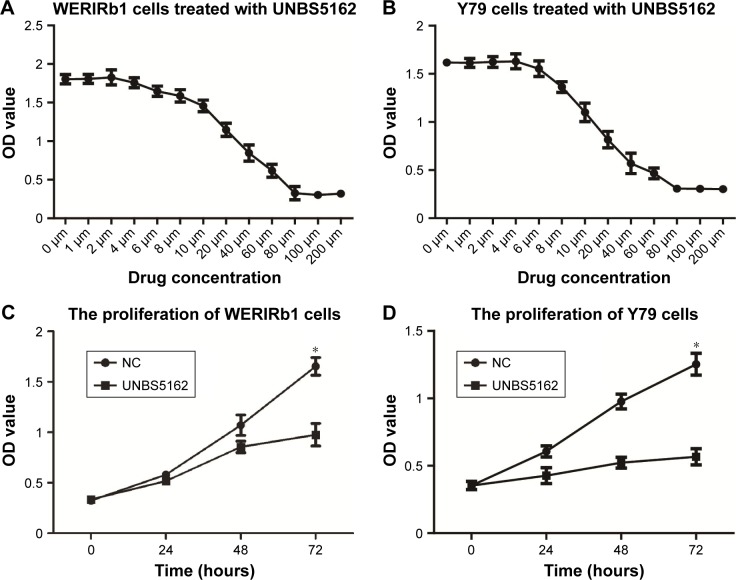
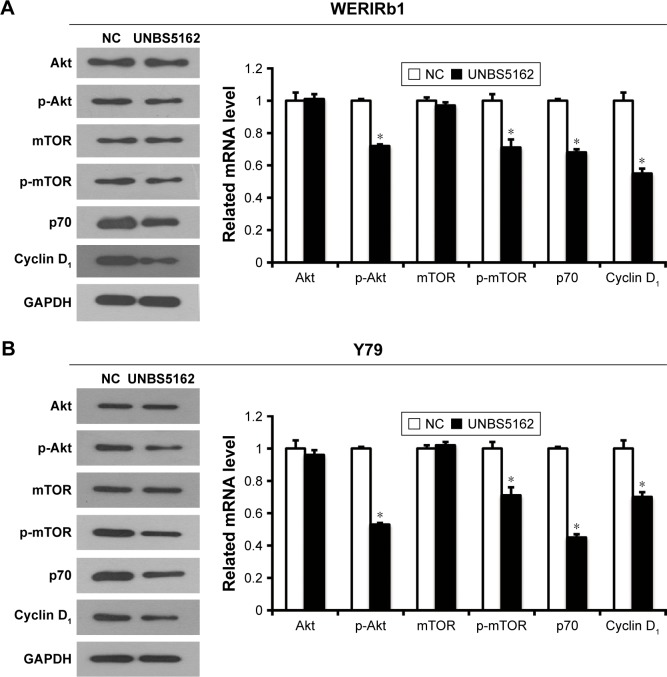
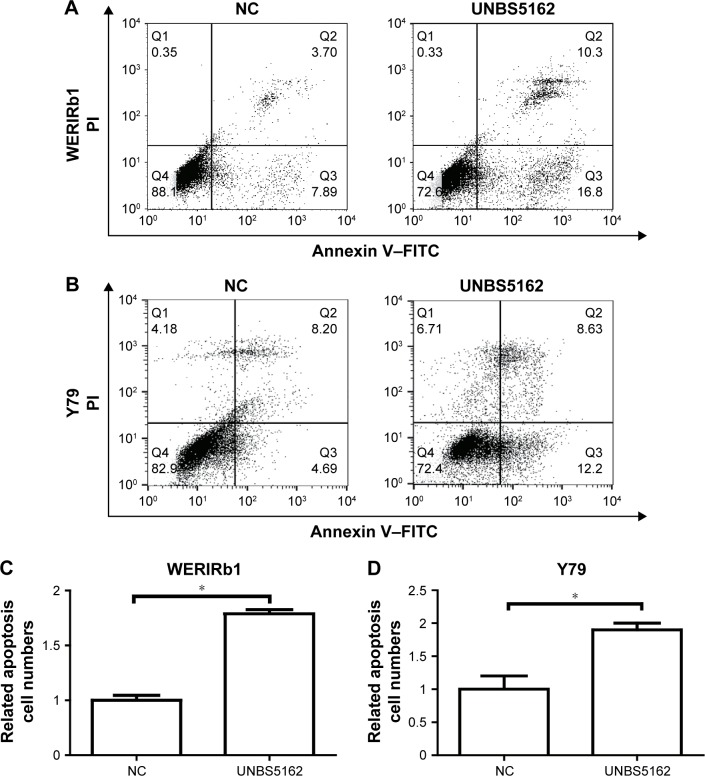
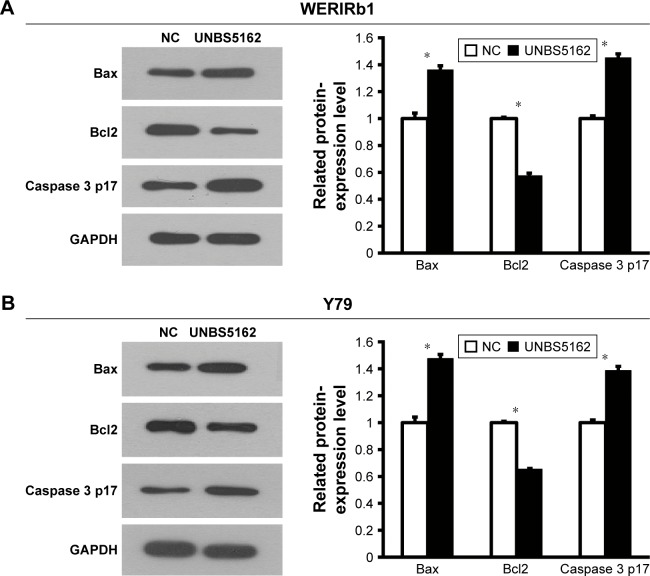
Human retinoblastomas are malignant intraocular tumors and have a high incidence in children. Chemotherapy combined with local therapy is the principal means of retinoblastoma treatment, the application of which has saved the eye of many children and avoided external irradiation. UNBS5162, a naphthalimide, has broad prospects as a tumor treatment, with fewer toxic side effects and higher cancer-suppression efficiency. However, the efficacy of UNBS5162 in human retinoblastomas is still not clear. In the present study, we investigated the specific mechanism of UNBS5162 in the human retinoblastoma cell lines WERIRb1 and Y79. Compared with a negative-control (NC) group, UNBS5162 treatment for 72 hours significantly decreased cell proliferation; meanwhile, more apoptotic cells were observed in the UNBS5162-treated group (27.1% in WERIRb1, 20.83% in Y79) than in the NC group (11.59% in WERIRb1, 12.89% in Y79). We also found caspase 3 p17 and Bax expression to be upregulated and Bcl2 downregulated significantly in UNBS5162-treated WERIRb1 and Y79 cells. The effects of UNBS5162 on human retinoblastoma cells may be regulated by the Akt-mTOR pathway. We found expression of the Akt pathway and key proliferation-related genes - those for p-Akt, p-mTOR, p70, and cyclin D - were downregulated significantly in the UNBS5162-treated group compared with the NC group in WERIRb1 and Y79. Therefore, for the first time, we demonstrated that UNBS5162 can inhibit proliferation and promote apoptosis of human retinoblastoma cells by regulating activity of the Akt-mTOR pathway in vitro, suggesting the potential value of UNBS5162 in treatment for human retinoblastoma.
人类视网膜母细胞瘤是一种恶性眼内肿瘤,在儿童中发病率较高。化疗联合局部治疗是视网膜母细胞瘤治疗的主要手段,其应用挽救了许多儿童的眼睛并避免了外部照射。萘二甲酰亚胺类化合物UNBS5162作为一种肿瘤治疗药物具有广阔前景,其毒副作用较少且抑癌效率较高。然而,UNBS5162在人类视网膜母细胞瘤中的疗效仍不明确。在本研究中,我们探究了UNBS5162在人类视网膜母细胞瘤细胞系WERIRb1和Y79中的具体作用机制。与阴性对照组(NC组)相比,UNBS5162处理72小时后显著降低了细胞增殖;同时,在UNBS5162处理组中观察到的凋亡细胞(WERIRb1组为27.1%,Y79组为20.83%)比NC组(WERIRb1组为11.59%,Y79组为12.89%)更多。我们还发现,在经UNBS5162处理的WERIRb1和Y79细胞中,半胱天冬酶3 p17和Bax表达显著上调,而Bcl2表达显著下调。UNBS5162对人类视网膜母细胞瘤细胞的作用可能受Akt-mTOR信号通路调控。我们发现,与WERIRb1和Y79细胞的NC组相比,UNBS5162处理组中Akt信号通路及关键增殖相关基因(p-Akt、p-mTOR、p70和细胞周期蛋白D)的表达显著下调。因此,我们首次证明UNBS5162在体外可通过调节Akt-mTOR信号通路的活性来抑制人类视网膜母细胞瘤细胞的增殖并促进其凋亡,这表明UNBS5162在人类视网膜母细胞瘤治疗中具有潜在价值。