Neumann Rainer, Ruppel Nicole, Schneider Jutta M
Zoologisches Institut, Biozentrum Grindel, Universität Hamburg, Hamburg, Germany.
PeerJ. 2017 Nov 15;5:e4050. doi: 10.7717/peerj.4050. eCollection 2017.
Animal growth is often constrained by unfavourable conditions and divergences from optimal body size can be detrimental to an individual's fitness, particularly in species with determinate growth and a narrow time-frame for life-time reproduction. Growth restriction in early juvenile stages can later be compensated by means of plastic developmental responses, such as adaptive catch-up growth (the compensation of growth deficits through delayed development). Although sex differences regarding the mode and degree of growth compensation have been coherently predicted from sex-specific fitness payoffs, inconsistent results imply a need for further research. We used the African , representing an extreme case of female-biased sexual size dimorphism (SSD), to study fitness implications of sex-specific growth compensation. We predicted effective catch-up growth in early food-restricted females to result in full compensation of growth deficits and a life-time fecundity (LTF) equivalent to unrestricted females. Based on a stronger trade-off between size-related benefits and costs of a delayed maturation, we expected less effective catch-up growth in males.
We tracked the development of over one thousand spiders in different feeding treatments, e.g., comprising a fixed period of early low feeding conditions followed by unrestricted feeding conditions, permanent unrestricted feeding conditions, or permanent low feeding conditions as a control. In a second experimental section, we assessed female fitness by measuring LTF in a subset of females. In addition, we tested whether compensatory development affected the reproductive lifespan in both sexes and analysed genotype-by-treatment interactions as a potential cause of variation in life-history traits.
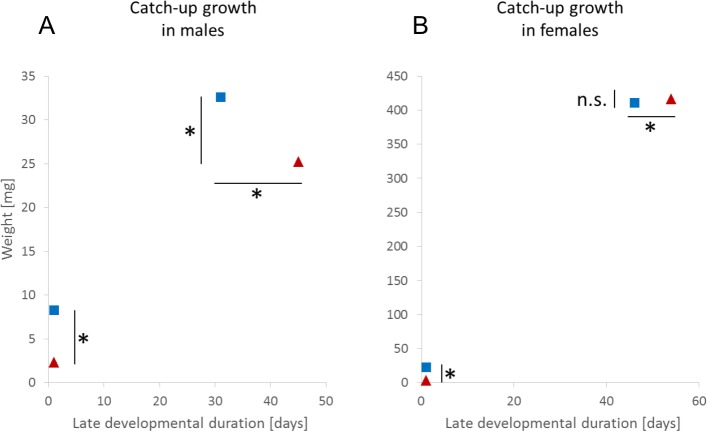
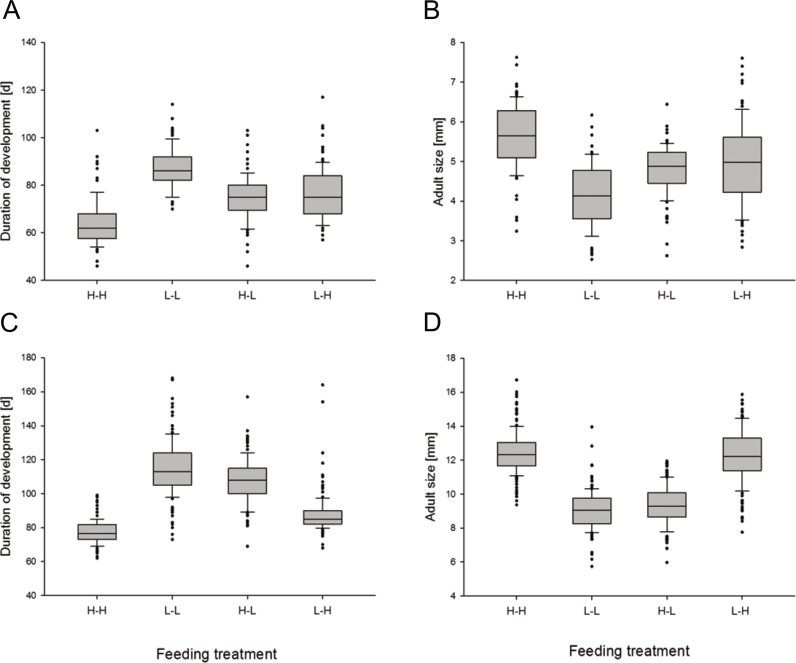
Both sexes delayed maturation to counteract early growth restriction, but only females achieved full compensation of adult body size. Female catch-up growth resulted in equivalent LTF compared to unrestricted females. We found significant interactions between experimental treatments and sex as well as between treatments and family lineage, suggesting that family-specific responses contribute to the unusually large variation of life-history traits in spiders. Our feeding treatments had no effect on the reproductive lifespan in either sex.
Our findings are in line with predictions of life-history theory and corroborate strong fecundity selection to result in full female growth compensation. Males showed incomplete growth compensation despite a delayed development, indicating relaxed selection on large size and a stronger trade-off between late maturation and size-related benefits. We suggest that moderate catch-up growth in males is still adaptive as a 'bet-hedging' strategy to disperse unavoidable costs between life-history traits affected by early growth restriction (the duration of development and adult size).
动物生长常常受到不利条件的限制,与最佳体型的偏差可能对个体的适应性产生不利影响,尤其是在具有确定性生长和狭窄终生繁殖时间框架的物种中。幼年早期的生长受限后来可通过可塑性发育反应来补偿,例如适应性追赶生长(通过延迟发育来补偿生长不足)。尽管从特定性别的适应性收益中可以连贯地预测出生长补偿模式和程度的性别差异,但不一致的结果表明需要进一步研究。我们使用非洲蜘蛛,它代表了雌性偏向的性大小二态性(SSD)的极端情况,来研究特定性别的生长补偿对适应性的影响。我们预测,早期食物受限的雌性蜘蛛的有效追赶生长将导致生长不足得到完全补偿,并且终生繁殖力(LTF)与未受限的雌性蜘蛛相当。基于与体型相关的益处和延迟成熟成本之间更强的权衡,我们预计雄性蜘蛛的追赶生长效果较差。
我们跟踪了一千多只处于不同喂养处理的蜘蛛的发育情况,例如,包括一段固定的早期低喂养条件,随后是不受限喂养条件、永久不受限喂养条件或作为对照的永久低喂养条件。在第二个实验部分,我们通过测量一部分雌性蜘蛛的终生繁殖力来评估雌性蜘蛛的适应性。此外,我们测试了补偿性发育是否影响两性的繁殖寿命,并分析了基因型与处理的相互作用,将其作为生活史特征变异的一个潜在原因。
两性都延迟成熟以抵消早期生长受限,但只有雌性蜘蛛实现了成年体型的完全补偿。与未受限的雌性蜘蛛相比,雌性蜘蛛的追赶生长导致了相当的终生繁殖力。我们发现实验处理与性别之间以及处理与家族谱系之间存在显著的相互作用,这表明家族特异性反应导致了蜘蛛生活史特征异常大的变异。我们的喂养处理对两性的繁殖寿命均无影响。
我们的研究结果与生活史理论的预测一致,并证实了强大的繁殖力选择导致雌性蜘蛛完全生长补偿。尽管发育延迟,雄性蜘蛛的生长补偿并不完全,这表明对大尺寸的选择较为宽松,并且在延迟成熟和与体型相关的益处之间存在更强的权衡。我们认为,雄性蜘蛛适度追赶生长作为一种“风险对冲”策略仍然是适应性的,以便在受早期生长受限影响的生活史特征(发育持续时间和成年体型)之间分散不可避免的成本。