Furmanczyk Ewa M, Kaminski Michal A, Spolnik Grzegorz, Sojka Maciej, Danikiewicz Witold, Dziembowski Andrzej, Lipinski Leszek, Sobczak Adam
Institute of Biochemistry and Biophysics, Polish Academy of Sciences, Warsaw, Poland.
Institute of Organic Chemistry, Polish Academy of Sciences, Warsaw, Poland.
Front Microbiol. 2017 Nov 7;8:1872. doi: 10.3389/fmicb.2017.01872. eCollection 2017.
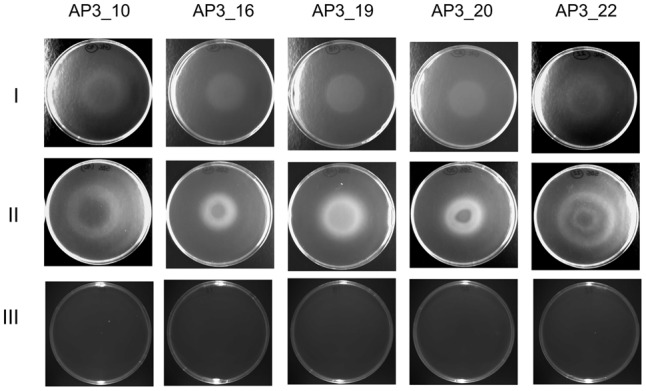
Due to their particular properties, detergents are widely used in household cleaning products, cosmetics, pharmaceuticals, and in agriculture as adjuvants tailoring the features of pesticides or other crop protection agents. The continuously growing use of these various products means that water soluble detergents have become one of the most problematic groups of pollutants for the aquatic and terrestrial environments. Thus it is important to identify bacteria having the ability to survive in the presence of large quantities of detergent and efficiently decompose it to non-surface active compounds. In this study, we used peaty soil sampled from a surface flow constructed wetland in a wastewater treatment plant to isolate bacteria that degrade sodium dodecyl sulfate (SDS). We identified and initially characterized 36 spp. strains that varied significantly in their ability to use SDS as their sole carbon source. Five isolates having the closest taxonomic relationship to the subgroup appeared to be the most efficient SDS degraders, decomposing from 80 to 100% of the SDS present in an initial concentration 1 g/L in less than 24 h. These isolates exhibited significant differences in degree of SDS degradation, their resistance to high detergent concentration (ranging from 2.5 g/L up to 10 g/L or higher), and in chemotaxis toward SDS on a plate test. Mass spectrometry revealed several SDS degradation products, 1-dodecanol being dominant; however, traces of dodecanal, 2-dodecanol, and 3-dodecanol were also observed, but no dodecanoic acid. Native polyacrylamide gel electrophoresis zymography revealed that all of the selected isolates possessed alkylsulfatase-like activity. Three isolates, AP3_10, AP3_20, and AP3_22, showed a single band on native PAGE zymography, that could be the result of alkylsulfatase activity, whereas for isolates AP3_16 and AP3_19 two bands were observed. Moreover, the AP3_22 strain exhibited a band in presence of both glucose and SDS, whereas in other isolates, the band was visible solely in presence of detergent in the culture medium. This suggests that these microorganisms isolated from peaty soil exhibit exceptional capabilities to survive in, and break down SDS, and they should be considered as a valuable source of biotechnological tools for future bioremediation and industrial applications.
由于其特殊性质,洗涤剂广泛应用于家用清洁产品、化妆品、药品以及农业领域,作为调整农药或其他作物保护剂特性的助剂。这些各类产品的使用量持续增长,这意味着水溶性洗涤剂已成为对水生和陆地环境而言最具问题的污染物类别之一。因此,识别出能够在大量洗涤剂存在的情况下存活并有效将其分解为非表面活性化合物的细菌非常重要。在本研究中,我们使用了从污水处理厂的表面流人工湿地采集的泥炭土来分离降解十二烷基硫酸钠(SDS)的细菌。我们鉴定并初步表征了36个菌株,它们在将SDS作为唯一碳源的利用能力上有显著差异。与该亚组分类关系最密切的五个分离株似乎是最有效的SDS降解菌,在不到24小时内就能分解初始浓度为1 g/L的SDS中80%至100%的SDS。这些分离株在SDS降解程度、对高洗涤剂浓度(范围从2.5 g/L到10 g/L或更高)的抗性以及平板试验中对SDS的趋化性方面表现出显著差异。质谱分析揭示了几种SDS降解产物,其中1-十二醇占主导;然而,也观察到了痕量的十二醛、2-十二醇和3-十二醇,但没有十二酸。天然聚丙烯酰胺凝胶电泳酶谱分析表明,所有选定的分离株都具有烷基硫酸酯酶样活性。三个分离株AP3_10、AP3_20和AP3_22在天然PAGE酶谱上显示出一条带,这可能是烷基硫酸酯酶活性的结果,而对于分离株AP3_16和AP3_19则观察到两条带。此外,AP3_22菌株在葡萄糖和SDS同时存在时显示出一条带,而在其他分离株中,该带仅在培养基中存在洗涤剂时可见。这表明从泥炭土中分离出的这些微生物具有在SDS中存活并分解SDS的特殊能力,它们应被视为未来生物修复和工业应用中生物技术工具的宝贵来源。