Perez Lilian G, Kerr J, Sallis J F, Slymen D, McKenzie T L, Elder J P, Arredondo E M
1 Joint Doctoral Program in Public Health, Department of Family Medicine and Public Health, University of California, San Diego, La Jolla, CA, USA.
2 Joint Doctoral Program in Public Health, Graduate School of Public Health, San Diego State University, San Diego, CA, USA.
Am J Health Promot. 2018 Feb;32(2):334-343. doi: 10.1177/0890117117742999. Epub 2017 Nov 22.
This study tested whether a multilevel physical activity (PA) intervention had differential effects on PA according to participants' perceptions of their neighborhood environment.
Two-group cluster randomized controlled trial.
San Diego, California.
Analytical sample included 319 Latinas (18-65 years) from churches randomized to the following conditions: PA (n = 8 churches, n = 157 participants) or attention control (n = 8 churches, n = 162 participants).
Over 12 months, PA participants were offered free PA classes (6/wk), while attention control participants were offered cancer prevention workshops.
Baseline and 12-month follow-up measures included self-report and accelerometer-based moderate to vigorous physical activity (MVPA), sociodemographics, and perceived neighborhood environment variables.
Mixed-effects models examined each PA outcome at 12-month follow-up, adjusted for church clustering, baseline PA, and sociodemographics. We tested interactions between 7 baseline perceived environment variables and study condition.
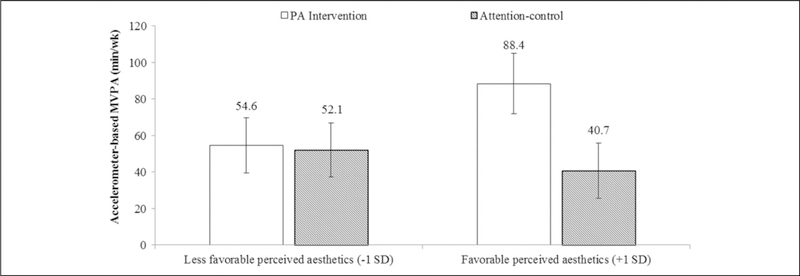
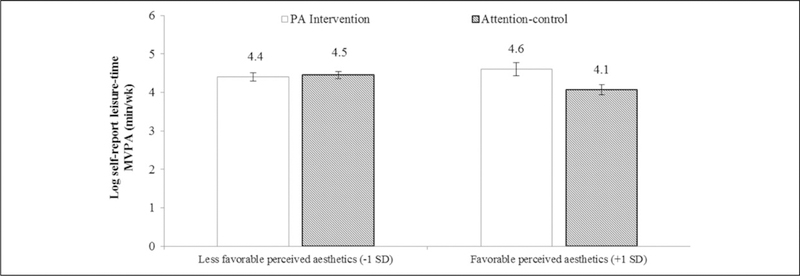
Neighborhood esthetics was the only significant moderator of intervention effects on accelerometer-based MVPA and self-report leisure-time MVPA. Participants in the PA intervention had significantly higher PA at follow-up than attention control participants, only when participants evaluated their neighborhood esthetics favorably.
Perceived neighborhood esthetics appeared to maximize the effectiveness of a multilevel PA intervention among Latinas. For sustainable PA behavior change, the environments in which Latinas are encouraged to be active may need to be evaluated prior to implementing an intervention to ensure they support active lifestyles.
本研究旨在检验一项多层次体育活动(PA)干预措施是否会根据参与者对其邻里环境的认知而对体育活动产生不同影响。
两组整群随机对照试验。
加利福尼亚州圣地亚哥。
分析样本包括来自各教会的319名拉丁裔女性(18 - 65岁),她们被随机分配到以下条件:体育活动组(n = 8个教会,n = 157名参与者)或注意力控制组(n = 8个教会,n = 162名参与者)。
在12个月的时间里,体育活动组的参与者可参加免费的体育活动课程(每周6次),而注意力控制组的参与者则参加癌症预防工作坊。
基线和12个月随访时的测量指标包括自我报告以及基于加速度计的中度至剧烈体育活动(MVPA)、社会人口统计学特征和邻里环境感知变量。
混合效应模型在12个月随访时检查每个体育活动结果,并对教会聚类、基线体育活动和社会人口统计学特征进行了调整。我们测试了7个基线环境感知变量与研究条件之间的相互作用。
邻里美观度是干预对基于加速度计的MVPA和自我报告的休闲时间MVPA影响的唯一显著调节因素。仅当参与者对其邻里美观度评价良好时,体育活动干预组的参与者在随访时的体育活动水平才显著高于注意力控制组的参与者。
邻里美观度似乎能使多层次体育活动干预对拉丁裔女性的效果最大化。为实现可持续的体育活动行为改变,在实施干预措施之前,可能需要对鼓励拉丁裔女性积极活动的环境进行评估,以确保这些环境支持积极的生活方式。