Chadi Nicholas, Kaufman Miriam, Weisbaum Elli, Malboeuf-Hurtubise Catherine, Kohut Sara Ahola, Viner Christine, Locke Jake, Vo Dzung X
Division of Adolescent Medicine, Department of Pediatrics, Hospital for Sick Children, University of Toronto, Toronto, ON, Canada.
Department of Pediatrics, Boston Children's Hospital, Harvard Medical School, Boston, MA, United States.
JMIR Res Protoc. 2017 Nov 27;6(11):e241. doi: 10.2196/resprot.7700.
Eight-week mindfulness-based interventions (MBIs) have a beneficial impact on mental health and well-being in adolescents with chronic health conditions. Usually delivered in person in a group setting, these programs are difficult to access for teens with disabilities or who do not have in-person MBIs available in their communities.
This paper outlines the rationale, development, and design of a randomized controlled trial comparing the effects of an MBI delivered in person or via eHealth in adolescents with a chronic illness. Quantitative outcomes will include mindfulness skills acquisition (primary outcome), effects of the MBI on self-reported mood, anxiety, self-esteem, illness perception, and physiological stress (via salivary cortisol), and qualitative outcomes will include individual practice, participant appreciation, and adaptation of the MBI for eHealth.
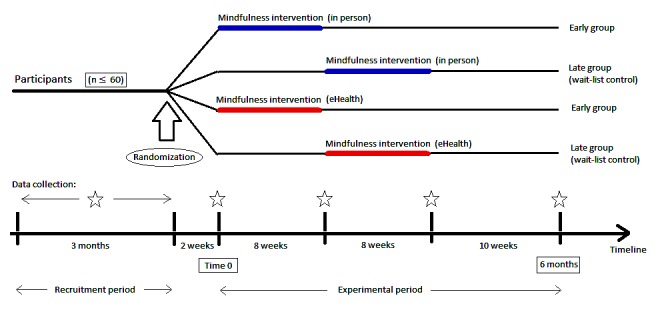
This is a randomized noninferiority mixed methods study comparing 2 MBI arms: in-person and eHealth. Participants are eligible to participate if they are aged 13 to 18 years, have a diagnosis of chronic medical condition, live close enough to the recruitment hospital to participate in the in-person arm of the study, and are currently followed by a health care provider. Each participant will receive an adapted 8-week MBI delivered either in person at a tertiary pediatric hospital or via a secure audio-visual platform allowing group interactions in real time. Groups will be facilitated by 2 experienced mindfulness providers. Quantitative and qualitative data will be collected through standardized research questionnaires administered via a secure, youth-friendly online platform and through semistructured interviews, participant log books, facilitator log books, and salivary cortisol analysis. Qualitative data will be analyzed using a grounded theory model.
Data collection is currently underway. Data analysis, manuscript writing, and additional publications are expected to be completed in the winter and spring of 2018.
Based on previous results from in-person trials conducted in adolescents and eHealth trials conducted in adults, we anticipate that both modes of delivery will significantly improve mindfulness skills acquisition, mood, anxiety, self-esteem, illness perception, and stress and that the magnitude of the effects will be correlated to the level of home practice. We predict that participants in both arms will show similar levels of home practice and that both modes of delivery will have high levels of feasibility and acceptability. If successful, this study could provide evidence for the use of eHealth in the delivery of 8-week MBIs in clinical adolescent populations, potentially increasing availability to MBIs for a large group of youth with mobility issues or living away from large urban centers.
ClinicalTrials.org NCT03067207; https://clinicaltrials.gov/ct2/show/NCT03067207 (archived by WebCite at http://www.webcitation.org/6v4ZK8RBH).
为期八周的正念干预(MBIs)对患有慢性疾病的青少年的心理健康和幸福感有有益影响。这些项目通常在团体环境中面对面开展,残疾青少年或其社区没有面对面正念干预项目的青少年难以参与。
本文概述了一项随机对照试验的基本原理、开发和设计,该试验比较了面对面或通过电子健康方式为患有慢性疾病的青少年提供正念干预的效果。定量结果将包括正念技能的获得(主要结果)、正念干预对自我报告的情绪、焦虑、自尊、疾病认知和生理压力(通过唾液皮质醇)的影响,定性结果将包括个人练习、参与者满意度以及正念干预对电子健康的适应性。
这是一项随机非劣效性混合方法研究,比较两个正念干预组:面对面组和电子健康组。年龄在13至18岁、被诊断患有慢性疾病、居住距离招募医院足够近以参与研究的面对面组且目前有医疗保健提供者随访的参与者有资格参与。每位参与者将接受为期8周的适应性正念干预,可在三级儿科医院面对面进行,或通过安全的视听平台进行,该平台允许实时进行团体互动。小组将由2名经验丰富的正念提供者指导。定量和定性数据将通过经由安全、对青少年友好的在线平台管理的标准化研究问卷以及通过半结构化访谈、参与者日志、指导者日志和唾液皮质醇分析来收集。定性数据将使用扎根理论模型进行分析。
数据收集目前正在进行。数据分析、论文撰写和其他出版物预计将于2018年冬春完成。
基于先前在青少年中进行的面对面试验和在成年人中进行的电子健康试验的结果,我们预计两种交付方式都将显著提高正念技能的获得、情绪、焦虑、自尊、疾病认知和压力,并且效果的程度将与家庭练习的水平相关。我们预测两组参与者的家庭练习水平将相似,并且两种交付方式都将具有较高的可行性和可接受性。如果成功,本研究可为在临床青少年人群中使用电子健康提供为期8周的正念干预提供证据,可能会增加大量有行动不便问题或居住在远离大城市中心地区的青少年获得正念干预的机会。
ClinicalTrials.org NCT03067207;https://clinicaltrials.gov/ct2/show/NCT03067207(由WebCite存档于http://www.webcitation.org/6v4ZK8RBH)。
