Khandwala Yash S, Raheem Omer A, Ali Mir Amaan, Hsieh Tung-Chin
1 Department of Urology, University of California San Diego, La Jolla, CA, USA.
2 University of California San Diego School of Medicine, La Jolla, CA, USA.
Am J Mens Health. 2018 Mar;12(2):472-478. doi: 10.1177/1557988317743152. Epub 2017 Nov 28.
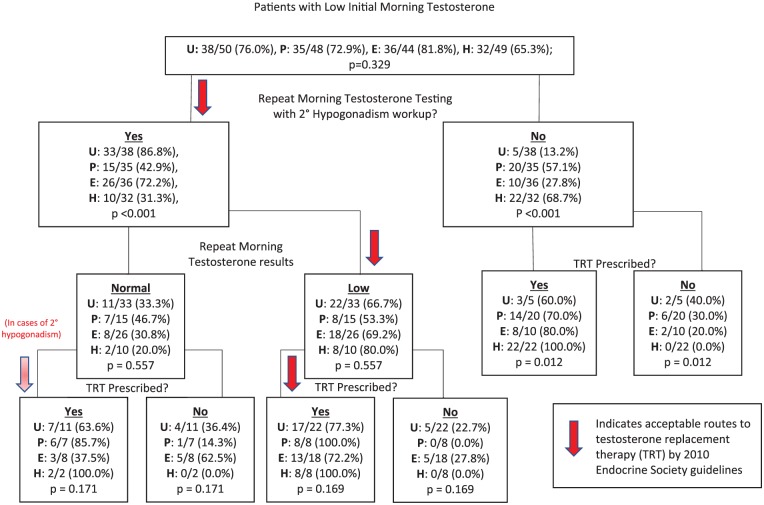
The objective of the current study was to measure the adherence of guideline-based evaluation and treatment of hypogonadism by medical specialty. A retrospective review was performed analyzing patients from a single academic institution within the past 10 years. The cohort of 193 men was grouped according to medical specialty of the diagnosing physician (50 urology, 49 primary care, 44 endocrinology, and 50 HIV medicine). Adherence to guidelines was assessed using the Endocrine Society's criteria. Primary care patients were older compared to the rest of the cohort ( p < .001) but BMI and cardiovascular risk factors were similar ( p = .900). Patients treated by urologists and endocrinologists had the highest percentage of low testosterone findings at initial encounter at 72% ( p < .001). Sixty-two percent of urology patients had low LH or FSH compared to 63.6% for endocrinology and 16% for primary care ( p < .001). As for brain MRI findings, no urology patients had positive findings (0/9) while eight pituitary adenomas (40%) were found by endocrinologists. Forty-five percent of men treated by urologists received TRT without repeat confirmation, compared to 58% of endocrinologists, 77% of primary care, and 88% of HIV medicine ( p < .001). All urology patients had PSA checked before TRT compared to 77.5% of primary care and 61.2% of endocrinology patients ( p = .063). Adherence to the guidelines helps prevent undue over-diagnosis and over-treatment of hypogonadism. This study suggests that adherence to guideline-based screening is varied among specialties.
本研究的目的是按医学专业衡量性腺功能减退基于指南的评估和治疗的依从性。进行了一项回顾性研究,分析过去10年内来自单一学术机构的患者。193名男性队列根据诊断医师的医学专业分组(50名泌尿外科医师、49名初级保健医师、44名内分泌科医师和50名艾滋病医学医师)。使用内分泌学会的标准评估对指南的依从性。与队列其他患者相比,初级保健患者年龄更大(p <.001),但体重指数和心血管危险因素相似(p =.900)。泌尿外科医师和内分泌科医师治疗的患者在初次就诊时睾酮水平低的比例最高,为72%(p <.001)。62%的泌尿外科患者促黄体生成素或促卵泡生成素水平低,而内分泌科为63.6%,初级保健科为16%(p <.001)。至于脑部磁共振成像结果,没有泌尿外科患者有阳性发现(0/9),而内分泌科医师发现了8例垂体腺瘤(40%)。泌尿外科医师治疗的男性中有45%在未重复确认的情况下接受了睾酮替代疗法(TRT),相比之下,内分泌科医师为58%,初级保健科为77%,艾滋病医学科为88%(p <.001)。所有泌尿外科患者在接受TRT前都进行了前列腺特异性抗原(PSA)检查,相比之下,初级保健科患者为77.5%,内分泌科患者为61.2%(p =.063)。遵循指南有助于防止性腺功能减退的过度诊断和过度治疗。本研究表明,各专业对基于指南的筛查的依从性各不相同。