Department of Pathology, University of Otago, Christchurch, New Zealand.
Genetics and Computational Biology Division, QIMR Berghofer Medical Research Institute, Queensland, Australia.
Breast Cancer Res. 2017 Nov 28;19(1):127. doi: 10.1186/s13058-017-0919-1.
Laboratory assays evaluating the effect of DNA sequence variants on BRCA1 mRNA splicing may contribute to classification by providing molecular evidence. However, our knowledge of normal and aberrant BRCA1 splicing events to date has been limited to data derived from assays targeting partial transcript sequences. This study explored the utility of nanopore sequencing to examine whole BRCA1 mRNA transcripts and to provide accurate categorisation of in-frame and out-of-frame splicing events.
The exon structure of BRCA1 transcripts from a previously studied control lymphoblastoid cell line were assessed using MinION nanopore sequencing of long-range reverse transcriptase-PCR amplicons.
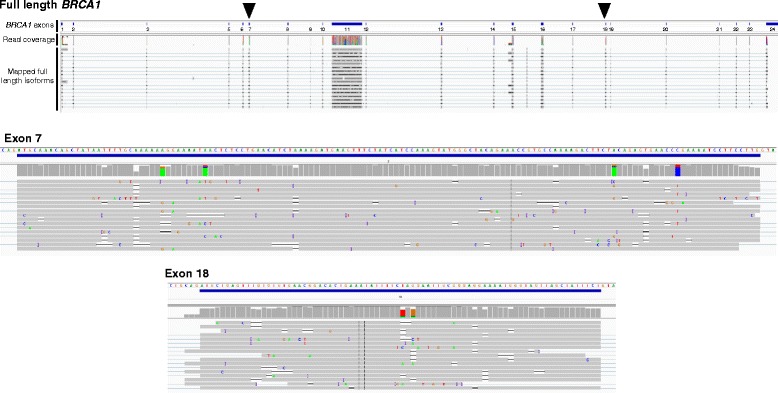
Our study identified and characterised 32 complete BRCA1 isoforms, including 18 novel isoforms which showed skipping of multiple contiguous and/or non-contiguous exons. Furthermore, we show that known BRCA1 exon skipping events, such as Δ(9,10) and Δ21, can co-occur in a single transcript, with some isoforms containing four or more alternative splice junctions. Fourteen novel isoforms were formed entirely from a combination of previously identified alternative splice junctions, suggesting that the total number of BRCA1 isoforms might be lower than the number of splicing events reported previously.
Our results highlight complexity in BRCA1 transcript structure that has not been described previously. This finding has key implications for predicting the translation frame of splicing transcripts, important for interpreting the clinical significance of spliceogenic variants. Future research is warranted to quantitatively assess full-length BRCA1 transcript levels, and to assess the application of nanopore sequencing for routine evaluation of potential spliceogenic variants.
评估 DNA 序列变异对 BRCA1 mRNA 剪接影响的实验室检测可通过提供分子证据来辅助分类。然而,迄今为止,我们对正常和异常 BRCA1 剪接事件的了解仅限于针对部分转录本序列的检测方法。本研究探索了纳米孔测序在检测完整 BRCA1 mRNA 转录本中的应用,以提供对框架内和框架外剪接事件的准确分类。
使用 MinION 纳米孔测序长距离逆转录酶-PCR 扩增子,评估来自先前研究的对照淋巴母细胞系中 BRCA1 转录本的外显子结构。
我们的研究鉴定并描述了 32 种完整的 BRCA1 异构体,包括 18 种新的异构体,它们显示多个连续和/或非连续外显子的跳跃。此外,我们表明,已知的 BRCA1 外显子跳跃事件,如Δ(9,10)和Δ21,可在单个转录本中同时发生,一些异构体包含四个或更多的替代剪接接头。14 种新的异构体完全由先前鉴定的替代剪接接头组合而成,这表明 BRCA1 异构体的总数可能低于以前报道的剪接事件数量。
我们的结果突出了 BRCA1 转录本结构的复杂性,这是以前没有描述过的。这一发现对预测剪接转录本的翻译框架具有关键意义,这对解释剪接变异的临床意义很重要。需要进一步的研究来定量评估全长 BRCA1 转录本水平,并评估纳米孔测序在常规评估潜在剪接变异中的应用。