Department of Microbiology, Ramón y Cajal Institute for Health Research (IRYCIS), Ramón y Cajal University Hospital, CIBERESP, Madrid, Spain
Centro Nacional de Biotecnología, CSIC, Madrid, Spain.
mBio. 2017 Nov 28;8(6):e01950-17. doi: 10.1128/mBio.01950-17.
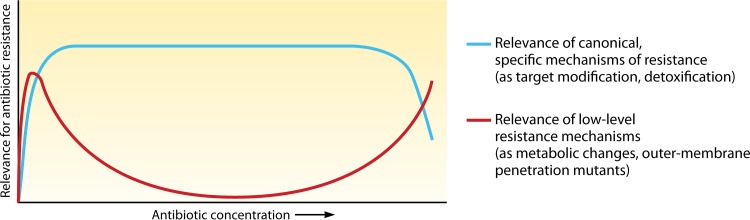
Antibiotics act on bacterial metabolism, and antibiotic resistance involves changes in this metabolism. Interventions on metabolism with drugs might therefore modify drug susceptibility and drug resistance. In their recent article, Martin Vestergaard et al. (mBio 8:e01114-17, 2017, https://doi.org/10.1128/mBio.01114-17) illustrate the possibility of converting intrinsically resistant bacteria into susceptible ones. They reported that inhibition of a central metabolic enzyme, ATP synthase, allows otherwise ineffective polymyxin antibiotics to act on The study of the intrinsic resistome of bacterial pathogens has shown that several metabolic genes, including multigene transcriptional regulators, contribute to antibiotic resistance. In some cases, these genes only marginally increase antibiotic resistance, but reduced levels of susceptibility might be critical in the evolution or resistance under low antibiotic concentrations or in the clinical response of highly resistant bacteria. Drug interventions on bacterial metabolism might constitute a critical adjuvant therapy in combination with antibiotics to ensure susceptibility of pathogens with intrinsic or acquired antimicrobial resistance.
抗生素作用于细菌代谢,而抗生素耐药性涉及这种代谢的变化。因此,用药物干预代谢可能会改变药物敏感性和耐药性。在他们最近的文章中,Martin Vestergaard 等人(mBio 8:e01114-17, 2017, https://doi.org/10.1128/mBio.01114-17)说明了将固有耐药菌转化为敏感菌的可能性。他们报告称,抑制中央代谢酶三磷酸腺苷合酶可使原本无效的多粘菌素类抗生素对固有耐药菌发挥作用。研究细菌病原体的固有耐药组发现,包括多基因转录调节因子在内的几个代谢基因与抗生素耐药性有关。在某些情况下,这些基因仅略微增加抗生素耐药性,但降低的敏感性水平在抗生素浓度较低时的进化或耐药性或高度耐药细菌的临床反应中可能是关键的。针对细菌代谢的药物干预可能构成抗生素联合应用的重要辅助治疗,以确保固有或获得性抗微生物耐药性病原体的敏感性。