Kim Mitchell, Mitchell Steven H, Gatewood Medley, Bennett Katherine A, Sutton Paul R, Crawford Carol A, Bentov Itay, Damodarasamy Mamatha, Kaplan Stephen J, Reed May J
Department of Emergency Medicine, University of Washington.
Division of Gerontology and Geriatric Medicine, Department of Medicine, University of Washington.
Drug Healthc Patient Saf. 2017 Nov 8;9:105-112. doi: 10.2147/DHPS.S143341. eCollection 2017.
Older adults are susceptible to adverse effects from opioids, nonsteroidal anti-inflammatory drugs (NSAIDs), and benzodiazepines (BZDs). We investigated factors associated with the administration of elevated doses of these medications of interest to older adults (≥65 years old) in the emergency department (ED).
ED records were queried for the administration of medications of interest to older adults at two academic medical center EDs over a 6-month period. Frequency of recommended versus elevated ("High doses" were defined as doses that ranged between 1.5 and 3 times higher than the recommended starting doses; "very high doses" were defined as higher than high doses) starting doses of medications, as determined by geriatric pharmacy/medicine guidelines and expert consensus, was compared by age groups (65-69, 70-74, 75-79, 80-84, and ≥85 years), gender, and hospital.
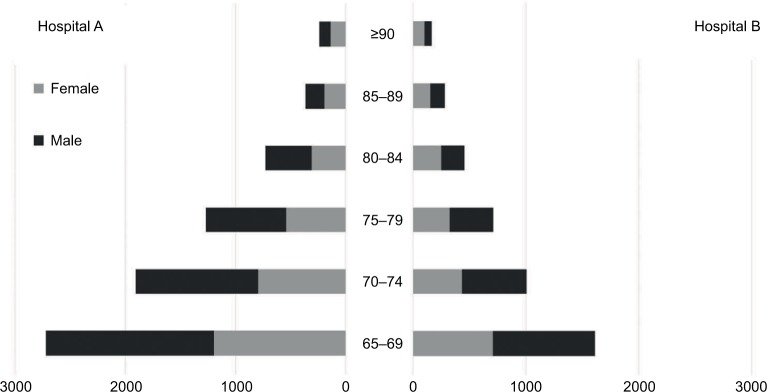
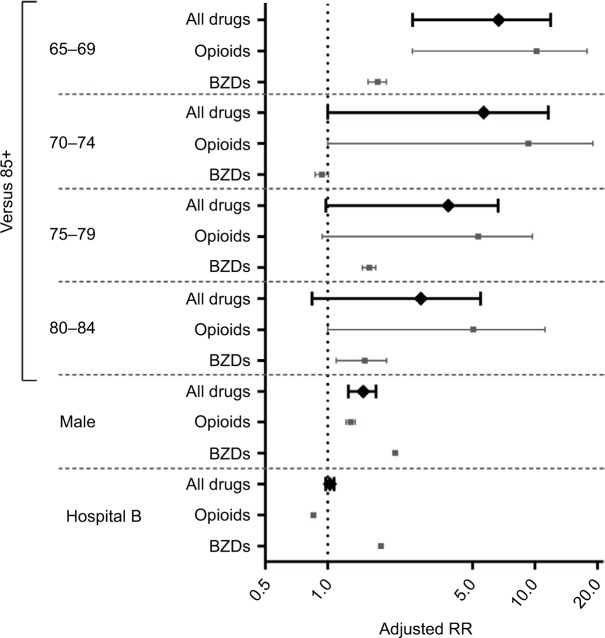
There were 17896 visits representing 11374 unique patients >65 years of age (55.3% men, 44.7% women). A total of 3394 doses of medications of interest including 1678 high doses and 684 very high doses were administered to 1364 different patients. Administration of elevated doses of medications was more common than that of recommended doses. Focusing on opioids and BZDs, the 65-69-year age group was much more likely to receive very high doses (1481 and 412 doses, respectively) than the ≥85-year age groups (relative risk [RR] 5.52, 95% CI 2.56-11.90), mainly reflecting elevated opioid dosing (RR 8.28, 95% CI 3.69-18.57). Men were more likely than women to receive very high doses (RR 1.47, 95% CI 1.26-1.72), primarily due to BZDs (RR 2.12, 95% CI 2.07-2.16).
Administration of elevated doses of opioids and BZDs in the older population occurs frequently in the ED, especially to the 65-69-year age group and men. Further attention to potentially unsafe dosing of high-risk medications to older adults in the ED is warranted.
老年人易受阿片类药物、非甾体抗炎药(NSAIDs)和苯二氮䓬类药物(BZDs)不良反应的影响。我们调查了急诊科(ED)中与给65岁及以上老年人使用高剂量这些相关药物有关的因素。
查询了两个学术医疗中心急诊科在6个月期间给老年人使用相关药物的急诊记录。根据老年药学/医学指南和专家共识确定的推荐起始剂量与高剂量(“高剂量”定义为比推荐起始剂量高1.5至3倍的剂量;“极高剂量”定义为高于高剂量)的药物起始剂量频率,按年龄组(65 - 69岁、70 - 74岁、75 - 79岁、80 - 84岁和85岁及以上)、性别和医院进行比较。
共有17896次就诊,代表11374名65岁以上的独特患者(男性占55.3%,女性占44.7%)。总共向1364名不同患者施用了3394剂相关药物,包括1678剂高剂量和684剂极高剂量。高剂量药物的施用比推荐剂量更为常见。聚焦于阿片类药物和苯二氮䓬类药物,65 - 69岁年龄组比85岁及以上年龄组更有可能接受极高剂量(分别为1481剂和412剂)(相对风险[RR] 5.52,95%置信区间2.56 - 11.90),主要反映阿片类药物剂量增加(RR 8.28,95%置信区间3.69 - 18.57)。男性比女性更有可能接受极高剂量(RR 1.47,95%置信区间1.26 - 1.72),主要是由于苯二氮䓬类药物(RR 2.12,95%置信区间2.07 - 2.16)。
在急诊科,老年人群中高剂量阿片类药物和苯二氮䓬类药物的施用很常见,尤其是在65 - 69岁年龄组和男性中。有必要进一步关注急诊科中给老年人使用高风险药物时潜在的不安全剂量问题。