• 文献检索
  • 文档翻译
  • 深度研究
  • 学术资讯
  • Suppr Zotero 插件Zotero 插件
  • 邀请有礼
  • 套餐&价格
  • 历史记录
应用&插件
Suppr Zotero 插件Zotero 插件浏览器插件Mac 客户端Windows 客户端微信小程序
定价
高级版会员购买积分包购买API积分包
服务
文献检索文档翻译深度研究API 文档MCP 服务
关于我们
关于 Suppr公司介绍联系我们用户协议隐私条款
关注我们

Suppr 超能文献

核心技术专利:CN118964589B侵权必究
粤ICP备2023148730 号-1Suppr @ 2026

文献检索

告别复杂PubMed语法,用中文像聊天一样搜索,搜遍4000万医学文献。AI智能推荐,让科研检索更轻松。

立即免费搜索

文件翻译

保留排版,准确专业,支持PDF/Word/PPT等文件格式,支持 12+语言互译。

免费翻译文档

深度研究

AI帮你快速写综述,25分钟生成高质量综述,智能提取关键信息,辅助科研写作。

立即免费体验

家族性进行性色素沉着过多和过少:一个中国家系的报告及遗传异质性证据

Familial progressive hyper- and hypopigmentation: a report on a Chinese family and evidence for genetic heterogeneity.

作者信息

Xiao-Kai Fang, Yue-Xi He, Yan-Jia Li, Li-Rong Chen, He-Peng Wang, Qing Sun

机构信息

School of Medicine, Shandong University - Jinan, China.

Department of Dermatology, The First Hospital of HeBei Medical University - Shijiazhuang, China.

出版信息

An Bras Dermatol. 2017 May-Jun;92(3):329-333. doi: 10.1590/abd1806-4841.20175567.

DOI:10.1590/abd1806-4841.20175567
PMID:29186243
原文链接:https://pmc.ncbi.nlm.nih.gov/articles/PMC5514571/
Abstract

BACKGROUND

Familial progressive hyper- and hypopigmentation (FPHH) is a rare genodermatosis that is characterized by diffuse hyper- and hypopigmented spots on the skin and mucous membranes. It is caused by a pathogenic mutation of the KITLG gene.

OBJECTIVES

To investigate the clinical features and mutation of the KITLG gene in a Chinese family with FPHH.

METHODS

Histopathological and immunohistochemical analysis of lesions from the proband was performed. The KITLG gene was screened for the presence of mutations.

RESULTS

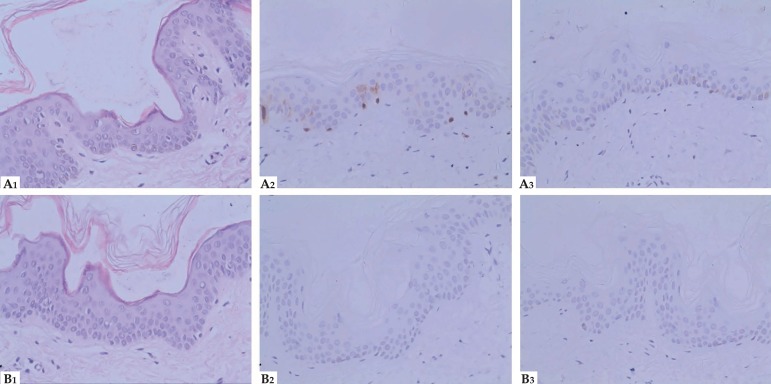
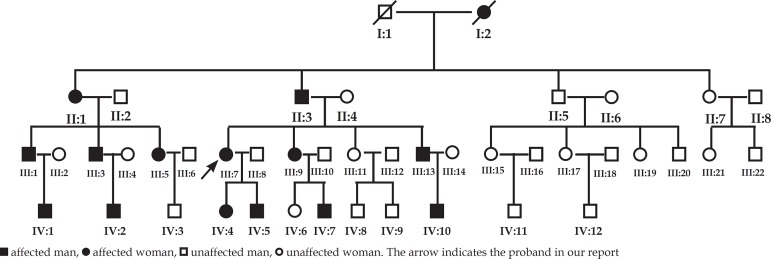
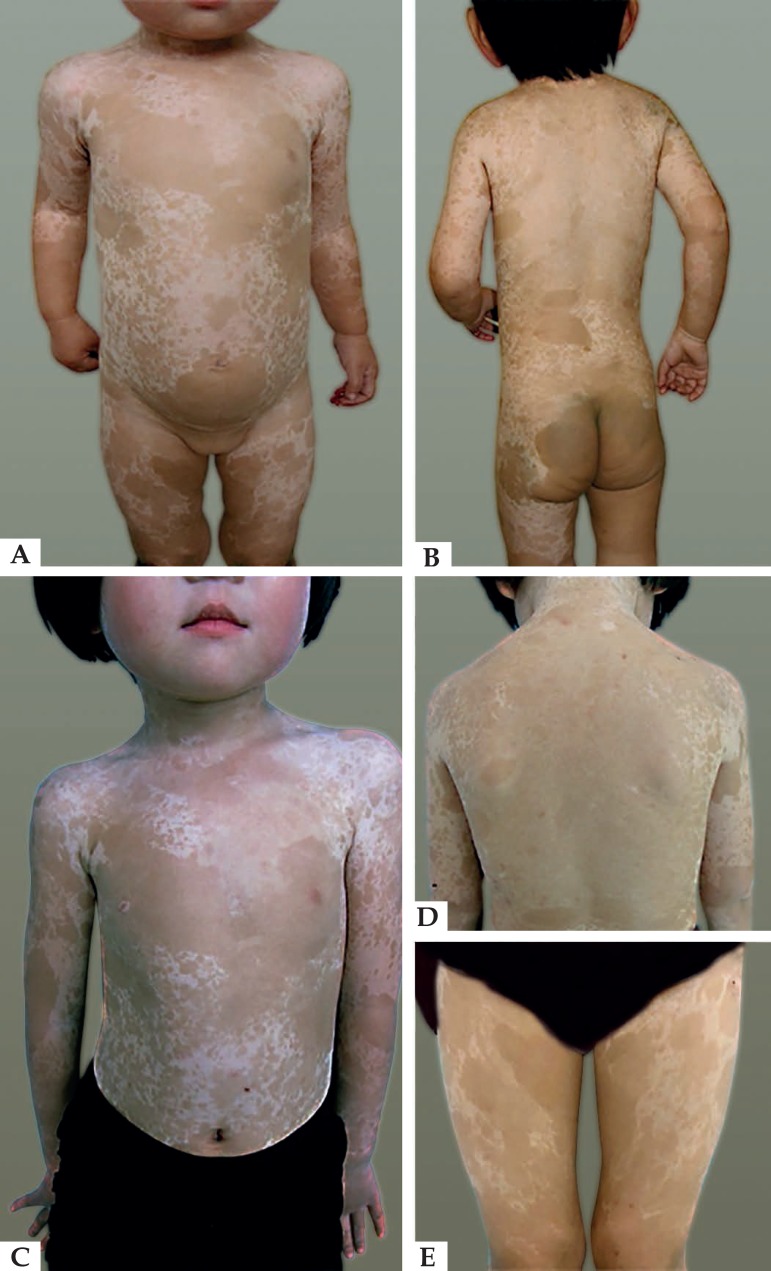
A Chinese family containing 14 individuals with FPHH was described, and the proband was a 5-year-old girl showing diffuse hyper- and hypopigmented lesions on her extremities and trunk. Histopathological and immunohistochemical staining for S100 and HMB45 of skin biopsy specimens from the hyperpigmented areas showed a striking increase in melanin throughout the epidermis, especially in the basal cell layer, and staining of hypopigmented area specimens displayed lower levels of melanin in the epidermis. Mutation analysis of the KITLG gene was performed, but no mutation was found.

STUDY LIMITATIONS

The new pathogenic gene was not found.

CONCLUSION

A family with FPHH was described. Analysis revealed that its members did not have any mutations of the KITLG gene, which provided evidence for genetic heterogeneity of this genodermatosis.

摘要

背景

家族性进行性色素沉着过多和过少症(FPHH)是一种罕见的遗传性皮肤病,其特征为皮肤和黏膜上出现弥漫性色素沉着过多和过少斑点。它由KITLG基因突变引起。

目的

研究一个患FPHH的中国家系的临床特征及KITLG基因的突变情况。

方法

对先证者的皮损进行组织病理学和免疫组化分析。筛查KITLG基因是否存在突变。

结果

描述了一个包含14名FPHH患者的中国家系,先证者为一名5岁女孩,其四肢和躯干有弥漫性色素沉着过多和过少性损害。对色素沉着过多区域的皮肤活检标本进行S100和HMB45的组织病理学和免疫组化染色显示,整个表皮黑色素显著增加,尤其是在基底细胞层,而色素沉着过少区域标本的染色显示表皮中黑色素水平较低。对KITLG基因进行了突变分析,但未发现突变。

研究局限性

未发现新的致病基因。

结论

描述了一个FPHH家系。分析显示其成员没有KITLG基因的任何突变,这为这种遗传性皮肤病的遗传异质性提供了证据。
https://cdn.ncbi.nlm.nih.gov/pmc/blobs/2dcb/5514571/874d78c7f6de/abd-92-03-0329-g03.jpg
https://cdn.ncbi.nlm.nih.gov/pmc/blobs/2dcb/5514571/9459d265a977/abd-92-03-0329-g01.jpg
https://cdn.ncbi.nlm.nih.gov/pmc/blobs/2dcb/5514571/dedfab9ac87c/abd-92-03-0329-g02.jpg
https://cdn.ncbi.nlm.nih.gov/pmc/blobs/2dcb/5514571/874d78c7f6de/abd-92-03-0329-g03.jpg
https://cdn.ncbi.nlm.nih.gov/pmc/blobs/2dcb/5514571/9459d265a977/abd-92-03-0329-g01.jpg
https://cdn.ncbi.nlm.nih.gov/pmc/blobs/2dcb/5514571/dedfab9ac87c/abd-92-03-0329-g02.jpg
https://cdn.ncbi.nlm.nih.gov/pmc/blobs/2dcb/5514571/874d78c7f6de/abd-92-03-0329-g03.jpg

相似文献

1
Familial progressive hyper- and hypopigmentation: a report on a Chinese family and evidence for genetic heterogeneity.家族性进行性色素沉着过多和过少:一个中国家系的报告及遗传异质性证据
An Bras Dermatol. 2017 May-Jun;92(3):329-333. doi: 10.1590/abd1806-4841.20175567.
2
Identification of a novel mutation in the KITLG gene in a Chinese family with familial progressive hyper- and hypopigmentation.在中国一个家族性进行性色素过度沉着和色素减退症的家系中鉴定到 KITLG 基因的一个新突变。
BMC Med Genomics. 2021 Jan 6;14(1):12. doi: 10.1186/s12920-020-00851-5.
3
KITLG mutations cause familial progressive hyper- and hypopigmentation.KITLG 突变导致家族性进行性色素过多和过少。
J Invest Dermatol. 2011 Jun;131(6):1234-9. doi: 10.1038/jid.2011.29. Epub 2011 Mar 3.
4
Novel mutation in the KITLG gene in familial progressive hyperpigmentation with or without hypopigmentation.家族性进行性色素沉着伴或不伴色素减退症中 KITLG 基因的新突变。
J Dermatol. 2020 Jun;47(6):669-672. doi: 10.1111/1346-8138.15313. Epub 2020 Mar 18.
5
De novo mutation in KITLG gene causes a variant of Familial Progressive Hyper- and Hypo-pigmentation (FPHH).KITLG 基因中的新生突变导致家族性进行性色素沉着过度和减退(FPHH)的一种变体。
Mol Genet Genomic Med. 2021 Dec;9(12):e1841. doi: 10.1002/mgg3.1841. Epub 2021 Oct 30.
6
Familial progressive hypo- and hyperpigmentation: a variant case.家族性进行性色素减退和色素沉着:变异型病例。
Indian J Dermatol Venereol Leprol. 2012 May-Jun;78(3):350-3. doi: 10.4103/0378-6323.95453.
7
[Clinical phenotype and genetic analysis of a Chinese pedigree affected with familial progressive hyperpigmentation and hypopigmentation].一个中国家族性进行性色素沉着和色素减退家系的临床表型与遗传学分析
Zhonghua Yi Xue Yi Chuan Xue Za Zhi. 2022 Dec 10;39(12):1360-1365. doi: 10.3760/cma.j.cn511374-20211123-00932.
8
Familial progressive hyper- and hypopigmentation and malignancy in two families with new mutations in KITLG.两个携带KITLG新突变的家族中的家族性进行性色素沉着过多和过少及恶性肿瘤
Clin Exp Dermatol. 2015 Dec;40(8):860-4. doi: 10.1111/ced.12702. Epub 2015 Jul 14.
9
Report of a child with sporadic familial progressive hyper- and hypopigmentation caused by a novel KITLG mutation.一例由新型KITLG突变引起的散发性家族性进行性色素沉着与色素减退患儿的报告。
Br J Dermatol. 2016 Dec;175(6):1369-1371. doi: 10.1111/bjd.14694. Epub 2016 Sep 27.
10
A case of familial progressive hyperpigmentation with or without hypopigmentation presenting with hypopigmented striae along the lines of Blaschko.一例伴有或不伴有色素减退的家族性进行性色素沉着,沿Blaschko线出现色素减退条纹。
J Dermatol. 2025 Jan;52(1):159-162. doi: 10.1111/1346-8138.17459. Epub 2024 Sep 13.

引用本文的文献

1
Identification of a novel mutation in the KITLG gene in a Chinese family with familial progressive hyper- and hypopigmentation.在中国一个家族性进行性色素过度沉着和色素减退症的家系中鉴定到 KITLG 基因的一个新突变。
BMC Med Genomics. 2021 Jan 6;14(1):12. doi: 10.1186/s12920-020-00851-5.
2
Cutaneous findings in Fanconi anemia.范可尼贫血的皮肤表现。
J Am Acad Dermatol. 2021 Nov;85(5):1253-1258. doi: 10.1016/j.jaad.2020.08.047. Epub 2020 Aug 18.

本文引用的文献

1
Familial progressive hyper- and hypopigmentation and malignancy in two families with new mutations in KITLG.两个携带KITLG新突变的家族中的家族性进行性色素沉着过多和过少及恶性肿瘤
Clin Exp Dermatol. 2015 Dec;40(8):860-4. doi: 10.1111/ced.12702. Epub 2015 Jul 14.
2
Incontinentia pigmenti.色素失禁症
An Bras Dermatol. 2014 Jan-Feb;89(1):26-36. doi: 10.1590/abd1806-4841.20142584.
3
Familial progressive hyperpigmentation: a case report.家族性进行性色素沉着症:一例报告
Case Rep Dent. 2012;2012:840167. doi: 10.1155/2012/840167. Epub 2012 Apr 18.
4
Familial progressive hypo- and hyperpigmentation: a variant case.家族性进行性色素减退和色素沉着:变异型病例。
Indian J Dermatol Venereol Leprol. 2012 May-Jun;78(3):350-3. doi: 10.4103/0378-6323.95453.
5
KITLG mutations cause familial progressive hyper- and hypopigmentation.KITLG 突变导致家族性进行性色素过多和过少。
J Invest Dermatol. 2011 Jun;131(6):1234-9. doi: 10.1038/jid.2011.29. Epub 2011 Mar 3.
6
Familial progressive hypermelanosis in Indian monozygotic twins.印度单卵双胞胎中的家族性进行性色素沉着症。
Pediatr Dermatol. 2011 Jan-Feb;28(1):62-5. doi: 10.1111/j.1525-1470.2010.01361.x. Epub 2011 Jan 25.
7
Hereditary congenital hypopigmented and hyperpigmented macules (Westerhof syndrome) in two siblings.两名兄弟姐妹患有遗传性先天性色素减退和色素沉着斑(韦斯特霍夫综合征)。
Br J Dermatol. 2009 Dec;161(6):1399-400. doi: 10.1111/j.1365-2133.2009.09428.x. Epub 2009 Aug 14.
8
A kindred with familial progressive hyperpigmentation-like disorder: implication of fibroblast-derived growth factors in pigmentation.家族性进行性色素沉着样疾病的同系物:成纤维细胞衍生的生长因子在色素沉着中的作用。
Eur J Dermatol. 2009 Sep-Oct;19(5):469-73. doi: 10.1684/ejd.2009.0724. Epub 2009 Jun 5.
9
Gain-of-function mutation of KIT ligand on melanin synthesis causes familial progressive hyperpigmentation.KIT配体在黑色素合成上的功能获得性突变导致家族性进行性色素沉着。
Am J Hum Genet. 2009 May;84(5):672-7. doi: 10.1016/j.ajhg.2009.03.019. Epub 2009 Apr 16.
10
Linkage of a locus determining familial progressive hyperpigmentation (FPH) to chromosome 19p13.1-pter in a Chinese family.
Eur J Dermatol. 2006 May-Jun;16(3):246-50.