Hu Liang, Chen Youfang, Liu Meicun
Geography and Planning School Sun Yat-sen University Guangzhou China.
Ecol Evol. 2017 Oct 8;7(22):9405-9414. doi: 10.1002/ece3.3479. eCollection 2017 Nov.
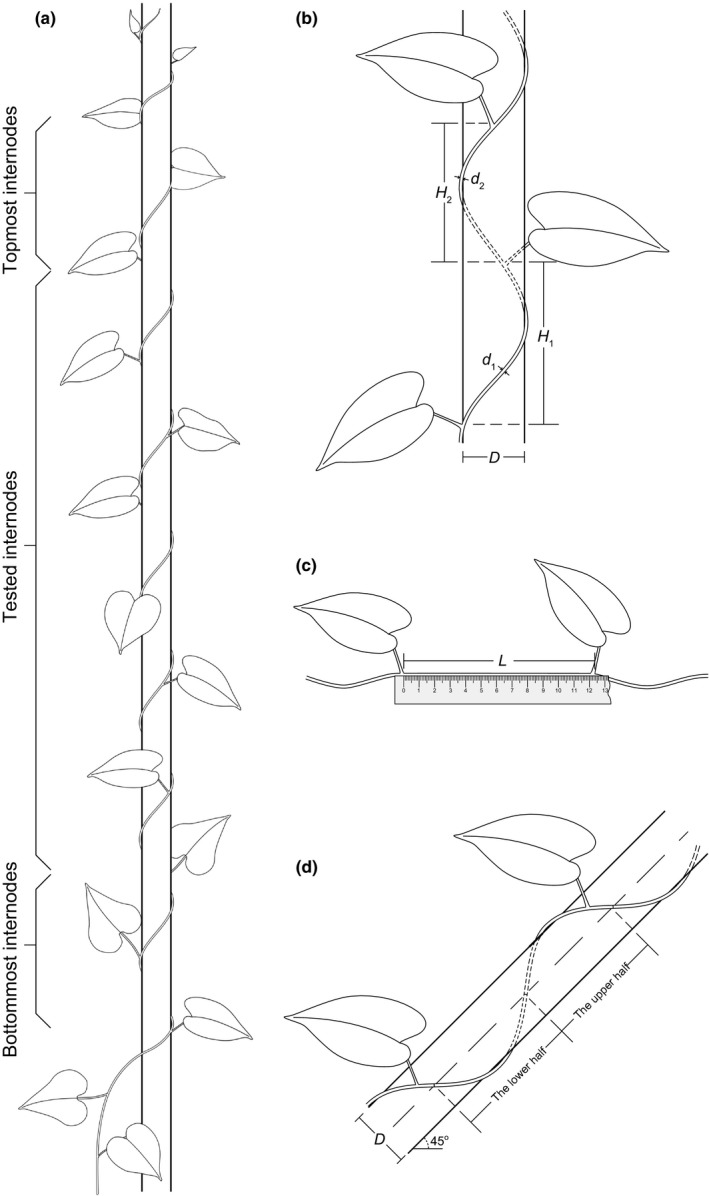
The curvature of the helical trajectory formed by herbaceous stem-twiners has been hypothesized to be constant on uniformly sized cylindrical supports and remains constant on different supports varying in diameter. However, experimental studies on the constant curvature hypothesis have been very limited. Here, we tested the hypothesis in a series of experiments on five herbaceous stem-twiners (, , , and ). We investigated how internode characteristics (curvature [β], diameter [], and length []) and success rate (SR) of twining shoots would be affected by support thickness (), temperature (), illumination, and support inclination. The results showed that: (1) the SR of tested species decreased, but increased with increasing support thickness. The β of the twining shoots on erect cylindrical poles was not constant, but it decreased with increasing or support thickness. (2) The SR of tested species was not obviously reduced under low-temperature conditions, but their β was significantly higher and significantly lower when temperature was more than 5°C lower. (3) The SR and of two tested species significantly declined, but β increased under 50% shading stress. (4) The curvatures of upper semicycles of shoots on 45° inclined supports were not significantly different from curvatures of those shoots climb on erect supports, whereas the curvatures of lower semicycles were 40%-72% higher than curvatures of upper semicycles. : Our study illustrates that stem curvatures of a certain herbaceous stem-twiners are not constant, but rather vary in response to external support, temperature, and illumination conditions. We speculate that herbaceous stem-twiners positively adapt to wide-diameter supports by thickening their stems and by reducing their twining curvatures. This insight helps us better understand climbing processes and dynamics of stem-twiners in forest communities and ecosystems.
草本茎缠绕植物形成的螺旋轨迹的曲率被假定在尺寸均匀的圆柱形支撑物上是恒定的,并且在直径不同的不同支撑物上也保持恒定。然而,关于恒定曲率假说的实验研究非常有限。在此,我们在对五种草本茎缠绕植物(、、、和)进行的一系列实验中检验了该假说。我们研究了节间特征(曲率[β]、直径[]和长度[])以及缠绕嫩枝的成功率(SR)如何受到支撑物厚度()、温度()、光照和支撑物倾斜度的影响。结果表明:(1)受试物种的SR降低,但随着支撑物厚度增加而增加。直立圆柱形杆上缠绕嫩枝的β并非恒定,而是随着或支撑物厚度增加而降低。(2)受试物种的SR在低温条件下没有明显降低,但当温度低于5°C时,它们的β显著更高且显著更低。(3)在50%遮荫胁迫下,两个受试物种的SR和显著下降,但β增加。(4)在45°倾斜支撑物上的嫩枝上半周期的曲率与在直立支撑物上攀爬的嫩枝的曲率没有显著差异,而在下半周期的曲率比上半周期的曲率高40%-72%。:我们的研究表明,某些草本茎缠绕植物的茎曲率并非恒定,而是会因外部支撑、温度和光照条件而变化。我们推测,草本茎缠绕植物通过加厚其茎并降低其缠绕曲率来积极适应大直径支撑物。这一见解有助于我们更好地理解森林群落和生态系统中茎缠绕植物的攀爬过程和动态。