Tegegn Masresha, Arefaynie Mastewal, Tiruye Tenaw Yimer
Adolescent reproductive health service officer, family guidance association of Ethiopia (FGAE), south area office, Dessie, Ethiopia.
Public health department, college of medicine and health sciences, Wollo University, Dessie, Ethiopia.
Contracept Reprod Med. 2017 Aug 7;2:21. doi: 10.1186/s40834-017-0048-3. eCollection 2017.
The contraceptive use of women in the extended postpartum period is usually different from other times in a woman's life cycle due to the additional roles and presence of emotional changes. However, there is lack of evidence regarding women contraceptive need during this period and the extent they met their need. Therefore, the objective of this study was to assess unmet need for modern contraceptives and associated factors among women during the extended postpartum period in Dessie Town, North east Ethiopia in December 2014.
A community-based cross-sectional study was conducted among women who gave birth one year before the study period. Systematic random sampling technique was employed to recruit a total of 383 study participants. For data collection, a structured and pretested standard questionnaire was used. Descriptive statistics were done to characterize the study population using different variables. Bivariate and multiple logistic regression models were fitted to control confounding factors. Odds ratios with 95% confidence intervals were computed to identify factors associated with unmet need.
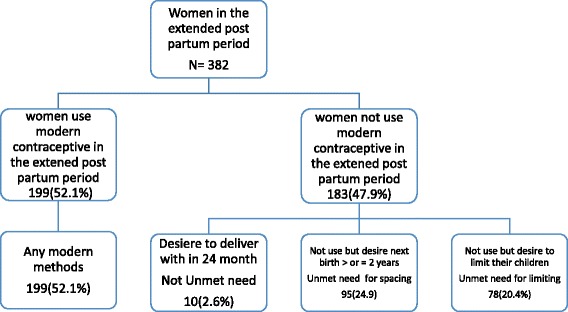
This study revealed that 44% of the extended post-partum women had unmet need of modern contraceptives of which 57% unmet need for spacing and 43% for limiting. Education of women (being illiterate) (AOR (adjusted odds ratio) =3.37, 95% CI (confidence interval) 1.22-7.57), antenatal care service (no) (AOR = 2.41, 95% CI 1.11-5.79), Post-natal care service (no) (AOR = 3.63, CI 2.13-6.19) and knowledge of lactational amenorrhea method (AOR = 7.84 95% CI 4.10-15.02) were the factors positively associated with unmet need modern contraceptives in the extended postpartum period.
The unmet need for modern contraception is high in the study area. There is need to improve the quality of maternal health service, girls education, information on postpartum risk of pregnancy on the recommended postpartum contraceptives to enable mothers make informed choices of contraceptives.
产后延长期女性的避孕方式通常与女性生命周期中的其他时期不同,这是由于她们承担了额外的角色且存在情绪变化。然而,关于这一时期女性的避孕需求以及她们的需求满足程度,目前缺乏相关证据。因此,本研究的目的是评估2014年12月在埃塞俄比亚东北部德西镇产后延长期女性中现代避孕方法的未满足需求及相关因素。
对在研究期前一年分娩的女性进行了一项基于社区的横断面研究。采用系统随机抽样技术共招募了383名研究参与者。数据收集使用了一份结构化且经过预测试的标准问卷。使用不同变量进行描述性统计以刻画研究人群特征。拟合二元和多元逻辑回归模型以控制混杂因素。计算95%置信区间的比值比以确定与未满足需求相关的因素。
本研究表明,44%的产后延长期女性有现代避孕方法的未满足需求,其中57%是间隔避孕需求未满足,43%是限制生育避孕需求未满足。女性教育程度(文盲)(调整后比值比[AOR]=3.37,95%置信区间[CI]1.22 - 7.57)、产前保健服务(未接受)(AOR = 2.41,95% CI 1.11 - 5.79)、产后保健服务(未接受)(AOR = 3.63,CI 2.13 - 6.19)以及哺乳期闭经法知识(AOR = 7.84,95% CI 4.10 - 15.02)是与产后延长期现代避孕方法未满足需求呈正相关的因素。
研究地区现代避孕的未满足需求较高。需要提高孕产妇保健服务质量、女童教育水平,提供关于产后妊娠风险以及推荐的产后避孕方法的信息,以使母亲能够做出明智的避孕选择。