Hassani Faezeh Arab, Peh Wendy Yen Xian, Gammad Gil Gerald Lasam, Mogan Roshini Priya, Ng Tze Kiat, Kuo Tricia Li Chuen, Ng Lay Guat, Luu Percy, Yen Shih-Cheng, Lee Chengkuo
Department of Electrical and Computer Engineering Faculty of Engineering National University of Singapore 4 Engineering Drive 3, #05-45 Singapore 117583 Singapore.
Singapore Institute for Neurotechnology National University of Singapore 28 Medical Dr. #05-COR Singapore 117456 Singapore.
Adv Sci (Weinh). 2017 Jul 26;4(11):1700143. doi: 10.1002/advs.201700143. eCollection 2017 Nov.
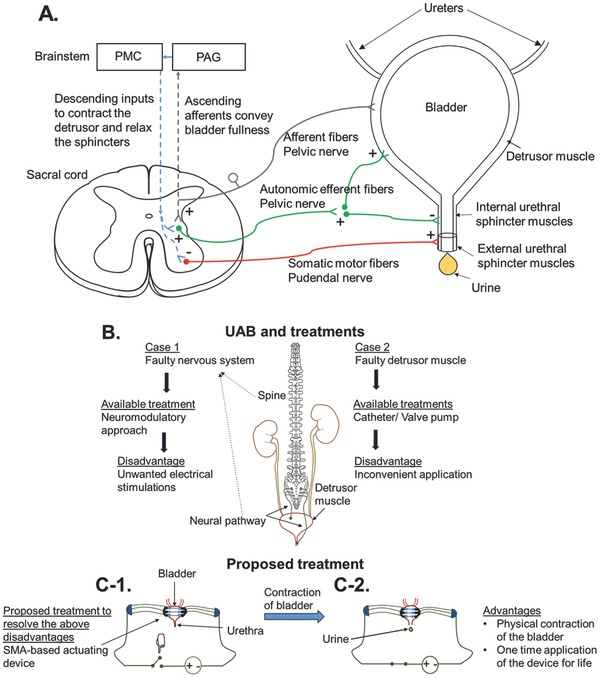
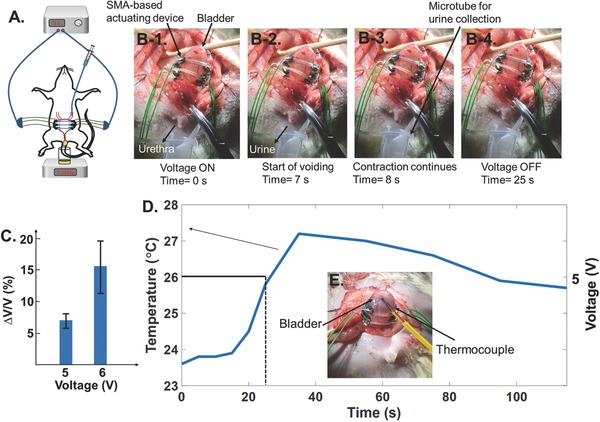
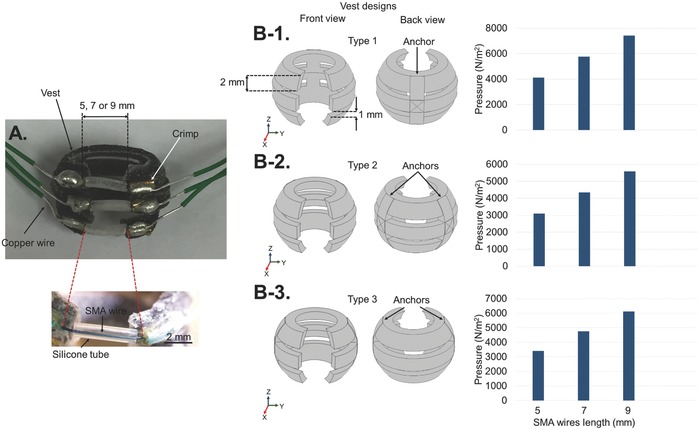
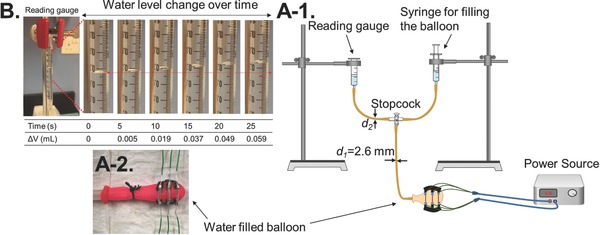
Underactive bladder or detrusor underactivity (DU) is defined as a reduction of contraction strength or duration of the bladder wall. Despite the serious healthcare implications of DU, there are limited solutions for affected individuals. A flexible 3D printed implantable device driven by shape memory alloys (SMA) actuators is presented here for the first time to physically contract the bladder to restore voluntary control of the bladder for individuals suffering from DU. This approach is used initially in benchtop experiments with a rubber balloon acting as a model for the rat bladder to verify its potential for voiding, and that the operating temperatures are safe for the eventual implantation of the device in a rat. The device is then implanted and tested on an anesthetized rat, and a voiding volume of more than 8% is successfully achieved for the SMA-based device without any surgical intervention or drug injection to relax the external sphincter.
膀胱活动低下或逼尿肌活动减退(DU)被定义为膀胱壁收缩强度或持续时间的降低。尽管DU对医疗保健有严重影响,但针对受影响个体的解决方案有限。本文首次展示了一种由形状记忆合金(SMA)致动器驱动的柔性3D打印可植入装置,用于物理收缩膀胱,以恢复DU患者对膀胱的自主控制。这种方法最初用于台式实验,用橡胶气球作为大鼠膀胱的模型,以验证其排尿潜力,以及该装置最终植入大鼠体内时的操作温度是否安全。然后将该装置植入麻醉的大鼠体内进行测试,基于SMA的装置在没有任何手术干预或药物注射以放松外括约肌的情况下,成功实现了超过8%的排尿量。