Shenzhen Key Laboratory of Affective and Social Cognitive Science, Shenzhen University, Shenzhen, 518060, China.
University Medical Center Groningen, University of Groningen, Groningen, 9713GZ, The Netherlands.
Sci Rep. 2017 Dec 4;7(1):16906. doi: 10.1038/s41598-017-17053-2.
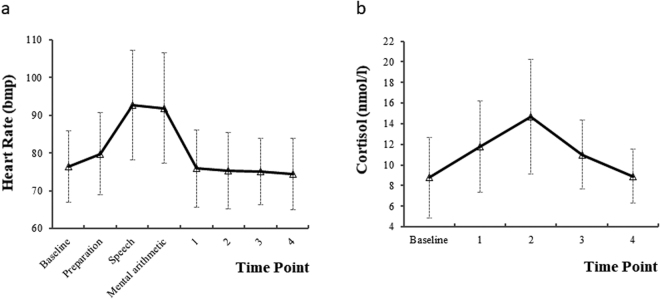
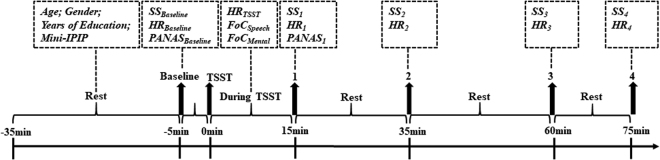
The present study examined the relationship between personality traits and the response to acute psychological stress induced by a standardized laboratory stress induction procedure (the Trier Social Stress Test, TSST). The stress response was measured with a combination of cardiovascular reactivity, hypothalamic-pituitary-adrenal axis reactivity, and subjective affect (including positive affect, negative affect and subjective controllability) in healthy individuals. The Generalized Estimating Equations (GEE) approach was applied to account for the relationship between personality traits and stress responses. Results suggested that higher neuroticism predicted lower heart rate stress reactivity, lower cortisol stress response, more decline of positive affect and lower subjective controllability. Individuals higher in extraversion showed smaller cortisol activation to stress and less increase of negative affect. In addition, higher openness score was associated with lower cortisol stress response. These findings elucidate that neuroticism, extraversion and openness are important variables associated with the stress response and different dimensions of personality trait are associated with different aspects of the stress response.
本研究考察了人格特质与通过标准化实验室应激诱导程序(Trier 社会应激测试,TSST)引起的急性心理应激反应之间的关系。在健康个体中,使用心血管反应性、下丘脑-垂体-肾上腺轴反应性和主观情感(包括正性情感、负性情感和主观可控性)的组合来测量应激反应。广义估计方程(GEE)方法用于解释人格特质与应激反应之间的关系。结果表明,较高的神经质预示着较低的心率应激反应、较低的皮质醇应激反应、正性情感的下降和较低的主观可控性。外向性较高的个体在皮质醇激活方面表现出较小的应激反应和较少的负性情感增加。此外,较高的开放性得分与较低的皮质醇应激反应相关。这些发现阐明了神经质、外向性和开放性是与应激反应相关的重要变量,不同的人格特质维度与应激反应的不同方面相关。