Shukla Anurakti, Srivastava Sudhakar, Suprasanna Penna
Institute of Environment and Sustainable Development, Banaras Hindu University, Varanasi - 221005, U.P., India.
Nuclear Agriculture & Biotechnology Division, Bhabha Atomic Research Centre, Mumbai - 400085, Maharashtra, India.
Curr Genomics. 2017 Dec;18(6):512-522. doi: 10.2174/1389202918666170608093327.
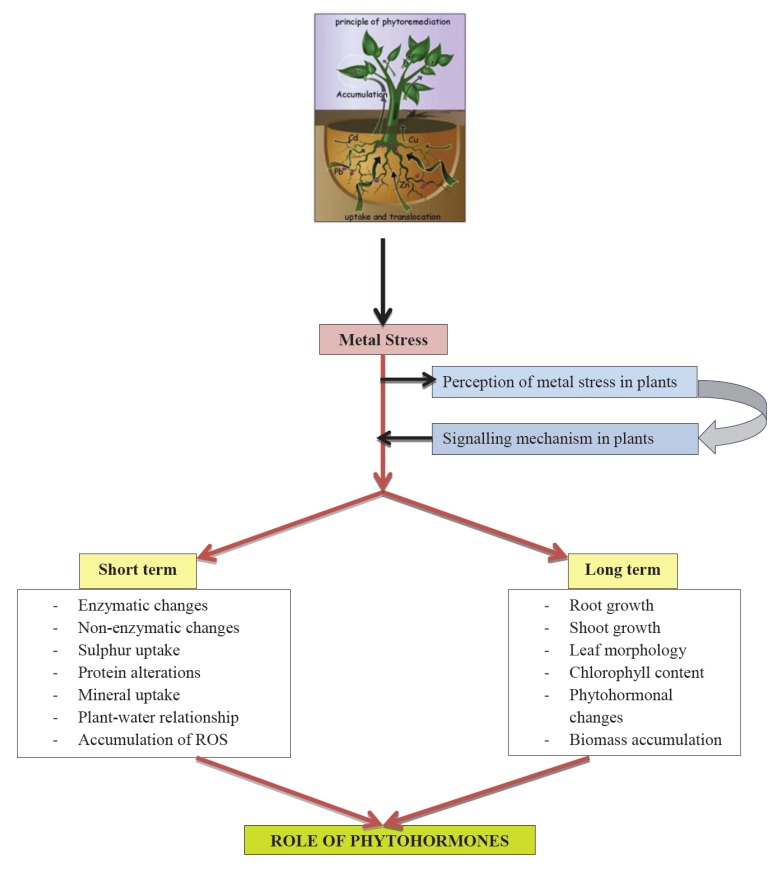
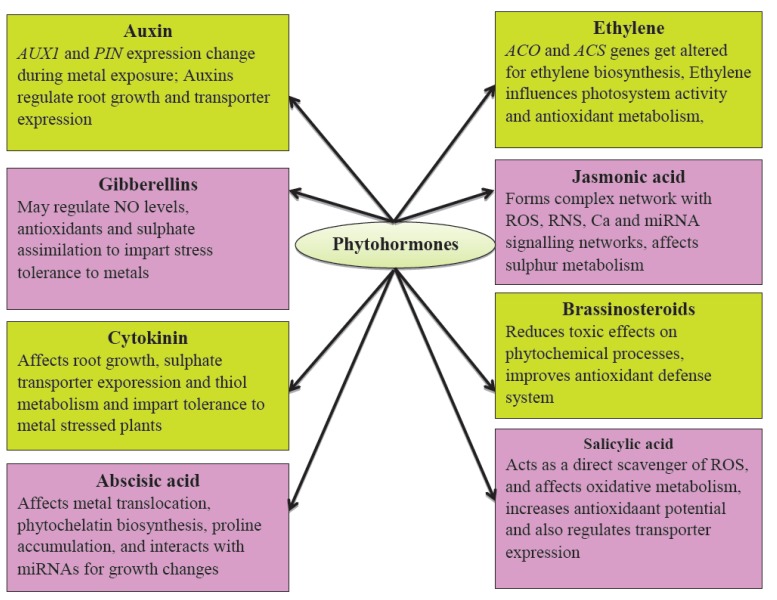
As a consequence of a sessile lifestyle, plants often have to face a number of life threatening abiotic and biotic stresses. Plants counteract the stresses through morphological and physiological adaptations, which are imparted through flexible and well-coordinated network of signalling and effector molecules, where phytohormones play important role. Hormone synthesis, signal transduction, perception and cross-talks create a complex network. Omics approaches, which include transcriptomics, genomics, proteomics and metabolomics, have opened new paths to understand such complex networks.
This review concentrates on the importance of phytohormones and enzymatic expressions under metal stressed conditions.
This review sheds light on gene expressions involved in plant adaptive and defence responses during metal stress. It gives an insight of genomic approaches leading to identification and functional annotation of genes involved in phytohormone signal transduction and perception. Moreover, it also emphasizes on perception, signalling and cross-talks among various phytohormones and other signalling components viz., Reactive Oxygen Species (ROS) and Reactive Nitrogen Species (RNS).
由于固着生长的生活方式,植物常常不得不面对许多危及生命的非生物和生物胁迫。植物通过形态和生理适应来应对这些胁迫,这些适应是通过灵活且协调良好的信号和效应分子网络实现的,其中植物激素发挥着重要作用。激素合成、信号转导、感知和相互作用构成了一个复杂的网络。包括转录组学、基因组学、蛋白质组学和代谢组学在内的组学方法,为理解这类复杂网络开辟了新途径。
本综述聚焦于金属胁迫条件下植物激素和酶表达的重要性。
本综述揭示了金属胁迫期间植物适应性和防御反应中涉及的基因表达。它深入探讨了导致鉴定和功能注释参与植物激素信号转导和感知的基因的基因组学方法。此外,它还强调了各种植物激素与其他信号成分(即活性氧(ROS)和活性氮(RNS))之间的感知、信号转导和相互作用。