Prentiss Sandra M, Friedland David R, Fullmer Tanner, Crane Alison, Stoddard Timothy, Runge Christina L
Department of Otolaryngology and Communication Sciences, Medical College of Wisconsin, Milwaukee, WI, USA.
World J Otorhinolaryngol Head Neck Surg. 2016 Nov 24;2(3):148-156. doi: 10.1016/j.wjorl.2016.09.001. eCollection 2016 Sep.
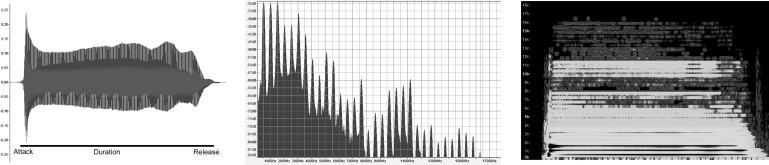
To investigate the contributions of envelope and fine-structure to the perception of timbre by cochlear implant (CI) users as compared to normal hearing (NH) listeners.
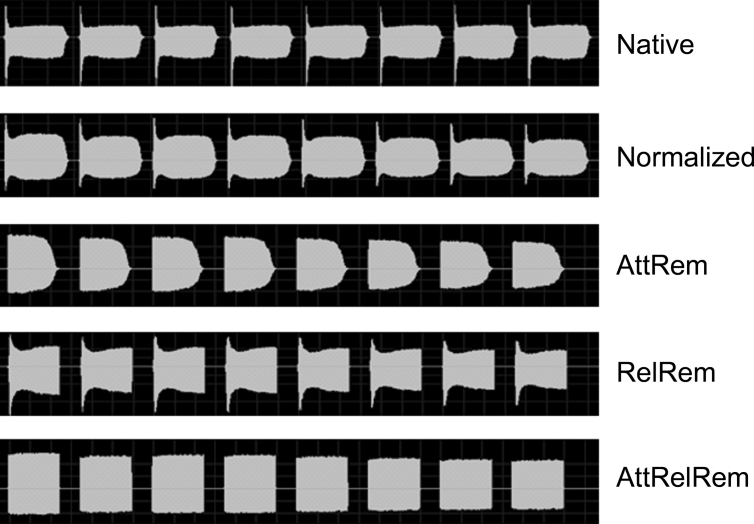
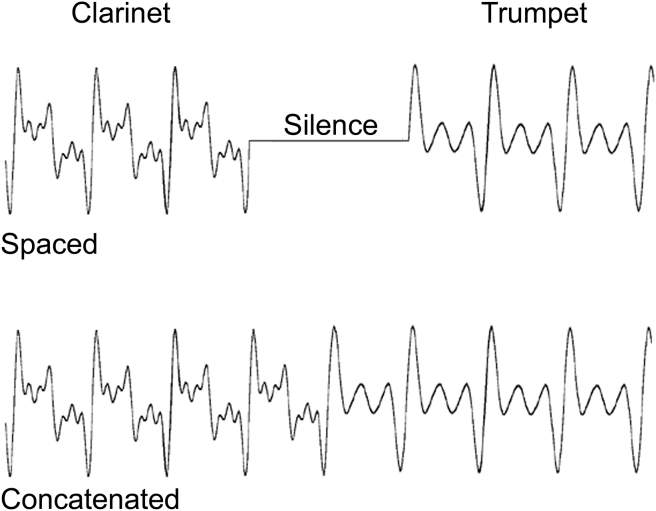
This was a prospective cohort comparison study. Normal hearing and cochlear implant patients were tested. Three experiments were performed in sound field using musical notes altered to affect the characteristic pitch of an instrument and the acoustic envelope. Experiment 1 assessed the ability to identify the instrument playing each note, while experiments 2 and 3 assessed the ability to discriminate the different stimuli.
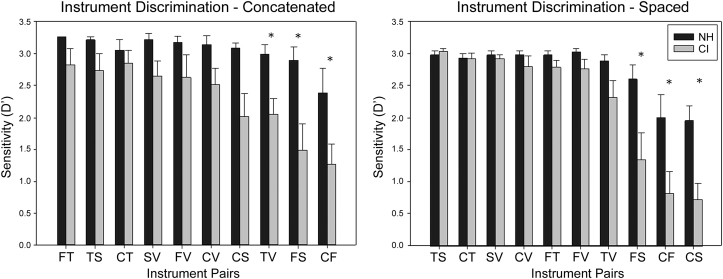
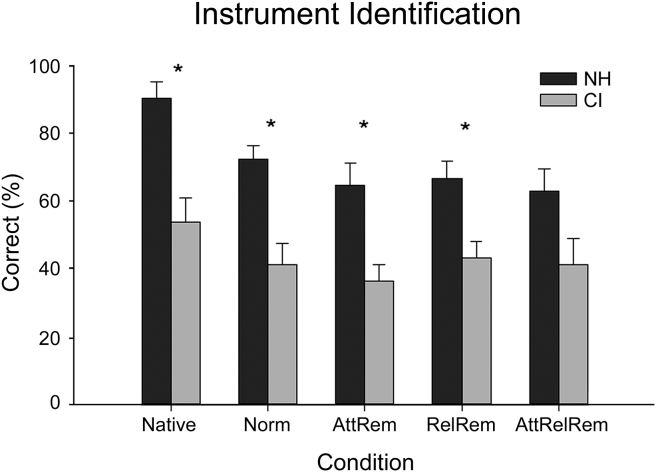
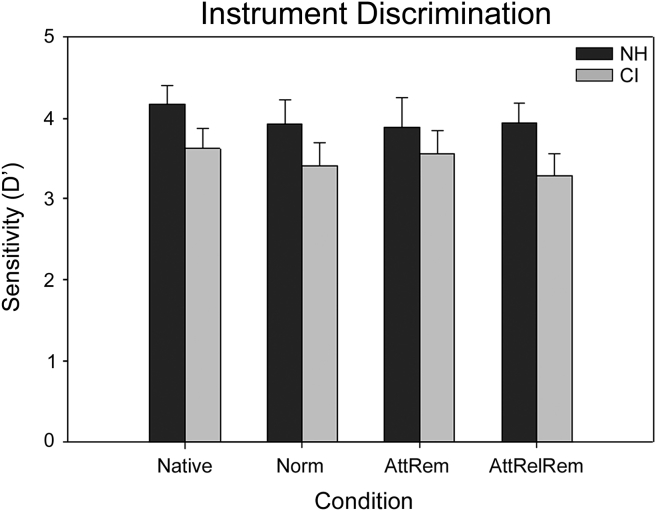
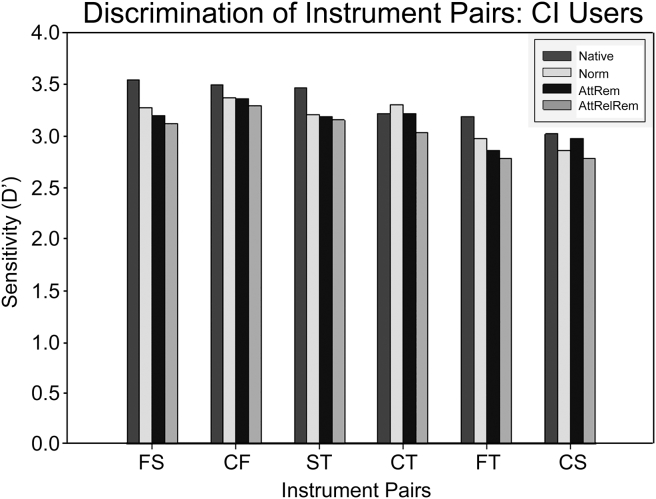
Normal hearing subjects performed better than CI subjects in all instrument identification tasks, reaching statistical significance for 4 of 5 stimulus conditions. Within the CI population, acoustic envelope modifications did not significantly affect instrument identification or discrimination. With envelope and pitch cues removed, fine structure discrimination performance was similar between normal hearing and CI users for the majority of conditions, but some specific instrument comparisons were significantly more challenging for CI users.
Cochlear implant users perform significantly worse than normal hearing listeners on tasks of instrument identification. However, cochlear implant listeners can discriminate differences in envelope and some fine structure components of musical instrument sounds as well as normal hearing listeners. The results indicated that certain fine structure cues are important for cochlear implant users to make discrimination judgments, and therefore may affect interpretation toward associating with a specific instrument for identification.
与正常听力(NH)听众相比,研究人工耳蜗(CI)使用者中包络和精细结构对音色感知的贡献。
这是一项前瞻性队列比较研究。对正常听力和人工耳蜗患者进行了测试。在声场中进行了三个实验,使用改变后的音符来影响乐器的特征音高和声学包络。实验1评估识别演奏每个音符的乐器的能力,而实验2和3评估区分不同刺激的能力。
在所有乐器识别任务中,正常听力受试者的表现均优于CI受试者,在5种刺激条件中的4种条件下达到统计学显著性。在CI人群中,声学包络的改变对乐器识别或区分没有显著影响。去除包络和音高线索后,在大多数情况下,正常听力者和CI使用者之间的精细结构辨别性能相似,但某些特定乐器的比较对CI使用者来说更具挑战性。
人工耳蜗使用者在乐器识别任务上的表现明显比正常听力听众差。然而,人工耳蜗听众能够像正常听力听众一样辨别乐器声音的包络和一些精细结构成分的差异。结果表明,某些精细结构线索对人工耳蜗使用者做出辨别判断很重要,因此可能会影响对与特定乐器进行关联识别的解释。