Chen Lanlan, Jiang Libin, Yang Bentao, Subramanian Prem S
Department of Ophthalmology, Hainan Branch of Chinese People's Liberation Army General Hospital, Sanya, Hainan, China.
Beijing Ophthalmology and Visual Sciences Key Laboratory, Beijing Tongren Eye Center, Beijing Tongren Hospital, Capital Medical University, Beijing, China.
BMC Ophthalmol. 2017 Dec 6;17(1):237. doi: 10.1186/s12886-017-0634-9.
Visual disturbances associated with isolated sphenoid sinus inflammatory diseases (ISSIDs) are easily misdiagnosed due to the nonspecific symptoms and undetectable anatomical location. The main objective of this retrospective case series is to investigate the clinical features of visual disturbances secondary to ISSIDs.
Clinical data of 23 patients with unilateral or bilateral visual disturbances secondary to ISSIDs from 2004 to 2014 with new symptoms were collected. Collected data including symptoms, signs, neuroimaging and pathologic diagnosis were analyzed.
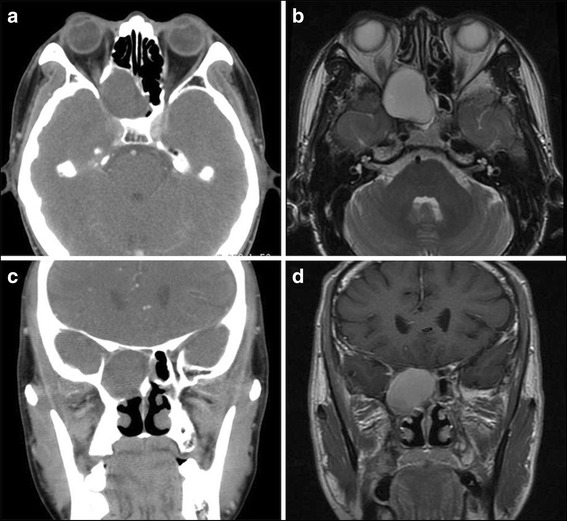
There were 14 males and 9 females, and their ages ranged from 31 to 83 years. Fifteen patients suffered blurred vision and 11 patients suffered binocular double vision, including 3 patients who had unilateral visual changes and diplopia simultaneously. Headache was observed in 18 patients, and orbit pain/ocular pain in 8 patients. Other presenting symptoms included ptosis (4 patients) and proptosis (1 patient). Only 5 patients had nasal complaints. The corrected visual acuities were between NLP to 20/20. Patients with diplopia included 5 with unilateral oculomotor nerve palsy and 6 with unilateral abducens nerve palsy. All patients performed orbital/sinus/brain radiologic examination and found responsible lesions in sphenoid sinus. All patients underwent endoscopic sinus surgery, and 9 patients were found to suffer sphenoid mucocele, 9 with fungal sinusitis, and 5 with sphenoid sinusitis. Visual disturbances improved in 6 patients, and all the patients with diplopia had a postoperative recovery.
Visual disturbances resulting from ISSIDs are relatively uncommon, but it is crucial that the patient with new vision loss or diplopia and persistent headache or orbit pain be evaluated for the possibility of ISSIDs especially before corticosteroid administration.
由于症状不具特异性且解剖位置难以察觉,孤立性蝶窦炎性疾病(ISSIDs)相关的视觉障碍很容易被误诊。本回顾性病例系列的主要目的是研究ISSIDs继发视觉障碍的临床特征。
收集2004年至2014年23例继发于ISSIDs且出现新症状的单侧或双侧视觉障碍患者的临床资料。对收集到的包括症状、体征、神经影像学和病理诊断的数据进行分析。
男性14例,女性9例,年龄范围为31至83岁。15例患者视力模糊,11例患者双眼复视,其中3例同时出现单侧视力改变和复视。18例患者出现头痛,8例患者出现眼眶疼痛/眼痛。其他表现症状包括上睑下垂(4例)和眼球突出(1例)。只有5例患者有鼻部症状。矫正视力在无光感到20/20之间。复视患者中,5例为单侧动眼神经麻痹,6例为单侧展神经麻痹。所有患者均进行了眼眶/鼻窦/脑部放射学检查,发现蝶窦有责任病灶。所有患者均接受了鼻内镜鼻窦手术,9例患者被发现患有蝶窦黏液囊肿,9例患有真菌性鼻窦炎,5例患有蝶窦炎。6例患者的视觉障碍得到改善,所有复视患者术后均恢复。
ISSIDs导致的视觉障碍相对少见,但对于新发视力丧失或复视且伴有持续性头痛或眼眶疼痛的患者,评估其是否患有ISSIDs至关重要,尤其是在使用皮质类固醇之前。