Østedgaard-Munck David Nicolas, Catalano Jacopo, Birch Kristensen Mette, Bentien Anders
Department of Engineering, Aarhus University, Hangoevej 2, 8200 Aarhus N, Denmark.
Data Brief. 2017 Sep 1;15:1-11. doi: 10.1016/j.dib.2017.08.036. eCollection 2017 Dec.
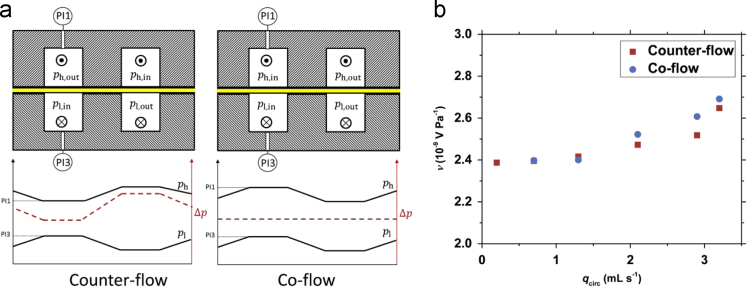
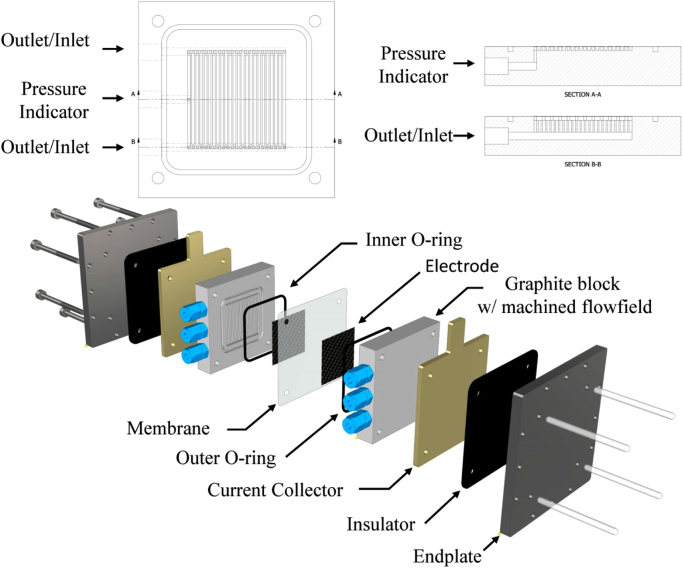
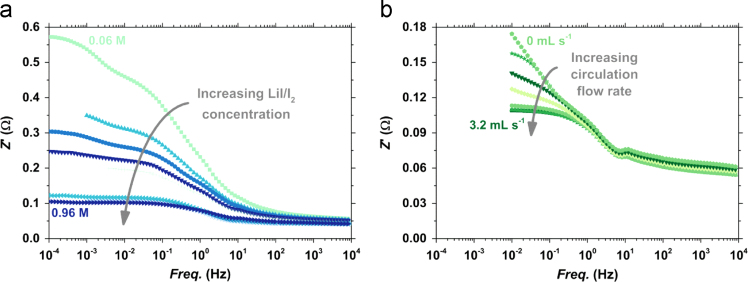
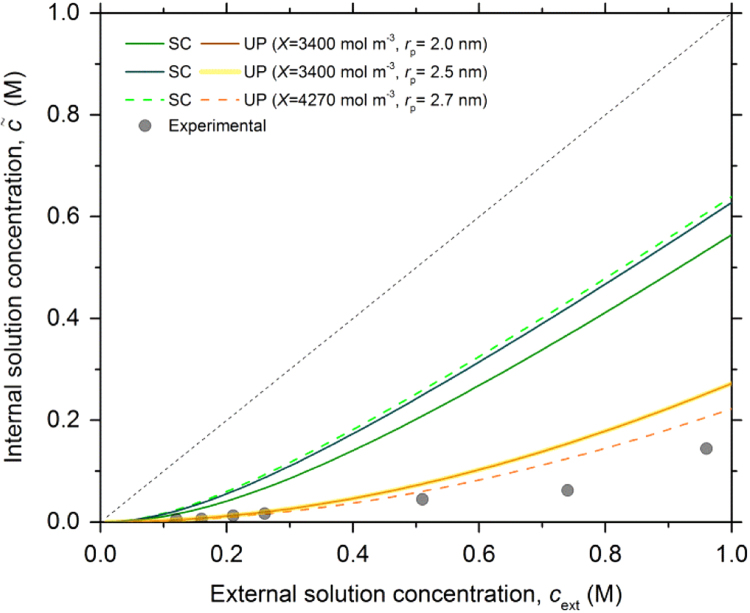
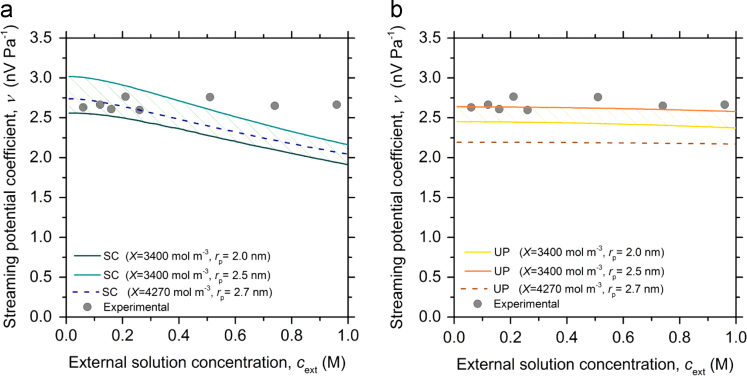
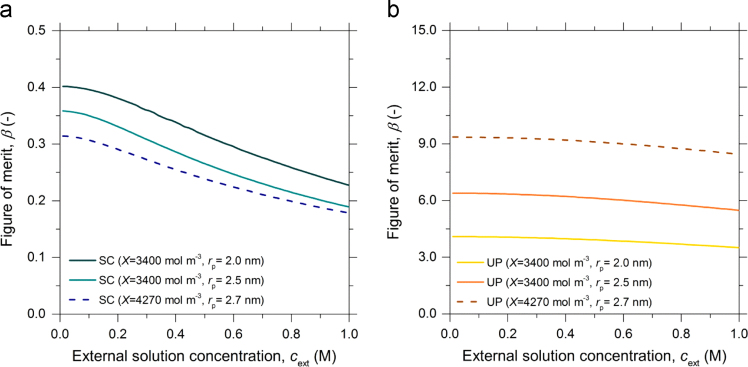
This article elaborates on the design and optimization of a specialized flow cell for the measurement of direct conversion of pressure into electrical energy (Electrokinetic Energy Conversion, EKEC) which has been presented in Østedgaard-Munck et al. (2017) [1]. Two main flow cell parameters have been monitored and optimized: A) the hydraulic pressure profile on each side of the membrane introduced by pumps recirculating the electrolyte solution through the flow fields and B) the electrical resistance between the current collectors across the combined flow cell. The latter parameter has been measured using four-point Electrochemical Impedance spectroscopy (EIS) for different flow rates and concentrations. The total cell resistance consists of contributions from different components: the membrane [Formula: see text], anode charge transfer [Formula: see text], cathode charge transfer [Formula: see text], and ion diffusion in the porous electrodes [Formula: see text]. The intrinsic membrane properties of Nafion 117 has been investigated experimentally in LiI/I solutions with concentrations ranging between 0.06 and 0.96 M and used to identify the preferred LiI/I solution concentration. This was achieved by measuring the solution uptake, internal solution concentration and ion exchange capacity. The membrane properties were further used to calculate the transport coefficients and electrokinetic Figure of merit in terms of the Uniform potential and Space charge models. Special attention has been put on the streaming potential coefficient which is an intrinsic property.
本文详细阐述了一种专门用于测量压力直接转化为电能(动电能量转换,EKEC)的流通池的设计与优化,该流通池已在Østedgaard - Munck等人(2017年)的文献[1]中有所介绍。监测并优化了两个主要的流通池参数:A)通过泵使电解液在流场中循环而在膜两侧产生的液压分布;B)跨组合流通池的集流体之间的电阻。已针对不同流速和浓度,使用四点电化学阻抗谱(EIS)测量了后一个参数。电池的总电阻由不同组件的贡献组成:膜[公式:见原文]、阳极电荷转移[公式:见原文]、阴极电荷转移[公式:见原文]以及多孔电极中的离子扩散[公式:见原文]。在浓度范围为0.06至0.96 M的LiI/I溶液中,通过实验研究了Nafion 117的固有膜特性,并用于确定优选的LiI/I溶液浓度。这是通过测量溶液吸收量、内部溶液浓度和离子交换容量来实现的。膜特性还被进一步用于根据均匀电位和空间电荷模型计算传输系数和动电品质因数。特别关注了作为固有特性的流动电位系数。