Gao Xu, Guha Avirup, Buck Benjamin, Patel Dilesh, Snider Melissa J, Boyd Michael, Afzal Muhammad, Badin Auroa, Godara Hemant, Liu Zhenguo, Tyler Jaret, Weiss Raul, Kalbfleisch Steven, Hummel John, Augostini Ralph, Houmsse Mahmoud, Daoud Emile G
Ohio State University Wexner Medical Center, Department of Internal Medicine, USA.
Ohio State University Wexner Medical Center, Division of Cardiovascular Medicine, USA.
Indian Pacing Electrophysiol J. 2018 Mar-Apr;18(2):68-72. doi: 10.1016/j.ipej.2017.12.001. Epub 2017 Dec 7.
Expert opinion recommends performing exercise testing with initiation of Class Ic antiarrhythmic medication.
To evaluate the rate and reason for discontinuation of Ic agent within the first year of follow up, with particular attention to rate of proarrhythmia and the value of routine treadmill testing.
This is a single center retrospective cohort study including consecutive patients with atrial arrhythmias who were initiated on a Class Ic agent from 2011 to 2016. Data was collated from chart review and pharmacy database.
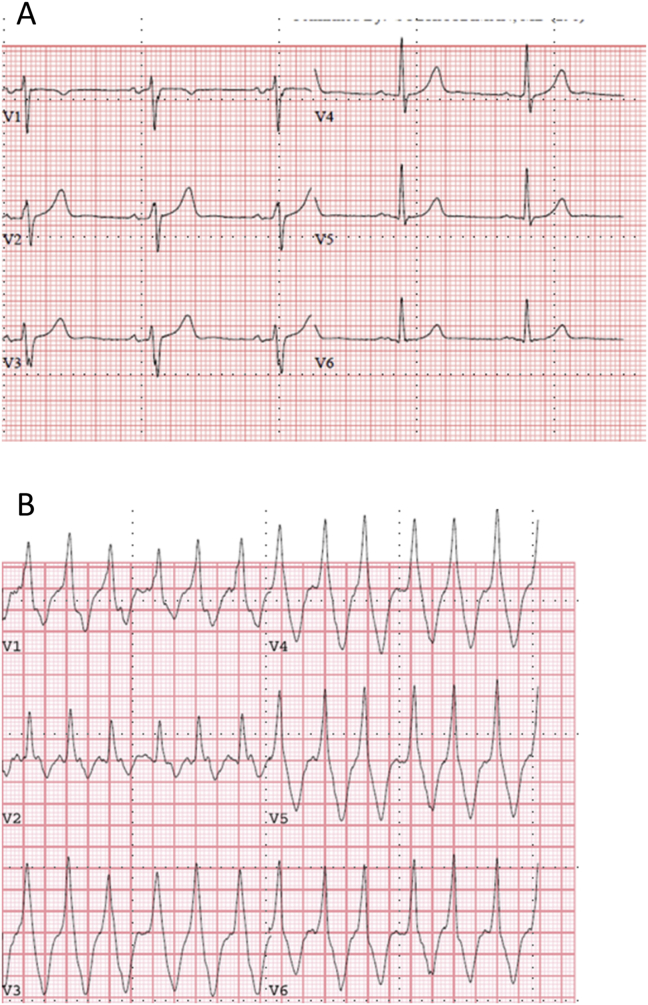
The study population included 300 patients (55% male, mean age 61; mean ejection fraction, 56%) started on flecainide (n = 153; 51%) and propafenone (n = 147; 49%). Drug initiation was completed while hospitalized on telemetry and the staff electrophysiologists directed dosing. There was one proarrhythmic event during initiation (0.3%). The primary reason for not being discharged on Ic agent was due to detection of proarrhythmia (n = 15) or ischemia (n = 1) with treadmill testing (5.3%). Exercise testing was the single significant variable to affect the decision to discontinue Ic drug, p < 0.0001 (95% CI: 1.89-6.08%). During follow up, the primary reason for discontinuation of Ic agent was lack of efficacy, 32%.
With proper screening, initiation of Class Ic agent is associated with very low rate of proarrhythmia. Treadmill testing is of incremental value and should be completed in all patients after loading Class Ic antiarrhythmic.
专家意见建议在开始使用Ic类抗心律失常药物时进行运动试验。
评估随访第一年内心律失常Ic类药物停用率及原因,尤其关注致心律失常发生率和常规平板运动试验的价值。
这是一项单中心回顾性队列研究,纳入2011年至2016年开始使用Ic类药物的连续性房性心律失常患者。数据通过病历审查和药房数据库整理。
研究人群包括300例患者(55%为男性,平均年龄61岁;平均射血分数56%),开始使用氟卡尼(n = 153;51%)和普罗帕酮(n = 147;49%)。药物起始在遥测监护下住院期间完成,由电生理科医生指导给药。起始阶段发生1例致心律失常事件(0.3%)。未带Ic类药物出院的主要原因是平板运动试验检测到致心律失常(n = 15)或缺血(n = 1)(5.3%)。运动试验是影响停用Ic类药物决策的唯一显著变量,p < 0.0001(95% CI:1.89 - 6.08%)。随访期间,停用Ic类药物的主要原因是疗效不佳,占32%。
通过适当筛选,开始使用Ic类药物时致心律失常发生率非常低。平板运动试验具有额外价值,所有服用Ic类抗心律失常药物负荷量后的患者均应完成该试验。