Santoro Azzurra, Tagel Maarja, Must Kärt, Laine Miia, Lassen Brian, Jokelainen Pikka
Department of Veterinary Medicine, University of Perugia, Via San Costanzo 4, 06126, Perugia, Italy.
Institute of Veterinary Medicine and Animal Sciences, Estonian University of Life Sciences, Kreutzwaldi 62, 51014, Tartu, Estonia.
Acta Vet Scand. 2017 Dec 11;59(1):82. doi: 10.1186/s13028-017-0349-1.
Toxoplasma gondii is a widespread occurring parasite infecting warm-blooded animals, including pigs and humans. The aims of this study were to estimate the prevalence of anti-T. gondii antibodies and to evaluate risk factors for T. gondii seropositivity in breeding pigs raised in Estonia. Sera from 382 pigs were tested with a commercial direct agglutination test, using a cut-off titer of 40 for seropositivity, for the presence of anti-T. gondii immunoglobulin G antibodies.
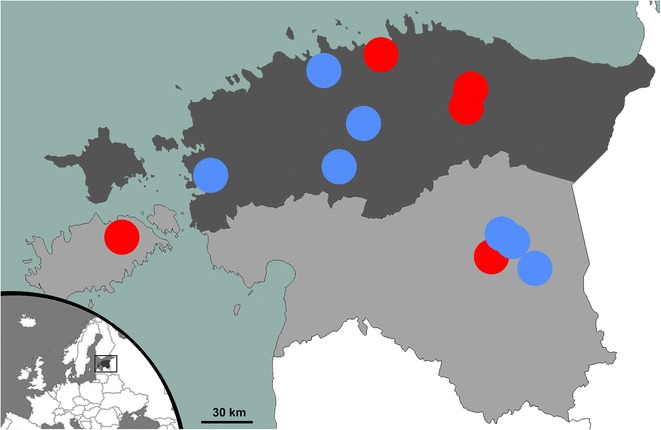
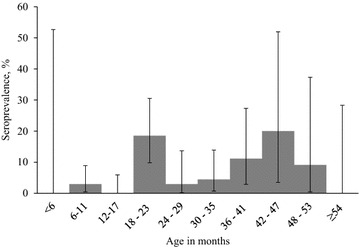
Twenty-two (5.8%) of the 382 pigs tested seropositive for T. gondii, and 6 of the 14 herds had at least one seropositive pig. The proportion of seropositive pigs within the herds ranged between 0 and 43%. Gender appeared as a significant factor, with sows having 5.6 times higher odds to be seropositive to T. gondii than boars. Seroprevalence did not increase with age.
Anti-T. gondii antibodies were present in a substantial proportion of breeding pig herds in Estonia. On the other hand, the presence of herds without seropositive pigs illustrates that porcine T. gondii infections can be avoided even in a country where the parasite is endemic and common in several other host species.
刚地弓形虫是一种广泛存在的寄生虫,可感染包括猪和人类在内的温血动物。本研究的目的是估计爱沙尼亚饲养的种猪中抗刚地弓形虫抗体的流行率,并评估刚地弓形虫血清阳性的危险因素。使用商业直接凝集试验对382头猪的血清进行检测,血清阳性的临界滴度为40,以检测抗刚地弓形虫免疫球蛋白G抗体的存在。
382头接受检测的猪中有22头(5.8%)刚地弓形虫血清检测呈阳性,14个猪群中有6个至少有一头血清阳性猪。猪群中血清阳性猪的比例在0至43%之间。性别似乎是一个显著因素,母猪血清阳性的几率是公猪的5.6倍。血清阳性率并未随年龄增长而增加。
爱沙尼亚相当一部分种猪群中存在抗刚地弓形虫抗体。另一方面,存在无血清阳性猪的猪群表明,即使在一个寄生虫在其他几种宿主物种中流行且常见的国家,猪的刚地弓形虫感染也是可以避免的。